Can Buildings Adapt to Climate Change?
Can Buildings Adapt to Climate Change?
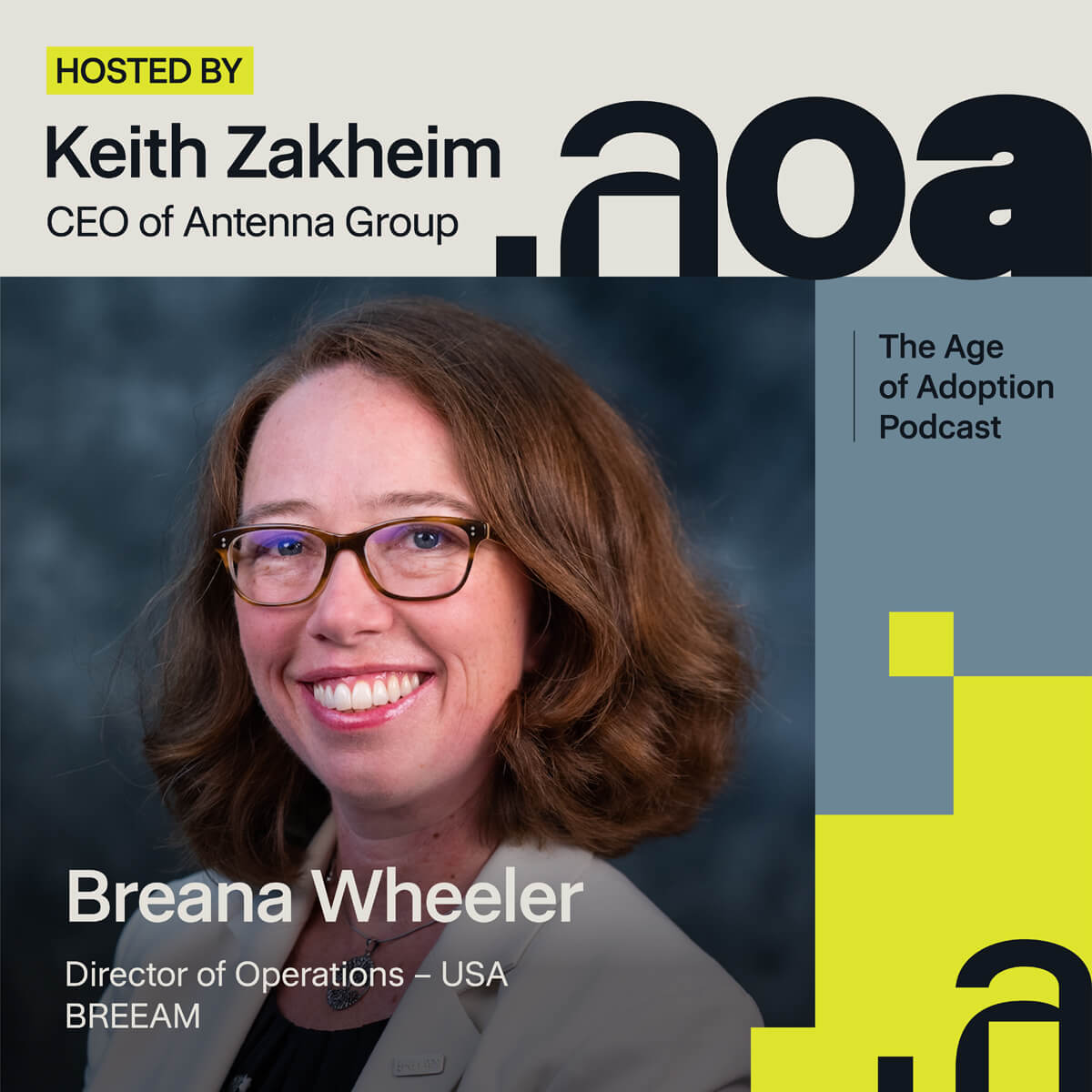
In this episode of Age of Adoption, recorded on Earth Day 2025, host Keith Zakheim speaks with Breana Wheeler, Director of Operations for BREEAM USA, about the critical role of certification in decarbonizing the built environment. Wheeler shares how BREEAM, the world's first science-based validation standard for sustainable building performance, has evolved since its 1990 inception to address not only carbon mitigation but also climate resilience and adaptation. With buildings contributing nearly 40% of global carbon emissions, Wheeler explains how BREEAM's standards help asset owners manage climate risk while maintaining building value.
The conversation explores parallels between pandemic response and climate action, highlighting the importance of international cooperation and science-based approaches to global challenges. Wheeler, whose environmental passion led her from receptionist to sustainability leader, outlines the opportunities and challenges in retrofitting existing buildings. With over 750,000 certificates issued worldwide yet 70% of existing building stock still needing certification, Wheeler emphasizes the critical role of finance, regulation, and long-term investment strategies in transforming real estate for a sustainable future.
Keith Zakheim 0:02
Welcome to the Age of Adoption podcast. I am your host, Keith Zakheim. Today, as we do with every podcast, we're going to ask our guest one.
Keith Zakheim 0:12
Question and one question only.
Keith Zakheim 0:14
What is your age of Climate adoption story? A little bit about the age of Adoption. We live in an era where enterprises of every shape and size, regardless of industry, must rapidly transform to become more sustainable, climate sensitive. And just my day job is CEO of the marketing public relations firm Antenna Group. Our agency works exclusively with conscious brands. What is a conscious brand? It is a brand that is conscious of its responsibility to be on the
Keith Zakheim 0:44
right side of history. Like most businesses, our clients are experiencing a transition from an age of innovation, an era in which technologists, entrepreneurs and investors focused on innovating climate and sustainable solutions, to this age of adoption which characterizes the world today. So if you the age of Adoption hypothesis, then there's really only one salient question to be asked. What is your age of Adoption story?
Keith Zakheim 1:17
We take for granted the various green environmental and sustainability certificates and plaques that grace the lobby walls of buildings both big and small. But the rigorous science based validation of sustainability performance in a built environment didn't exist until 1990 when Briam introduced its third party certified standards that have helped improve asset performance at every stage, from design through construction to use and refurbishment. On today's episode of the
Keith Zakheim 1:47
Age of Adoption podcast, which also happens to be Earth Day. So happy Earth Day to all of our listeners. Brianna Wheeler, Director of Operations for Briam usa, chats with me about the responsibility incumbent on real estate stakeholders to decarbonize the built environment and Briam's leadership in driving innovation and progress to make this a reality. Back with Briana in a sec.
Keith Zakheim 2:14
Brianna, welcome to the Age of Adoption podcast.
Breana Wheeler 2:18
Thanks for having me, Kate.
Keith Zakheim 2:19
Pleasure. And we are here live in San Francisco during San Francisco Climate Week. Your organization, Briam, I know, is sponsoring events and I'm sure you're here to network and keep up on the latest and greatest in our space. I am as well, but really so happy to have you here and it's great to have the conversation in person. I think when we last got together, last met was at New York Climate Week, so we're Climate Week buddies I guess.
Breana Wheeler 2:43
Right. Well, there's lots of them going on, so it's exciting to be involved.
Keith Zakheim 2:48
There is, it's funny, we have, there's D.C. climate Week in a few weeks, there's London Climate Week, which we go to. And this year for the first time, we are visiting Prague for Prague Climate Week as well. It's either their first or second year. So climate week's every year, right? Yeah. We don't have the travel budget for Antarctica yet, so hopefully they'll wait a few years before doing that. Anyway, Brianna, you have a fascinating background which has brought you to Briam usa where you're the director of operations. But I know our listeners would be really interested in your career journey and
Keith Zakheim 3:18
how you got here.
Breana Wheeler 3:20
Well, long story. It started when I was very young. No, I've always been interested in the environment and environmental issues from a really young age. So I knew when I was thinking about career options that that's what I wanted to do, something focused on the environment. But I didn't really have a career path. I didn't know really what it looked like. I just knew what I was passionate about. So when I went to college, I went to San Francisco State University. I got a double degree in geography because environmental studies didn't exist at that time. That's dating me a
Breana Wheeler 3:50
little bit. But geography and political science. So political science was a little bit of a. An addition, more of a joy of mine other than environment. But that degree, you know, provided a fair amount of understanding of complexity, of problems and of the human element of that. But it still wasn't really a career. I ended up spending two years doing study abroad in the uk, where I met my spouse. And so that kind of changed my trajectory. I ended up
Breana Wheeler 4:20
moving to the UK and I was there for almost a decade. And so when I got there, I was freshly graduated from college, didn't really know anybody, getting comfortable in being in a new place. And I needed a job like everybody does. And my, you know, everybody has a backup plan. Some people waitress or whatever. I do office administration. So I looked for a job, you know, that I could do that with. But I really thought about the company that I wanted to work for and the principles, the values.
Breana Wheeler 4:51
And it just so happened there was a receptionist job going at Skanska Infrastructure Development. So Infrastructure development is a portion of Skanska that looks at the financing of design, build and operate projects. It's not the construction wing. But I was intrigued. Skanska had a really good reputation. I was surprised at how much they talked about sustainability, particularly in that time. Very deep green. So that's where I started. And eventually, you know, I, I started as a receptionist. I became the executive
Breana Wheeler 5:20
assistant to a couple of directors and eventually the executive vice president. And, you know, in that time I really enjoyed the work. I enjoyed supporting them. And I learned a lot about a lot of Things. But I decided to go back to university to go get my master's degree. So the programs there are 12 months. So the first six months I worked full time and went to school full time, which is not very usual for. For the uk and then I took a sabbatical to go do my research.
Breana Wheeler 5:50
So just before I was heading off to do that, I sat down with the evp and he said, well, clearly you don't want to do this for the rest of your life. What do you want to do? And I took a deep breath and kind of went off on a. You know, Skysca is so big on this. This is a really important thing, but we're not doing much here. Here's what I want to do. And I kind of laid it out what I thought we could do. And he said, okay, you got the job when you get back. Right? I know that that was my face too.
Keith Zakheim 6:16
Whoa.
Breana Wheeler 6:17
Yeah. Like, okay, how did I just do that? But. But that's kind of where I started. So I went and got my master's degree, which again, was not specifically. It was environment, politics and globalization. Very timely of that. And I studied stuff that had nothing to do with construction or the built environment, but. But what it did was give me an appreciation of interconnectedness, subtleties, human condition, of how we organize
Breana Wheeler 6:46
resources, manage them and so on. So. So when I came back to the workforce, that's when I started my career, and that was 2007. So after that I did. I had a number of roles, but it was mostly what was entirely focused on environmental management as of risk and an opportunity for business. So I could have been in any organization. The career was really about thinking about sustainability as a risk for business for,
Breana Wheeler 7:16
you know, managing. The basis of what our, you know, what our business was, was built on a lot of knowledge base on that, but really it was thinking about, what are those risks to the business? What are the opportunities that we could utilize and ultimately make our business stronger. Really the fundamental of what sustainability means, like the longer term. So, yeah, so I had a. I had a decade in the UK and then decided to move back. And so I'm based in San Francisco and once again landed here without a job. Just kind of
Breana Wheeler 7:46
showed up. And that was a real change because I had gone from, you know, a business culture in which environment, sustainability had a place, a critical place and an acknowledged pathway, there's a professional organization. And I landed and just went, hey, where is everybody? And couldn't. Couldn't see it. Couldn't see it visibly in the Same way in business that I had in the uk. So once again, I got a temp job as a
Breana Wheeler 8:16
receptionist at one of the most prominent skyscrapers here in San Francisco. And I got talking to the chief engineer, who is a lovely man, very enthusiastic. We started talking about sustainability and I said, oh, well, this is really interesting. I've never heard of this. So what's leed? And I'd never heard of it before. It was the first time I had heard about a framework for thinking about sustainability in a built environment. Now this was, you know, hilarious, right? Because Briam is from the
Breana Wheeler 8:46
uk. I was aware of Briam, but I had no interactions prior to me moving back. And within a year I was working on bringing Briam to the United States as part of a founding team.
Keith Zakheim 8:59
So you kind of come full circle in that way.
Breana Wheeler 9:01
Yeah, I couldn't get away from it and my spouse is British and so we were all laughing together about this. Like I tried really hard, but boy, it just clogged me back.
Keith Zakheim 9:09
So I'm British also. My story is much less interesting. I moved here, I think, at the age of one, so I didn't have much agency over where I lived at the age of one. But I love going back to London whenever, every time I go back, it kind of just feels. Feels right, you know, like I belong there. It's really interesting. So Briam and you've been there, I guess, close to 10 years. Is that, is that what I saw?
Breana Wheeler 9:29
Yep. Goody. Oh gosh, it's nine years this month.
Keith Zakheim 9:33
Wow. Okay. Yeah. And as you know, this podcast really tries to dig into how organizations, companies, nonprofits, entrepreneurs, etc, have seen a significant change when it comes to climate and sustainability, from let's say pre pandemic to the last few years and what we call the age of adoption now, Ream has been around since 1990 and from what I understand, it's issued
Keith Zakheim 10:03
750,000 plus certificates and ultimately it was the first to have a science based kind of standards that define and validate sustainability performance in the built environment. So a lot has changed since 1990. The world has changed. So I'm sure a lot in terms of how Bram operates, how it sells, what the market reception is to, what you're selling, overall awareness and adoption has changed. So with
Keith Zakheim 10:33
that set up, Brianna, I'm going to ask you the question that I ask everybody. Sometimes it does strike heart strike fear in the hearts of people, sometimes it doesn't. But what is your age of adoption story?
Breana Wheeler 10:46
So it's important, I think, to think about where Briam kind of stems from. And our organization, BIRI, is a 100 plus year old building science research organization. So we are both very long term in the way that we think about this. So Briam came out of the idea around what sustainable development meant. And in 1990, coming off the back of the Brundtland Report, which was this broad academic sketch of what we thought about sustainable development, it was absolutely clear
Breana Wheeler 11:16
we weren't there and this is something we needed to be in the future. So Briam's first standard was really thinking about pushing that boundary and defining it based on where we were in that time. And it's worth remembering 1990, climate change was something that was going to happen in the future if we didn't take action. And so our first standards were very much thinking about avoidance, you know, how do you reduce carbon emissions, for example?
Breana Wheeler 11:46
And that is a very different story to what we have today. And so, you know, Briam, as the standard evolves, as the science evolves, we're a science driven standard. That's essentially what we do. So Briam's evolution over time has been the recognition, for example, that climate change moved from a theoretical into an impactful and accelerating kind of process. And in that mind, what does that mean for the built environment? For us, that changed from simply talking about avoiding carbon
Breana Wheeler 12:16
emissions. Right. Limiting warming.
Keith Zakheim 12:18
People don't always appreciate what's the size of the contribution the built environment makes to the problems around climate change and carbon emissions. And it's significant.
Breana Wheeler 12:28
Yeah, if you look at the pie chart, it's almost 40% depending on who talks about it. And that's a huge, huge piece of the puzzle. Right. And a lot of that is, you know, that's the existing building stock. And we think about how much construction was happening certainly up to the pandemic. And we're talking about walking in a level of, particularly on carbon, but a level of emissions that was frightening on that level. Add to that that, you know,
Breana Wheeler 12:58
the trajectories of what science was initially predicting warming would look like started accelerating and appearing a lot earlier than we thought. Right. So, you know, which suggested that maybe her climate models weren't as, you know, they were too conservative. Maybe we shouldn't have been, you know, as conservatives as we were. But for us it was very much around, okay, we need to now shift. It's not just about mitigation, but it's also about adaptation. And this is where resilience comes in. So our
Breana Wheeler 13:28
role as a standard has been to provide the definition from a science base Thinking about the impacts that buildings have and then also laying the pathway and refining that over time to help us understand what the built environment needs to do to address those impacts. So the rise of resilience, I mean we, you know, our standard, our NU standard, our latest version was released in 2020. We, we were the first in
Breana Wheeler 13:58
the world to put in a resilience category alongside every other category, to position it alongside, you know, operational emissions. To say this is also important and how do we think about that? We have to be thinking not just.
Keith Zakheim 14:11
Around, can you unpack that a little bit, the resilience standard?
Breana Wheeler 14:13
Yeah, sure. So, so this was thinking about that Physical risk had always been part of Briam, but we thought about it much as you would. I mean any physical risk. Right. And, and that existed before climate change, but climate change was introducing or enhancing particular risks, weather related and so on. Right. It's not like a tornado didn't exist before climate change, but the frequency, the intensity and the risk to assets were shifting quite quickly. So for us, you know, avoiding emissions,
Breana Wheeler 14:43
reducing your emissions wasn't going to change that fact that the world is warming, but it was going to impact the building in the longer term because if it couldn't withstand, you know, it was designed and built to, to a very particular climate or context, if that world is changing, how is that going to hold?
Keith Zakheim 15:01
So like, let's just say buildings by the water were built for a category three hurricane, worst case, category four. And all of a sudden you're seeing multiple category four fives. That would be an example of figuring out how to make these buildings, the built environment, more resilient. Correct.
Breana Wheeler 15:20
And for existing buildings, you know, when you're, when you're looking at, you know, for the current owner or you know, multiple owners over its life cycle, they're supposed to be lasting anywhere between 80 and 100 years, depending on what they were designed for. And all of a sudden that's shifting and they were only designed maybe to hit that, you know, to have an occasional category three. They're just not designed that way. So in order to protect the asset value, you had to think about how they were going to harden the infrastructure, how are they were going to protect the building to make that work. That's a
Breana Wheeler 15:49
totally different shift, you know, in what, in what we were doing from the beginning. And it's interesting, the pandemic accelerated the idea that this was super important, the warming was happening. But I think the acknowledgement really came about because, you know, the pandemic was felt like one of those Black swan events. Like, we could never have seen this coming. Oh, wait until we saw it coming, because then all of a sudden you saw insurance policies that included pandemic as one of those things that were
Breana Wheeler 16:19
excluding. You know, we saw the research, we saw. And as everybody started to kind of understand what was happening in the pandemic, this was something we didn't foresee because we didn't look. And climate change is this thing we have seen. We are looking, and now what do we do? There was this great cartoon I saw that, that pictured the pandemic as the first tsunami wave and climate risk and climate change as the second one, the bigger one. And that was
Breana Wheeler 16:49
really poignant because that's where we're. I think that's where the kind of understanding that we can see this risk coming and we can plan for it, but it's not just about reducing the emissions. We also have to plan for the fact that the world is going to be different than what it has been. And, you know, net zero carbon is going to be about stopping further warming, but it's not necessarily going to be about returning the world to what it was before.
Keith Zakheim 17:16
Yeah, the pandemic is such a great analog, and over the last few years, it's been referenced so many times in my conversations with professionals in the climate sustainability space. I mean, again, there are so many parallels. Preparedness, of course, being one, governments investing the right amount of resources into getting out ahead of these kinds of issues. But to me, one of the most more interesting parallels is that like climate change, the pandemic, or the pandemic, like climate change was internal,
Keith Zakheim 17:46
was global in scope. Right. And the U.S. ultimately, we didn't have to be the originators of the, of the virus, the coronavirus, to ultimately be impacted significantly by it.
Breana Wheeler 18:01
Yeah.
Keith Zakheim 18:02
And it could be in the other direction as well. So you have this existential problem that internationally demands cooperation, and if any country of any continent, if any region decides this is not their problem, they're not going to be spared the consequences. And I think that was super powerful. And of course, you know, we won't get into politics right now, but. But that lesson may have been lost on, on some people, but I think overall, in general, private sector, public sector, it's a
Keith Zakheim 18:32
lesson that was internalized. And I think that has been, or that has spurred what we call the age of adoption.
Breana Wheeler 18:37
Yeah, well, and I would say we have precedent for this. I mean, climate change is a scale bigger, but we have the Montreal Protocol, which was organized and reduced ozone emission. Right. Through industry, through the science. And that agreement came about because the science was presented, the nations came together and even though Jose Ho wasn't appearing over their land necessarily, there was an understanding that eventually this is a
Breana Wheeler 19:07
global scale problem that will eventually all come home to roost for us. And so it was important that as contributors to that problem, we all work together. So yeah, I look at climate changes and really lots of international problems in this way is that, you know, we are so interconnected economically and you know, I mean, just through travel alone, I mean that's the biggest thing about pandemics now, right? Is, you know, we're just a flight away from everybody at this point. That actually
Breana Wheeler 19:37
understanding that interconnectedness is a, you know, it's a, it's a point of concern. Right. Like, and some people will feel the need to just shut up and be like, you know, close up doors and kind of to protect. But actually it's our superpower too, that ability to come together to realize that, that we can put our minds together. And I think the pandemic was a great example about the science, the way that kind of drew through and understanding the, you know, what was happening and at speed, you know,
Breana Wheeler 20:08
it holds promise for what is possible with climate change. This is our planet, right. There's no other raft at this point.
Keith Zakheim 20:16
I know, there's Mars maybe, right?
Breana Wheeler 20:19
Yes, I'm, Yes, I. Right. But I mean in the scale of hoot, we're not all going there. No, so, so that's the thing. If we, if we care, you know, and I love that idea. You know, almost everybody always thinks about themselves as they're going to be on the raft. And I'm like, let's all assume we're not going to.
Keith Zakheim 20:34
Yeah, let's look at the Titanic. More people die than we're saved.
Breana Wheeler 20:37
Right, let's remember that, like, and so we can always be empathetic with the people who are definitely not going to be on that raft. Right. So how can we address this, this challenge? We have, we have the tools, we need, the will, need that will. And I think business has an amazing role to play in this. Hugely focused. And I think actually, you know, in this particular case it really comes down to the fundamentals of our business world, which is that it makes business sense to manage
Breana Wheeler 21:07
risk, to identify it, manage it. And, and ultimately, you know, the people who make money are the folks who see this as opportunity and so, you know, the silver lining kind of person. That's who I am. But you know, that is an aspect of this that I think you know, we can, we can be fearful or we can look at this as we do with lots of different risks and actively manage them and move forward.
Keith Zakheim 21:32
Yeah, we're at time, but I'm going to ask you a quick question and ask for a minute response. But this did intrigue me so globally and Briam is a global organization from what I understand around, let's call it 30% of total office building stock and the top 10 green cities in the world. The top 20 is certified, meaning more than 70% of existing stock will need to be certify, which means it will need to be retrofitted. What needs to happen for that to
Keith Zakheim 22:02
happen?
Breana Wheeler 22:03
Finance is a big part of that. So there needs to be mechanisms to support existing buildings transitioning. Right. Most, you know, existing buildings for the most part, although there's some exceptions post pandemic. But you know, they're operating buildings, they are generating cash. It's very difficult to displace tenants or residents more importantly. Right. But the change needs to happen. So how do you do that? How do do that at scale? And a lot of those renovations are not going to be whole. You know, we always
Breana Wheeler 22:33
imagine them as whole building renovations. Right. Strip it right back down. That's not going to happen. It's actually the, the opportunities as equipment ages out, as they break and need replacement. It's a series of tiny interventions and a forward planning that needs to come with that. You know, one of the sharper ends of this has been regulation. We've seen that where building performance standards have come in New York for example. But, but there's also an element of transition risk
Breana Wheeler 23:02
that many owners are looking at. They know the future world needs better assets and actually to position them to have any value at all, not just from a sustainability angle, they need to be improved. Sustainability is part of that story. It's not the sole reason to do anything, but it becomes a key value driver. But the long term thinking making this part of the investment strategy is going to be critical. Great.
Keith Zakheim 23:28
And I was remiss I did not wish you a happy Earth Day today. Today is Earth Day.
Breana Wheeler 23:33
It is.
Keith Zakheim 23:34
And celebrating it in San Francisco during Climate Week with you. What could be better?
Keith Zakheim 23:40
Thank you.
Keith Zakheim 23:40
Well, thank you Brianna so much for joining us and enjoy Climate Week and look forward to connecting in soon.
Breana Wheeler 23:45
Thanks so much. Appreciate it.
Keith Zakheim 23:48
The Age of Adoption Podcasts featured CEOs, investors, entrepreneurs and policymakers sharing their climate and sustainability business transformation stories. Episodes can be found on your favorite podcast apps including itunes and Spotify. The Age of Adoption podcast is brought to you by Antenna Group. Antenna is the home of conscious brands. We partner with companies that don't wait for change to happen. These brands, brands shape the future, are
Keith Zakheim 24:18
awake and already moving, Unsure if you are a conscious brand or even if you are one, whether you are positioned as one, please visit our website at www.antennagroup.com and take the Conscious Compass Assessment, a groundbreaking tool that enables enterprises to assess their brand against the eight traits of brand consciousness. At Antenna, we partner with companies big and small, from growth Stage to Fortune 100, to
Keith Zakheim 24:47
tell their climate and sustainability stories. So once again, if you're interested in joining the conscious brand movement and learning more about Antenna Group, please check out our website at www.antennagroup.com. ping us on LinkedIn and make sure to visit the Conscious Compass.
Breana Wheeler 25:07
Sam.