Data Centers and Decarbonization
Data Centers and Decarbonization
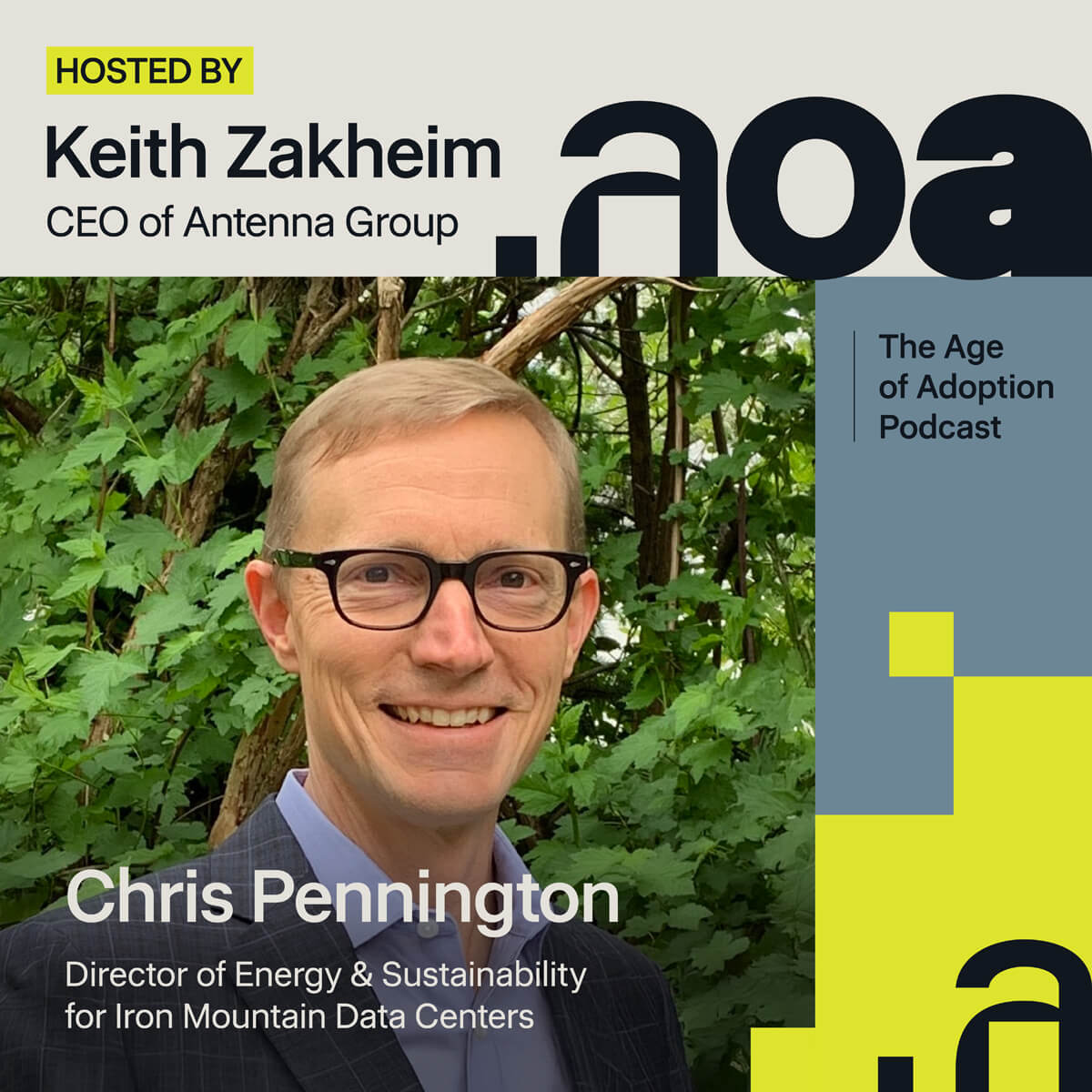
Chris Pennington is Director of Energy and Sustainability for Iron Mountain Data Centers, leading the charge toward 24/7 carbon-free energy by 2040. How did a college student looking for part-time work become a global energy strategy pioneer? His story perfectly illustrates the evolution of corporate sustainability thinking—from operational efficiency to industry-wide decarbonization.
"The story actually began when I answered a newspaper ad," Pennington reveals, describing his path from frontline operations to sustainability leadership. Today, he positions Iron Mountain as a digital utility that enables widespread decarbonization across entire industries. What makes this approach revolutionary? As Goldman Sachs projects 160% growth in global data center power demand by 2030, Pennington's co-location model aggregates customer loads to achieve unprecedented efficiency gains. He explains their pioneering Green Power Pass product and grid flexibility solutions, including battery systems that can disconnect entire data centers from the grid while maintaining critical operations. But can data centers really become part of the climate solution rather than just the problem?
Keith Zackheim 0:00
Welcome to the Age of Adoption podcast. I am your host, Keith Zackheim. Today as we do with every podcast, we're gonna ask our guest one question and one question only. What is your age of climate adoption story? A little bit about the age of adoption. We live in an era where enterprises of every shape and size, regardless of industry, must rapidly transform to become more sustainable, climate sensitive, and just.
Keith Zackheim 0:30
My day job as CEO of the marketing public relations firm antenna group. Our agency works exclusively with conscious brands. What is a conscious brand? It is a brand that is conscious of its responsibility to be on the right side of history. Like most businesses, our clients are experiencing a transition from an age of innovation.
Keith Zackheim 0:51
An era in which technologists, entrepreneurs and investors focused on innovating climate and sustainable solutions to this age of adoption, which characterizes the world today. So if you accept the age of adoption hypothesis, then there's really only one salient question to be asked. What is your age of adoption story?
Keith Zackheim 1:17
Jigger Shaw is Wiley considered one of the pioneers of the modern clean energy revolution, making his appearance on the Age of Adoption podcast, a true milestone. I could spend half of the podcast listing Jiggers professional accomplishments, but instead I'll highlight two that were of a historic nature.
Keith Zackheim 1:38
First Jigger revolutionized the solar industry by inventing the power purchase agreement model at Sun Edison, allowing customers to adopt solar without upfront costs. Second, and most recently, jigger served as director of the Department of Energy's Loan Programs Office, where he expanded loan authority from 40 billion to 400 billion.
Keith Zackheim 2:02
Under his leadership, the loan program's office announced 53 deals totaling $107 billion. In committed Project Investment, helping WS Clean energy investment from 111 billion in 2020 to 236 billion in 2023. Today on the Age of Adoption podcast, Jigar shares why he believes market forces will overcome political headwinds and how the revolution that he helped start will continue to transform our lives back with jigger in a gif.
Keith Zackheim 2:36
Jigger Shaw, welcome to the Age of Adoption podcast. Finally my turn. Yes, it is your turn. And uh, we feel incredibly lucky to get you on the podcast that we've had some great guests in the past, but in terms of the Mount Rushmore of clean tech and clean energy and whatever they call it today, I think you belong.
Keith Zackheim 2:54
So we're really, really thrilled to have you today. Wow. Thank you. So let's kind of talk, let's start with your background and your career journey, and I'm just gonna point a few things out. First of all, as somebody who grew up in a family, I grew up in Washington, DC and my father was a political appointee, the defense Department on a couple of occasions, and my brothers done similar things and worked on the Armed Services Committee.
Keith Zackheim 3:16
So I'm somebody who was a deep appreciation for those who commit themselves to public service, especially those like yourself who stepped away. From an incredibly successful career in the private sector to commit himself to do work in the public sector on behalf of others. Appreciate all your efforts in the public realm and, and serving, serving our country and serving others.
Keith Zackheim 3:39
So love to hear about that. But also before that, a prolific career in clean energy and almost from the beginning of what we can call the second wave of, of clean energy in this country. Kind of the first wave ending. 19 79, 19 80, and then 2005 or so, really there being a renewed focus in in, in solving for climate and sustainability.
Keith Zackheim 4:03
So your past Sun Edison, where you're credited for introducing power purchase agreement, generate capital. I know where you focused on sustainability infrastructure agreements. We mentioned Department of Energy Loan Program Office, where I know you oversaw the expansion of the loan authority from 40 billion to 400 billion, and then now at multiplier.
Keith Zackheim 4:25
So, and of course another podcaster over the open circuit podcast where I guess the band has gotten back together reuniting with the Energy Gang gang, Catherine Hamilton and Steven Lacey. So with all of that, jigger, appreciate you sharing their career journey. It's a fascinating one and, and again, one that really has been at the forefront of moving our industry forward.
Jigar Shah 4:49
Well, thank you. Yeah, no, it's been a, it, it's been a great ride and it's been wonderful to see how many thousands of people, frankly, have joined us on this ride. So it's been great to see how large the, the, the industry has gotten. It's a movement, I mean, it really Oh, yeah. Is a movement, right? Yeah. I mean, it's a movement, but more importantly, I mean, when I.
Jigar Shah 5:10
I thought about joining the movement. You know, I think the first few folks I talked to in high school said that I needed an engineering degree to, to join this movement. And so I got a mechanical engineering degree from the University of Illinois. But today, I think you can have any background in join the movement, right?
Jigar Shah 5:25
You can be professional in communications and, and you know, media, or you could also be an extraordinary, you know, person in hr or somebody who's a recruiter or somebody who's doing whatever. Like, I mean. We need every single skillset we could possibly find now to join the movement, which is a big change from when I joined.
Keith Zackheim 5:44
Yeah. Uh, one of the things that I always point out about our agency, but it's true of anybody who's working in climate and sustainability, is no matter what your function or your skill, I think when we look in the mirror. We see climate professionals first, or climate warriors first, and whatever that particular function is, or career is second, right?
Keith Zackheim 6:03
So in our case, it's communications or marketing professional is what we do. But when we look in the mirror, it's really a climate professional, a climate warrior, and joining that movement. So you start at University of Illinois with your academic background, and then where'd you go?
Jigar Shah 6:17
And then I got a job in Vermont at this place called Atlantic Orient Corporation that designed small wind turbines and they had funding issues, so couldn't pay me.
Jigar Shah 6:27
And so I also stocked shelves at the, the grocery store nearby to pay bills. And so sort of the work to jobs to support your solar and renewable energy habit, you know, type situation. And then after that was able to. Get a job to get me back down to DC where my now wife, you know, was, and so, so that was great.
Jigar Shah 6:47
And joined BP Solar. Right. And so BP Solar is, you know, at the time was one of the largest manufacturers in the world. I think it was the largest and had about a hundred megawatts worth of manufacturing capacity. And so it was a small industry when I joined.
Keith Zackheim 7:03
Okay. Your humility is coming through, but if you could take us through the full arc of your career.
Jigar Shah 7:09
Yeah, I mean, you know, it's, it's one of those things where, you know, I started doing the wind turbine stuff. I got to DC worked for a group called Energetics, right? Which was, you know, somebody who had contracts with the US Department of Energy and others, and worked on a biofuels database. It turned out that we were funding 23 different fuels, you know, and so, and they had never been evaluated against each other, and so we put the first database together to do that.
Jigar Shah 7:36
Then I joined BP Solar and you know, there was doing a lot of strategy and, and that kind of work and that's where we started thinking about financing and we started thinking about these kinds of heady issues. At the time, John Brown was the CEO of bp and he's the one who rebranded BP as Beyond Petroleum, if you remember.
Jigar Shah 7:54
And so lived through that. Very inspired by his work. But I started Sun Edison out of BP Solar. And so that was 2003 and sun took off almost immediately. It was clearly a idea whose time had come. There were a lot of companies that were evaluating solar and not able to get past their CFO, who was like, I'm not gonna use our cash for this.
Jigar Shah 8:16
So a power purchase agreement or pay as you save solar was born and took off really quickly. We sold the company in 2009 to MEMC, which at the time was sitting on a ton of cash from their Silicon Empire. And, and then I went to go work with Richard Branson to set up his new global nonprofit called the Carbon War Room.
Jigar Shah 8:36
And we were ahead of our time there. You know, we realized early on that large corporations were unlikely to be the source of. Massive change that the climate needed. And it was really entrepreneurs who, you know, frankly, uh, were the ones who were the change makers. And elevating the entrepreneurs is something that Richard Branson does better than anyone.
Jigar Shah 8:54
And so we dominated the new cycle for, I think four years from shipping to, to aviation fuels, to, you know, building efficiency, all sorts of things, right? So that was fantastic, and we're able to merge that into the Rocky Mountain Institute. And today, you know, most of rmis. Money is under the model that we created at the Carbon War and then started to generate capital with two fantastic friends, Matan Friedman and Scott Jacobs.
Jigar Shah 9:18
And again, an idea whose time had come. We, the big insight would generate capital is it was permanent capital vehicle, right? So we were not A-G-P-L-P structure where you had time-based funds, right? The way tho those funds normally work is you get to invest those funds for seven years, and at the end of that you're supposed to, you know, shut it down and, and pay.
Jigar Shah 9:37
Pay back, the investors would generate capital. They were shareholders of a company. And so that money was there permanently. And as you know, a lot of clean tech companies. Don't necessarily meet their timelines, but they still have an extraordinary product. And so that level of flexibility that generate capital brought to the table, you know, really became the perfect solution for a lot of companies.
Jigar Shah 9:59
And today, I think they're over $10 billion. Of, you know, assets under management. And so I think it's been a huge home run and there's a lot of folks I think, that are trying to copy that permanent structure model now. So, so yeah, that's been my career arc is really trying to figure out how to best help these companies commercialize technology.
Jigar Shah 10:17
And then obviously the last job was joining the DOE, the loan programs office. And again, you know, there are a lot of folks who have extraordinary technologies, but I. Their first of a kind, deployment's a billion dollars. And so unless you have the public sector that's ready to partner with the private sector, you really can't, you know, finish that last step.
Keith Zackheim 10:39
Yeah, for sure. And I guess we'll get into kinda the DOE and then the transition out multiplier when we talk about the age of adoption. So we'll stick a pin in that for now. I know we're gonna get back to it. Our format traditionally has been two questions, but we figured that. You'd be a great first guess to answer three.
Keith Zackheim 10:57
So we, we crowdsourced. We crowdsourced a question. Got some really great ones. And typically I don't like to delve into politics. I like a lot more to talk about policy. Sure. Having said that, I. Right now politics and this industry are inextricable and there's just so much pressure. It seems like downward pressure and headwinds coming from the political environment that a lot of the questions that we received understandably touched on that.
Keith Zackheim 11:24
So I'm gonna put try to make it not political and much more policy. But the bottom line is that there is these headwinds. There seems to be a backlash around some of the prior. Policies and grants and other types of things coming out of the previous administration. And in general, the question that we received is to what degree do you feel the rise of populism around the globe, which is an interesting way of formulating it, not just in this country, is likely to derail the business case for companies looking to provide climate solutions.
Jigar Shah 12:01
I think it's exactly the opposite, right? Like, I don't know about you, but I'm a big tailgater and you know, when I go tailgating places, like everyone is selling solar at the tailgate, right? Like, and they are clearly not, you know, rooting for Joe Biden. Right. And so I think there are a lot of people in populism that hate electric utility companies.
Keith Zackheim 12:26
Yeah. We must tailgate at different places because the tailgates I go to before the Washington Commander Games, typically people are way too drunk to talk about clean energy. But anyway,
Jigar Shah 12:35
well, it may not be a great place to sell solar, but there are people selling it. Right. And so I, I just think that in general, the vibe of populism is around.
Jigar Shah 12:45
Anti monopolies, right. Being anti, you know, large corporations telling you what to do, et cetera. Right. And so I think this notion of independence is something that I think a lot of popula are quite familiar with. I think the, the big challenge that, that we have in this moment is that, is that. You're in a situation where the president of the United States clearly was wronged by an offshore wind farm off the coast of his golf course in Scotland, and he just hates offshore wind.
Jigar Shah 13:15
Today, all offshore wind farms, as you know, are beyond the sight line, so you can't see it from the shore, but the one that you know was installed in Scotland was close to the shore, and so you could see it, right? And he just hates it. And you know, I don't think we're ever gonna change his mind on that piece.
Jigar Shah 13:31
But I think on solar, when you think about what's closing right now, it's solar, right? So like I feel like we're in this warped place where people can say whatever they wanna say on Twitter or whatever, whatever it is. But at the end of the day, the folks who are closing financings are solar, not natural gas plants, right?
Jigar Shah 13:51
It's not coal plants, right? And so. Okay, like fine. But like the projects that just closed financing last week were solar plants now. Everything is actually under assault right now because of the uncertainty from tariffs and the uncertainty from lots of other things. And people are worried that they don't really know what the rules of the game are for the next four years yet because.
Jigar Shah 14:15
We're just changing the rules every other week, and so I think that is leading to a lot of people not wanting to move forward. But the other thing I'm seeing is enormous adoption right now of rooftop solar, right? I mean, I have never seen it stronger. There's a lot of people saying, wow, these policies are definitely gonna raise my rates by 10% a year for the next three years.
Jigar Shah 14:35
Like, I'm gonna get off this rollercoaster and figure out a way to fix my electricity costs for the next. 20 years. Right. And so you're seeing, I think there's 50 gigawatts of solar panels already in warehouses in the United States, mostly for DG Solar. And so I've seen, I think 35 major national chains issue RFPs to put solar on their rooftops across 20,000 locations across the country.
Jigar Shah 15:00
And so my sense is, is that that. That populism itself is not, you know, pro or against clean energy, in most case, I think it's pro local energy. Which could be coal, but usually is clean energy, so, so I think that populism is fine, the bigger problem that we have right now. Can I just
Keith Zackheim 15:22
challenge you on that real quick?
Keith Zackheim 15:23
Yeah. Because the way you define populism is a backlash or deep sus suspicion of monopolies. I think it's broader than that. It's a deep suspicion of institutions and large institutions. Institutions that typically may operate behind closed doors. Certainly decisions are, and. The, a frustration, somebody call it a paranoia, that those decisions aren't necessarily for the benefit of most people.
Keith Zackheim 15:49
So government, some will call it the deep state as well. That is an institution that people are very suspicious of and, and a lot of that is what brought this administration into office. And the backlash that we're seeing is government programs. And I guess the question there is, okay, and I gr it and I get it, localized energy typically does make sense 'cause people feel they have greater, greater agency in making those decisions.
Keith Zackheim 16:17
But from a federal government perspective and its impact on energy policy and climate in general, I think that's probably, if I had to sharpen the question, that's what the question is.
Jigar Shah 16:30
I mean, I think when you think about the commercialization of technology, which is a lot of what I led for the last four years.
Jigar Shah 16:37
That process is definitely harder this next four years. Right. And and and to the extent that, you know, you believe that the public sector is an essential partner in the commercialization of technology. The public sector is unlikely to show up in the next four years because of the, the, the trends that you're talking about.
Jigar Shah 16:56
For a lot of our technologies we're already commercialized. Right. Whether it's electric vehicles or home battery storage systems or solar panels on your roof, or energy efficiency or whatnot, and a lot of those localized solutions, I think will move forward without the federal government being a partner and.
Jigar Shah 17:12
They might be a little bit more expensive than they were before because of tariffs and the tax, but everything is right and whatever. Yeah. But ultimately it saves you a lot of money versus your electricity bill. And so I think that's, you know, something that folks want to embrace and, and wanna move forward on.
Jigar Shah 17:28
So I hear you like, I think for the commercialization of new technology, we might be looking at a pause here for the next four years. Yeah.
Keith Zackheim 17:36
Okay. Well, jigger appreciate that and I appreciate our people that listen to the podcast and those that are interested in, in, in contributing that question. But let's get to the question of the day.
Keith Zackheim 17:47
I know that probably at press conferences and when you had to speak and interact with the Secretary of Energy, you probably got harder questions, but nonetheless, I'm gonna challenge you with this one, jigger. What is your age of adoption story?
Jigar Shah 18:02
Well look, I think that, you know, I have a mug that says Deploy, deploy, deploy on the mug.
Jigar Shah 18:07
And so I think I have been on the shtick since my book came out in 2013. So I've been, I've been a deploy first kind of guy, and I think I took a. Pretty definitive stance on the chicken and eggs issue of what comes first, innovation or deployment. And I think it's deployment, right? And I think innovation actually follows deployment.
Jigar Shah 18:27
So that's where my head has been at. And I think I have always covered every angle of that. So when I was doing SunEdison, it was obviously financing and as a service, you know, type innovations. When I did generate capital, it was similar, right? We wanted to be the first. Checks in. And even at the loan programs office, it was something very similar, right?
Jigar Shah 18:46
Getting Wall Street to accept, you know, low income borrowers figuring out how to get diversification of geographies, et cetera. And so today, you know what Jonathan Silver and I have formed with Multiplier is we've found that right now when you think about doing well by doing good, our industry is doing so much good.
Jigar Shah 19:07
But it's not clear to me that all the entrepreneurs and management teams are doing well. Right. I don't know that they're getting the exits that they thought they were supposed to get. Right. And so that's a lot of what I'm focused on right now is making sure people get paid. Because what I'm worried about is that we're gonna do all this good.
Jigar Shah 19:23
People aren't gonna get paid, and then they're gonna like start their next company in. Drones or defense or you know, and something else. And I want them to stay in our industry because I think it's essential to tackling the climate problem, right? And so a lot of what I'm focused on right now is figuring out where these little frictions are around the deploy, deploy, deploy section.
Jigar Shah 19:44
One being how do folks get paid? But two, you know, things like, you know, why are folks who seemingly are saving tons of money through pilots, not signing big long-term contracts. For their entire fleet, like what's holding some of this stuff back locally. And it turns out that it's all sorts of crap, right?
Jigar Shah 20:02
And so, and it's just long checklists, checklists of things that people have to get through. But I am convinced that over the next next four years, we can actually pivot to tackling things that already pay for themselves, that already save people money and just blow the doors off of the adoption.
Keith Zackheim 20:22
So it's, it's an advisory service model, kind of a consulting model more than a traditional VC model.
Keith Zackheim 20:31
Yeah. We don't
Jigar Shah 20:31
invest money. We invest our time and we only get paid in stock. And so that way we don't get paid anything unless that stock actually gets monetized. Right. So that way we're fully aligned with. The entrepreneur management team, right? Like, if they don't get paid, then we don't get paid. Right?
Jigar Shah 20:49
And so, so I feel like that's the best way to align interests. And so it's, it's an exciting new experiment that we're running. And we'll see if it works, right? But it's an entirely new experiment, I think.
Keith Zackheim 21:01
Yeah. Well, jigger, that's a great way to put a bow on this episode. If I was a technology entrepreneur in climate and sustainability, I would definitely want you advising me, so I'm sure, I'm sure there's a backlog of companies and entrepreneurs that are seeking to get involved with, with your new organization.
Keith Zackheim 21:23
So Jigger, thank you so much for joining the Age of Adoption. God bless in Godspeed. We all have a lot of work to do here, and you leading that charge makes all of us feel better.
Jigar Shah 21:34
Wow. Well that, that is an amazing sentiment and I'm really proud of being part of this industry for so long. I think we just have the best people in the world working in this industry, and there's no other industry.
Jigar Shah 21:45
I'd rather be locked in arms with other people, you know, and
Keith Zackheim 21:50
great. Thank you Jigger.
Jigar Shah 21:52
Thanks.
Keith Zackheim 21:54
The Age of Adoption podcast features CEOs, investors, entrepreneurs, and policymakers sharing their climate and sustainability business transformation stories. Episodes can be found on your favorite podcast apps, including.
Keith Zackheim 22:08
iTunes and Spotify. The Age of Adoption podcast is brought to you by Antenna Group. Antenna is the home of conscious brands. We partner with companies that don't wait for change to happen. These brands shape the future, are awake and already moving. Unsure if you are a conscious brand. Or even if you are one, whether you are positioned as one, please visit our website@www.antennagroup.com and take the Conscious Compass Assessment, a groundbreaking tool that enables enterprises to assess their brand against the eight traits of brand consciousness.
Keith Zackheim 22:47
At Antenna, we partner with companies big and small from growth stage to Fortune 100 to tell their climate and sustainability stories. So once again. If you're interested in joining the Conscious Brand Movement and learning more about Antenna Group, please check out our website at www.andantennagroup.com.
Keith Zackheim 23:07
Ping us on LinkedIn and make sure to visit the conscious Compass.