Decarbonizing Long-Haul Transportation
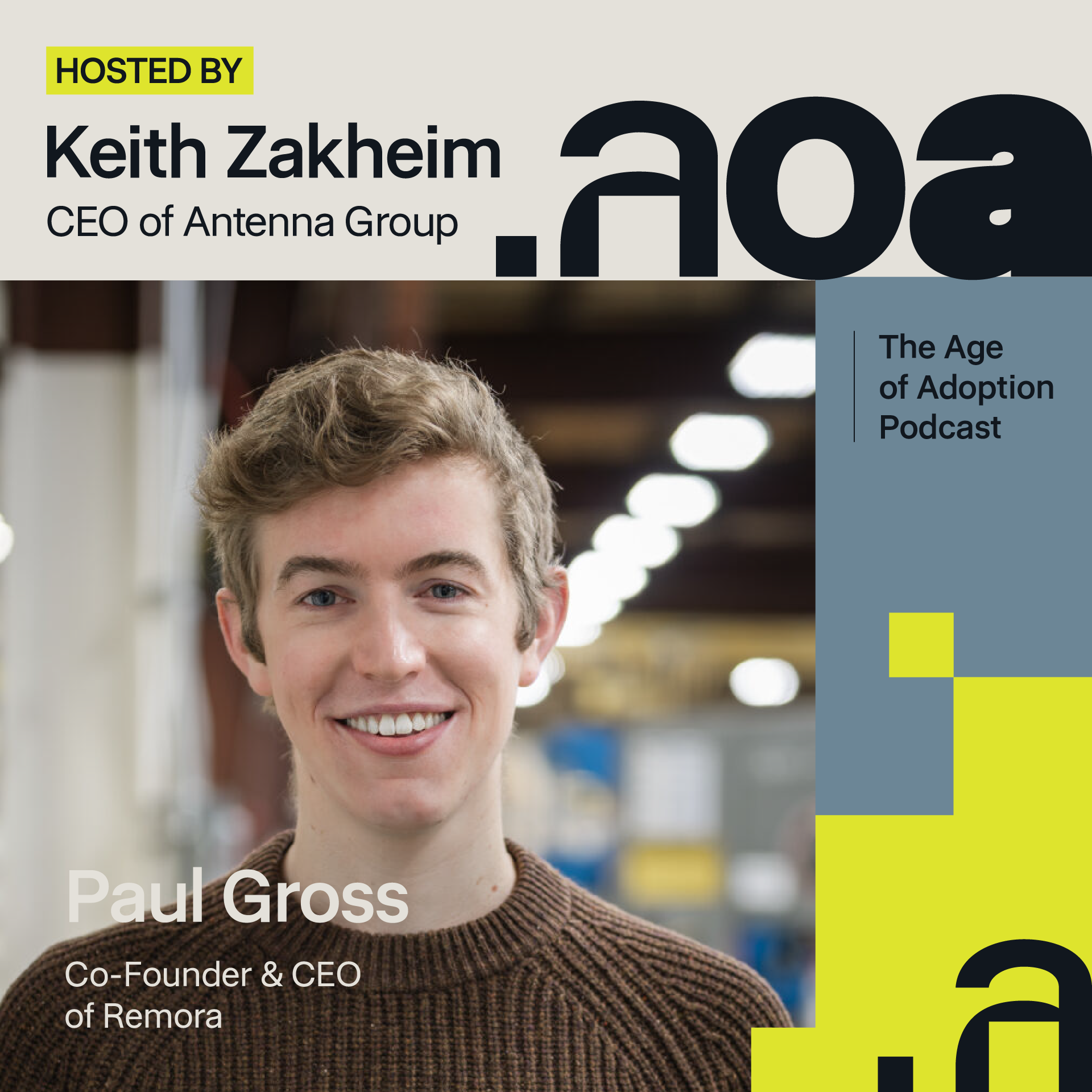
Paul Gross, co-founder & CEO of Remora
Paul Gross, CEO and co-founder of Remora, joins the podcast to discuss his company's revolutionary approach to mobile carbon capture technology. At just 28, Gross has raised $60 million to retrofit semi-trucks and locomotives with systems that capture up to 90% of CO2 emissions. Unlike traditional electrification efforts that struggle with heavy-duty transport, Remora's solution works with existing diesel fleets. "We wanted to take carbon capture from being this big over budget construction project to being this product that can be manufactured over and over again," Gross explains. The company turns captured CO2 into beverage-grade liquid carbon dioxide, addressing surprising market shortages. Can retrofitting existing transportation infrastructure accelerate decarbonization faster than waiting for full fleet replacement?
Keith Zakheim
[00:00:00] Welcome to the Age of Adoption podcast. I am your host, Keith Zackheim. Today as we do with every podcast, we're gonna ask our guest one question and one question only. What is your age of climate adoption story? A little bit about the age of adoption. We live in an era where enterprises of every shape and size, regardless of industry, must rapidly transform to become more sustainable, climate sensitive, and just. My day job as CEO of the marketing public relations firm antenna group. Our agency works exclusively with conscious brands. What is a conscious brand? It is a brand that is conscious of its responsibility to be on the right side of history. Like most businesses, our clients are experiencing a transition from an age of innovation. An era in which technologists, entrepreneurs and investors focused on innovating climate and sustainable solutions to this age of adoption, which [00:01:00] characterizes the world today. So if you accept the age of adoption hypothesis, then there's really only one salient question to be asked. What is your age of adoption story? Paul Gross was just 23 years old when he had the realization that would reshape his career and potentially transform an entire industry. While studying statistics and data science at Yale University, Paul recognized a fundamental limitation in the push to electrify transportation. Some vehicles are simply too big, too heavy, and travel too far to run on batteries alone. That insight led him to co-found remora, a company building carbon capture technology for trains and trucks, the hard to abate transport sectors responsible for massive emissions. What makes Remoras approach revolutionary is its practicality. Instead of replacing the entire fleets of diesel locomotives and long haul [00:02:00] trucks, they retrofit existing vehicles with technology that captures up to 90% of CO2 from exhaust while reducing soot and particulates. The scale of this opportunity is staggering. Medium and heavy duty trucks alone account for 23% of transportation emissions in the US While a single freight locomotive can burn 5,000 gallons of diesel and generate 56 tons of CO2. Before refueling at 24, Paul was named to Forbes 30 under 30 list, and now at the ripe old age of 28, he's leading a company that just closed a $60 million series B round. Today on the Age of Adoption podcast, Paul shares how a college thesis. Project became a venture backed company tackling one of climate's toughest challenges and why mobile carbon capture could be the key to decarbonizing transportation at the speed and scale we need back with Paul in a gif. Paul, [00:03:00] welcome to the Age of Adoption podcast. Thanks for having me. My pleasure. Paul, where, where are you based? We didn't get to that. I'm in Detroit, Michigan. Fantastic. All right. Motor City.
Paul Gross
Exactly. Automotive capital of the world.
Keith Zakheim
When you're all done with this, this is gonna be carbon capture city. That's right. That's our ambition.
Paul Gross
That's the goal.
Keith Zakheim
Paul, as I just teased, I guess you founded and are running a company that is at the forefront of carbon capture, certainly in the, let's call it mobility sector for now, transportation sector, and we'll get into all of that. You also at a young age founded this company and are operating this company. So typically when we ask execs and other guests to share their career journey, it typically is for a couple of decades. In your case, it's not, but I still would love to understand, at least I know our listeners would, how you got here. I'm sure you know you graduated from Yale, you could have done a number of different things, how you got [00:04:00] from there to here or anything else that you know would be of interest.
Paul Gross
Yeah, well the journey to starting Remos starts growing up in San Francisco where, yeah, I grew up in a liberal family. They cared about the environment, and you know, I just heard over and over again the importance of taking care of the place we live. Taking care of our planet. And you know, my grandmother was this kind of hippie Unitarian Universalist minister who took me for long walks on the beach. And we had to pick up all the trash that we saw on the beach. And you know, I went to this kind of hippie middle school where we watched an Inconvenient Truth in Science class. So I was surrounded by. People that really cared about this problem with climate change, and I saw the wildfire seasons get worse and worse every year. You know, I had family members who lost their homes. I remember that crazy day during COVID when it was like dark orange skies and ash raining down, and it just felt like a problem that I wanted to work on. So, you know, going through Yale, I initially thought, Hey, maybe I'll work on a [00:05:00] political campaign and try to get folks elected who care about this problem. But I quickly got frustrated by how that might have been a good
Keith Zakheim
idea in, in hindsight, but, all right,
Paul Gross
right. Hindsight is 2020 on that one, but I, I instead decided, you know, I, I need to build a solution that can scale up profitably because that's the way that we're going to get to the kind of scale that matters for climate. And so I decided to start a company and it really, it was very simple. I knew no one at all in the startup world, so I just applied to Y Combinator and I emailed a whole bunch of professors in the space to ask about their great students, and that's how I encountered my co-founders. So we teamed up, applied to Y Combinator and got in, and that was how we started Remora.
Keith Zakheim
And that was in 2021? Is
Paul Gross
that, that was in 2020.
Keith Zakheim
2020, right. Okay, great. The,
Paul Gross
the heart of the pandemic. We were, you know, online meeting each other. We had never met in person when we applied for funding. So it was completely a leap of faith to go do this [00:06:00] outta college.
Keith Zakheim
That's wild. Uh, good for you. Uh, and I made a joke about the political environment. It's a little bit of a, you know, I don't know if it's a joke or, or what kind of humor it is, but, but either way. What's been interesting about the process to getting to this big, beautiful bill as it relates to climate is carbon capture. And I don't, I don't know fully how it ended up, but as I saw it, it was kind of a favored child. Yeah. In this bill as it was being negotiated. Part of that, you know, I remember reading about how big oil was lobbying on behalf of carbon capture, which would make sense, but anyway, is that in fact the case, Paul, before we get into the question of the day.
Paul Gross
It is. So carbon capture is this very unusual topic politically because it's super bipartisan.
Keith Zakheim
Yeah, the
Paul Gross
big tax credit that gives us money for every ton of CO2 we capture actually started with George Bush back in 2008. It then was expanded by President Trump. Back in his first term. Then it was expanded by [00:07:00] President Biden and now it was just expanded again in the reconciliation bill that just passed. So we're really happy that, you know, everyone sees the value in carbon capture on both sides of the aisle.
Keith Zakheim
Yeah. It's irrelevant what the motivations are on each side. The reality is we can all agree, which is very rare in this environment. Absolutely. So having said that, that you are unlike a number of the other industries or, or college industries within climate that we're working with that. Did not come out unscathed from that. Bill, you're, you're in a good place. So Paul, you ready for the question? I'm ready. You've been prepping for it, I hope. Bring it on. Paul, what is your age of adoption story?
Paul Gross
For us? Carbon capture has been in the works for a hundred years. It was actually pioneered in the 1930s and for a long time it just hasn't scaled up. And I think there's a big question around why. The reason is that the existing carbon capture technology is just not good enough. It's [00:08:00] not cheap enough. It's not energy efficient enough, and unfortunately, the solvent that they're using. Are standing on the shoulders of decades of research that has gone into a new better carbon capture technology, which is this solid sorbent that's like a little pellet that captures CO2, and we are really lucky to be. Right at the moment when that solids Sorbent was ready for prime time. And so we are the company that's leading the commercialization and adoption of that technology. So I really view us as, yes, we're still doing some more innovation on the process in parallel, but we are really driving the adoption of this new technology and getting it out into the world.
Keith Zakheim
So let's talk about some of those applications for it. Absolutely. I, I, I think when most people think about carbon capture, they're thinking of big industrial site that's, you know, that's right. There's a lot of exhaust and a lot, you know, smoke stacks and let's capture, but that's not what you're solving for right now.
Paul Gross
Right? So [00:09:00] we're instead retrofitting semi-trucks and locomotives and other small sources with carbon capture technology. And, and the reason we're doing that is we think another reason carbon capture hasn't been adopted is that it's this one-off. Construction project that takes a long time to build. It's always behind schedule. It's always over budget. It's like high speed rail in California. People talk about it for 30 years and then it doesn't get done and, and I think we see that over and over again with construction projects in the us. So we wanted to take carbon capture from being this big over budget construction project to being this. Product that can be manufactured over and over again. A product that can get down a cost curve, that can actually scale up in what America knows how to do best, which is manufacturing. So we said, well, okay. What are some of the smaller sources of CO2 that are. Scaled enough and repeatable enough that we could build an actual carbon capture [00:10:00] product for them, and we immediately thought of trucks and trains. So that's where we've decided to focus, is retrofitting these big semi-truck and locomotives with carbon capture
Keith Zakheim
and those again, so whether it's semi, you know, mid heavy-duty vehicles, whether it's freight rail, these are. Industries that struggle with go with electrification. Is that right? And and the reason, and so if you can expound a little bit on the reason why, you know, 'cause some may look at this at first blush and say, wow, this is competing with electrification. But where technology is today, that's not the case. If you can address that.
Paul Gross
Yeah, we are complimentary with electrification and the reason for that is batteries are big and heavy and that's not a big deal when you're electrifying a passenger car. But it is a big deal when you're electrifying a vehicle that whose primary motive is to transport freight. If you take up space, if you take up weight with batteries, you don't have space and weight for freight [00:11:00] and on a train that's really dramatic. You would need 750 times the batteries of a Tesla model S for a single locomotive. So that means you would not only be filling up your locomotive with batteries, you'd have like 10 cars behind your locomotive with batteries, and it's not practical to do that. You take away a lot of freight. You couldn't charge those. I mean, it would just be totally impractical. Then you could say, well, what about overhead electrical lines? Maybe those would be more practical. The problem is you would have to build out over a trillion dollars of overhead electrical lines to cover the vast distance. That is the US Freight Network, and that's assuming we pay the prices. Other countries pay for overhead electrical and not, not to mention
Keith Zakheim
impact on the grid, which already is an issue.
Paul Gross
Totally avoid all that. Yeah. The, the largest railroads each use a billion gallons of diesel a year. So to switch over all of that energy to electric is just totally non-starter with our current grid.[00:12:00] So I, I think the way I would frame it is, look, we are tackling those really hard, heavy. Long haul industries, it just can't be electrified. And that's where carbon capture can be at its best.
Keith Zakheim
How big is the locomotive industry, train industry, what
Paul Gross
have you? There are six major railroads that do a hundred billion dollars in annual re because
Keith Zakheim
I'm, I'm watching, I, I dunno if you're watching the Gilded Age on HBO. Oh, I'm not. So the, one of the main characters, he's one of these, you know, barons of industry, captains of industry, and his particular industry is, is rail transportation. And it's all about how they, they were building, you know, east to west tracks and all the, you know, the cigar room. The cigar was a cigar filled rooms cigar, smoke filled rooms where the deals would happen between him and JP Morgan and everybody else. Great. Yeah. Good series. Read. Put it on your list.
Paul Gross
Yeah, the railroads Built, built America. These co, I mean, we are so honored to be working with these companies that are literally 200 years old. I, [00:13:00] I mean, it's just amazing. They're these storied institutions and I think they can be a big role in building the next generation of technology that, you know, we're working on alongside them.
Keith Zakheim
Yeah, it really is when you take a deep dive into the industry and ultimately the innovation around it. But the implementation of infrastructure, it's, it's, I mean, late 19th century, early 20th century. Like that is so much of the history of this country. And listen, listening to a podcast about Rockefeller and, and one of his many ways that, that he, that he was, you know, he, he became really wealthy and, and just his genius and prescient in terms of what was gonna happen was. Essentially getting all the options for the real estate around where the, where he thought tracks were gonna go, and being able to sell that. And anyway, it's definitely worth a deep dive. So that's fascinating, Paul. It makes a lot of sense in terms of market challenges around electrification and where you can step into decarbonize. Love that. I think [00:14:00] anybody who cares about climate loves that. Tell me about the economics of this, because ultimately it's the economy stupid, right? So the economics of this, how does that work?
Paul Gross
My number one thesis about climate tech is that your unit economics have to work. Yep. And you can't be asking for some green premium. It's not gonna happen. So that is especially,
Keith Zakheim
especially not in this environment.
Paul Gross
Completely agree. Yeah. So that's what we're focused on and our model is very simple. We sell the carbon capture system to the railroad or the trucking company, and then we give them a share of the revenue from selling the captured CO2 on the backend. And that means that what's that
Keith Zakheim
market like now? Does, does this bill change that market at all?
Paul Gross
It do well, it makes the economics even more favorable for us. Okay, because there are two revenue streams when we capture a ton of CO2. The first is the government gives us a tax credit for every ton of CO2. The government pays us that [00:15:00] amount that we get paid just got increased
Keith Zakheim
by the reconciliation. What about selling the credits though? What about that? So.
Paul Gross
We are not selling any carbon credits. We are selling the physical liquid carbon, CO2. So we produce beverage, grade liquid carbon dioxide from these locomotives, and then we pump it off the capture car and we can actually go sell it to a food and beverage producer, to a greenhouse, a water treatment company. It's used in welding and I mean, it's not just carbonating soft drinks and beer, it's also. Freeze drying chicken or freeze drying vegetables. It's creating dry ice to transport food. It's used in every part of the food and beverage supply chain. So we are turning on this new supply chain for liquid carbon dioxide in the US which is used in agriculture, manufacturing, all these critical sectors and. I think the other fascinating dynamic here is that there's actually a shortage of CO2 in the US in certain regions. [00:16:00] So much so stop
Keith Zakheim
and think about that. There's a shortage of C2 two.
Paul Gross
It, it's totally wild. We, we are in such a shortage that in some areas we actually mine CO2 out of the ground in order to supply enough to the market. So I'll give you one example. I was talking to a distributor in Florida. He currently buys his CO2 from an inactive volcano in Mississippi where they are mining the CO2. So they mine it outta the ground. Then they transport 800 miles to Orlando, then they sell it in Orlando, and that emits a lot more CO2. It's also very expensive to transport CO2. So if we can instead capture CO2 from, I don't know, one of the locomotives in Orlando, that's gonna be a much better supply chain for this distributor.
Keith Zakheim
Yeah, that's, that's, that is fascinating. Actually blows my mind. It's so surprising. Yeah. So I guess the last. Question for you or, or [00:17:00] just love, love your perspective on it is, you know, this is the age of Adoption podcast. Of course, and, and you know, my agency Antenna group, we've been working for companies in the age of innovation, so more companies like yours in the climate tech side today, those kinds of companies. But of course those who are adopting, you know, fortune 500 companies. And very often in these conversations, there's an innovation. Era and demarcation point. And then on the other side, there's adoption. Your company, it seems like, is actually experiencing both at once. So I'd love to unpack that a little bit because I wonder, uh, as we, as we speak to maybe more growth stage companies of your ilk. Whether we're gonna see more of that, because again, in the past it's been the innovators and then their adoption stories, how now they've been able to move into market for adopters. But it looks like yours is happening simultaneously.
Paul Gross
Yeah. I think we will see more of that. And the reason is that for a lot of these technologies.[00:18:00] You can deploy a version one product that is good enough. The unit economics work, the technology works. It's a good proof point, but there are still so many step changes you can achieve on the technology to improve the cost structure and the energy efficiency, and that's what we see. We've tried to be very disciplined with not building the perfect product before we deploy it. We wanna deploy that as soon as we're ready, we wanna deploy it, but we have all of these ideas about how to improve the efficiency of the technology further, and that's where the innovation can continue in parallel, and then get integrated into the product as it gets adopted to make it better and better to improve the economics, to improve the customer experience.
Keith Zakheim
Paul, that's a great place to stop, I think. Really appreciate your time and your insights. I'm gonna take a lot from this conversation, but the one that I'm probably gonna be chewing on all day is that there are people who. Need to get CO2 and are mining for it. So that's, that one [00:19:00] again is super interesting. But I really thank you for your time. Good luck and Godspeed and all that you do. I have a sneaking suspicion that we'll be hearing a lot more from you in the future.
Paul Gross
Well, thank you so much for having me. This is super fun.
Keith Zakheim
The age of Adoption podcast features CEOs, investors, entrepreneurs. And policy makers sharing their climate and sustainability business transformation stories. Episodes can be found on your favorite podcast apps, including iTunes and Spotify. The Age of Adoption podcast is brought to you by Antenna Group. Antenna is the home of conscious brands. We partner with companies that don't wait for change to happen. These brands shape the future, are awake and already moving. Unsure if you are a conscious brand. Or even if you are one, whether you are positioned as one, please visit our website@www.antennagroup.com and take the Conscious Compass Assessment, a [00:20:00] groundbreaking tool that enables enterprises to assess their brand against the eight traits of brand consciousness. At Antenna, we partner with companies big and small from growth stage to Fortune 100 to tell their climate and sustainability stories. So once again. If you're interested in joining the Conscious Brand Movement and learning more about Antenna Group, please check out our website at www.andantennagroup.com. Ping us on LinkedIn and make sure to visit the conscious Compass.