Designing For The Next 100 Years
Designing For The Next 100 Years
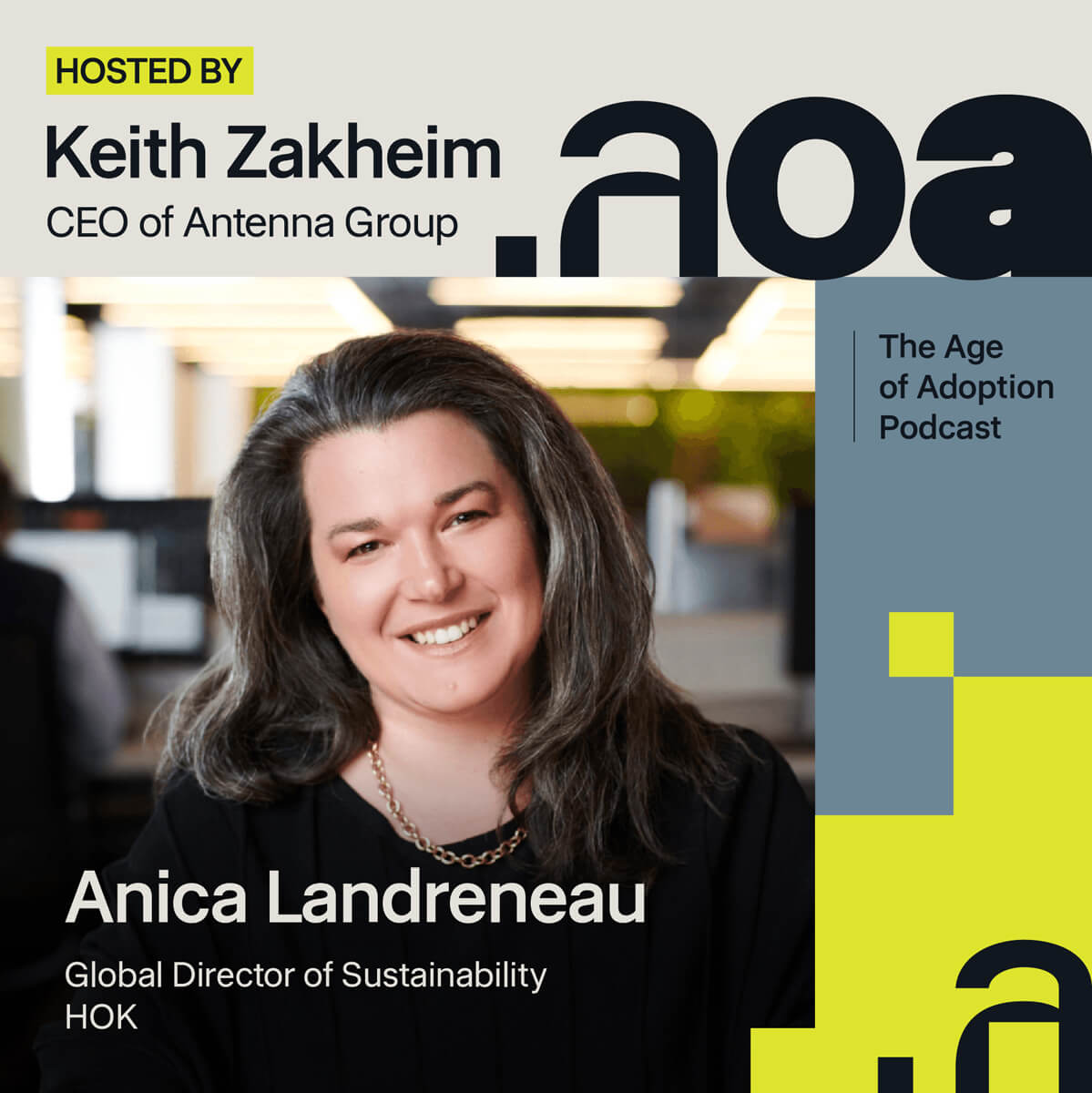
As Global Director of Sustainability at HOK, Anica leads the firm that designed Mercedes-Benz Stadium—the NFL's first LEED Platinum-certified venue. From a Texas architecture student told she'd "never find a job" in sustainability to becoming one of the industry's most influential voices, her journey reflects the evolution of green building itself. "It's not sustainable if it's not for everyone," she insists, explaining how voluntary certifications eventually create cost parity that allows practices to be codified, bringing equity to all.
The conversation delves into HOK's meticulous approach to carbon reduction—examining everything from concrete mix designs to nursery trays for landscaping. Anica reveals the economic logic behind sustainability choices: "If I optimize the design and use less material, that costs less." This practical mindset helps explain how HOK has been carbon neutral since 2022 while working toward net-zero emissions in its designs by 2030. With refreshing candor, she connects today's cutting-edge practices to the firm's 1955 Midwestern roots, where resource efficiency and durability weren't trendy—they were just good business. For anyone interested in how buildings shape our climate future, this Earth Day conversation offers both technical depth and surprising accessibility.
Keith Zakheim 0:02
Welcome to the Age of Adoption podcast. I am your host, Keith Zakheim. Today, as we do with every podcast, we're going to ask our guest one question and one question only. What is your Age of Climate adoption story? A little bit about the Age of Adoption. We live in an era where enterprises of every shape and size, regardless of industry, must rapidly transform to become more sustainable, climate sensitive. And just my day job is CEO of the
Keith Zakheim 0:32
marketing public relations firm Antenna Group. Our agency works exclusively with conscious brands. What is a conscious brand? It is a brand that is conscious of its responsibility to be on the right side of history. Like most businesses, our clients are experiencing a transition from an age of innovation, an era in which technologists, entrepreneurs and investors focused on innovating climate and sustainable solutions, to this age of adoption which characterizes the world today.
Keith Zakheim 1:02
So if you accept the Age of Adoption hypothesis, then there's really only one salient question to be asked. What is your Age of Adoption story? Mercedes Benz Stadium is on target to meet LEED Platinum Certification, the industry's internationally recognized rating system for environmentally conscious developers. This accomplishment is no accident, of course. Stadium executives had to be committed to this
Keith Zakheim 1:32
and deserve to be commended. But the execution of the project in all of its complexity could only be done by a global building design, architecture, engineering and planning firm committed to the highest standards of sustainability design. On today's Age of Adoption podcast, which was recorded in San Francisco during San Francisco Climate Week, I speak with Anika Landrenaux, Global Director of Sustainability at hok,
Keith Zakheim 2:02
the firm that spearheaded the award winning Mercedes Benz stadium in Atlanta, Georgia. HOK has been carbon neutral since 2022 and is dedicated to achieving net zero emissions in the project it designs by 2030. Anika is a true sustainability leader. In addition to her executive position at hok, she serves on the board of the New Buildings Institute on the U L I Net Zero Imperatives Steering Committee and
Keith Zakheim 2:32
chairs the U.S. green Building Council's Lead Steering Committee leading the rollout of lead version 5. Her purview is a unique one and you will not want to miss her thoughts and insights. Back with Anika in a gif. Anika, welcome to the Age of Adoption podcast.
Anica Landreneau 2:51
Thank you for having me.
Keith Zakheim 2:52
My pleasure. And we are in San Francisco in person. Climate Week. That's exciting.
Anica Landreneau 2:58
It's very exciting.
Keith Zakheim 2:59
And you got in today as did I, and we are recording as a four o', clock. So maybe not as fresh as we would be if we'd done it at 10am, but I have no doubt this is going to be a great One. And today is Earth Day. So happy Earth Day to you.
Anica Landreneau 3:13
Happy Earth Day to you.
Keith Zakheim 3:14
So, Annika, you have today a pretty prominent position as the design director for HOK's global sustainable design department, business practice. Practice. And you know, one of the things we always hear from our listeners is that they enjoy understanding how our guests got to where they are in their career. For some, it's a meandering journey. For others, it's been pretty methodical, but it's super interesting to them. And especially
Keith Zakheim 3:44
someone like yourself that has a position right now that is so impactful when it comes to climate sustainability. Would love it if you could share that journey.
Anica Landreneau 3:53
Sure. Thanks. It's a great question. I do get that a lot from emerging professionals and from students who are looking to embark on a career in sustainability. So I went to school for architecture and I went to school at a time when there were not degrees in sustainability. There were a couple of electives in sustainability, but it wasn't a master's program or a whole degree program like you see today. But it was something I knew was important and that I cared very much about. I went to school in Texas, in Houston, Texas. And you might be able to imagine, imagine
Anica Landreneau 4:23
at that time there were more architects than clients who cared about green building. And so I cared very much about it. I decided it was.
Keith Zakheim 4:30
Although Texas loves its wind, they do.
Anica Landreneau 4:32
Love its wind and solar, but and.
Keith Zakheim 4:34
Carbon capture now as well.
Anica Landreneau 4:36
And green building is very much still a voluntary, you know, aspiration for many building owners. But it is definitely not something that is regulated or heavy, heavily incentivized. So I, it was something I as a voluntary program in my own curriculum, overlaid on the program that my studio professors would give to me and sort of self track, self study for my academic career and learned a lot and was really passionate about it. And then, you know, decided that's what I wanted my career to be focused on. And people told me I
Anica Landreneau 5:05
was never going to find a job doing that, but I always felt like it was important.
Keith Zakheim 5:09
Always love those positive voices that we've all had. Right.
Anica Landreneau 5:12
But it's really neat. It's great that you're so passionate. You'll never find a job doing that.
Keith Zakheim 5:15
I was a philosophy major, so can you imagine how many people spoke.
Anica Landreneau 5:17
You'll never find a job that makes you a great conversationalist, which is good for what you do now. So my first job out of school, traditional architectural intern. I decided to be the green champion. And so I bring that up. I was helping my colleagues and clients Understand the importance of green building and the different types of ways of doing it strategies. I bring it up because entrepreneurialism is really important. If you want to do what I do. You're asking people to take a departure from their status quo, from their business as usual. So you have to
Anica Landreneau 5:47
have an entrepreneurial spirit to be successful at that.
Keith Zakheim 5:50
There's almost entrepreneurial talents that you have in terms of being inside an organization and being the advocate or evangelist for sustainability.
Anica Landreneau 6:00
It's really critical. You have to bring people along with you and get them to try new things and you have to make it a positive experience or they won't do it again. So I ended up moving to D.C. in 2005 and I worked for Climate policy think tank actually. And that was great because it brought an understanding of sort of global policy and how that related to the building industry and the buildings industry's footprint in terms of global carbon emissions. There was a little bit of right place, right time.
Keith Zakheim 6:24
So a little bit of 2005 was that George Bush's addiction to oil speech. And that was kind of kicked off.
Anica Landreneau 6:30
We had, you might remember, EPAC 2005, ESA 2007. A lot of the federal government's commitment to reducing fossil fuel emissions by 2030 came around that era. And D.C. passed its own Green Building act in 2006. So serendipity is another part of success. Right place, right time. I was passionate, knew a little bit about green building at a time when D.C. needed people, people who knew a little bit about green building. So ended up working for a third policy, third party green building consulting firm and then got my job at HOK in 2007 and I've been there ever since,
Anica Landreneau 7:00
long term, but built a whole discipline around it, around helping our clients green their buildings, pursue certifications when that was meaningful to them. But ultimately, you know, understanding what sustainability meant to them, where to find value in that and how to really enhance the projects they were working on through the lens of sustainability.
Keith Zakheim 7:17
Yeah, and before we get to the age of adoption question, just reviewing your bio. It seems that your impact on sustainability in the built environment certainly transcends just what you're doing at hok. So I know you're on the board of the New Buildings Institute, the ULI Net Zero Imperative Steering Committee. You chair a committee of the U.S. green Building Council as well. Can you touch on that a little bit? Both, you know, kind of what motivates you to be so active outside of what I'm sure is a time
Keith Zakheim 7:47
consuming full time job and how critical that is to your career.
Anica Landreneau 7:53
Those are great questions. First of all, I would say they're absolutely interrelated to the work that I do. Codes, policy, voluntary rating systems, like my role as the lead steering committee chair, rolling out leave V5, all interrelated. One of the things I learned along the way is many of my colleagues would say clients don't want to do any more than they have to do, so they only want to do what the code makes them do or what the law makes them do. So I felt very early on it was important to get engaged in the process of changing the regulatory framework in which we work.
Anica Landreneau 8:23
So if I can change the codes, if I can change the policies, if I can work on incentives, testify before Congress, ask for an expansion of 179D, ask for other incentives, if I can change that framework, then I'm creating an incentive to do the kind of work that I want to be doing. And I know a lot of other people out there in my industry want to be doing. I also think that these things are interrelated and they're really important the way they work together. Voluntary certifications, rating systems help create new early adopters, people who will try new things. They help normalize those practices
Anica Landreneau 8:53
through normalization, that reduces that cost premium for those things that might be atypical or outside the norm. As the cost premium comes down, as those practices are normalized, you see wider market adoption, and then they become fairly cost neutral. And at that point in time, when you have enough market adoption, you get to cost parity, you can codify them. And that's where we get to equity. That's when everyone has access to low VOC paints, to good indoor air quality, to a good thermal envelope, to resilience, to healthy buildings.
Anica Landreneau 9:22
And so it's really important to work up and down that spectrum, I think, because it's not sustainable if it's not for everyone.
Keith Zakheim 9:29
Yeah. And I know HOK recently launched a toolkit about equity and design. Right. And it's a roadmap for creative and creating inclusive, community focused spaces, partnering with the community, planning for inclusion, equity of experience, health and well being, championing environmental justice, all those kinds of things. So. And hok, I mean, it's really a leader and really progressive in that area.
Anica Landreneau 9:54
Absolutely. And service to your earlier question and to that statement, HOK has not made me do these things outside of my nine to five jobs. HOK thinks it's part of my job to be a leader and it's part of our responsibility as a large firm to lead by example. And so leading by example, changing codes and policy, leading by example by releasing toolkits because we have the wherewithal to create them. Smaller firms, 1, 2 people, 10 people might not have the capacity to do those things. And we do. And so it's important that we share the knowledge that we create.
Keith Zakheim 10:21
Yeah. And that's also healthy company culture when they provide the resources, support individuals that want to be leaders in their space and want to do things that are maybe not necessarily part of the 9 to 5 job, but ultimately will redound to the benefit of the company and to society at large.
Anica Landreneau 10:39
And it's not that business to create demand for building, which we happen to do really well. Right. So changing policies.
Keith Zakheim 10:46
Mercedes Benz stadium, right?
Anica Landreneau 10:48
Yeah.
Keith Zakheim 10:48
And the Falcons. Yeah.
Anica Landreneau 10:49
Lee Platinum NFL stadium.
Keith Zakheim 10:51
Yeah. Great. Well, that is a fantastic, I think, entry point to the question that sometimes does strike fear in the heart of my guests, but is a fantastic opportunity to reflect on all the amazing things that you and HOK are doing in the age of adoption. So, Anika, what is your age of adoption story?
Anica Landreneau 11:13
Well, my whole career has been focused on climate and focused on sustainability. So when I was in school, as I mentioned, you know, I was learning a lot of statistics about the impact buildings had on the environment, the amount of contribution we had to landfill debris through demolition and construction activity, 40% of global carbon emissions. So I think that's where I really started to connect my general passion for the environment to what I was going to do professionally. HOK has been, I think, committed to sustainability since its founding in 1955. It's a Midwestern firm originally, and it's just good
Anica Landreneau 11:43
common sense, I think Midwestern.
Keith Zakheim 11:44
Values, common sense and Midwestern right to.
Anica Landreneau 11:47
Be resource efficient, to worry about durability.
Keith Zakheim 11:50
And last, just totally unrelated to what you're going to say. And we're going to get back to it in a second. But about the Midwest, I love the Midwest. To me, New York has, which is where I'm from, manic energy, which is great at times, but it's manic. The west coast doesn't have the same manic energy. It's kind of got intellectual vibe, driven by ideas, but sometimes a little bit of arrogance. The Midwest to me is the perfect medium. It's got good business
Keith Zakheim 12:19
energy, not manic, but good business energy. A lot of smart people, really good ideas, but down to earth. So anyway, if I was in charge of the Midwest tourism agency, I just gave it a great plug. But you mentioned Midwest. I couldn't have myself. And we can get back to age of adoption.
Anica Landreneau 12:38
Yeah, sorry. I'd say it's part of the values the firm was founded on. So before sustainability was even a thing, I think it was just part of the culture of the firm.
Keith Zakheim 12:46
So what did that mean in 1950?
Anica Landreneau 12:48
I think, like I said, resource efficiency, durability, buildings that last, buildings that stand the test of time. We call it resilience now, but, you know, just good, good quality construction and then resource efficiency. Don't waste things. If you think about our grandparents or great grandparents, you know, ancestors who lived through depression and who wouldn't throw out their empty containers, you know why you shouldn't throw away parts of your building, you shouldn't throw away your building. It's, it's just, you know, those types.
Keith Zakheim 13:13
Of things, they didn't have fast fashion back then.
Anica Landreneau 13:15
Why would you wait, no. And you wouldn't waste materials, right?
Keith Zakheim 13:18
Absolutely not.
Anica Landreneau 13:19
You wouldn't waste energy. So in 2010, we signed on to the 2030 challenge and we started reporting and tracking our operational forecast. Operational carbon emissions. For every building that we designed in our portfolio and our interior spaces over the last few years, we've added embodied carbon. We've added, with the MAP 2040 commitment, our refrigerants, the embodied carbon of our mechanical systems. We've added the Asla 2040, so sequestered carbon in our landscapes as well as embodied carbon in our hardscapes. We have an interiors commitment. So now we're
Anica Landreneau 13:49
looking at not just carbon and circularity, but the health impacts of the materials that we use inside of our buildings. So over time we've added these commitments and we're transparent. We track these projects, we optimize them and we share that information. And we also mentor other firms. Again, we're a large firm. We have the capacity to build rigor and tools and we will share what we're learning with other firms. Gladly.
Keith Zakheim 14:11
Is that with reports or is that with webinars?
Anica Landreneau 14:13
Webinars. And I have done hands on mentoring of counterparts and other firms. And I've met some of my closest peers and other firms I've met through mentorships and that the ARA will organize. You can sign up to be a mentor. And I think it's really important because we won't get where we need to go unless all ships drive. Yep. So. So we've been doing that. And then a couple of years ago we started, you know, we're a carbon neutral firm. Our firm operations. I have to say this, the impact of our projects, the emissions we avoid through this work every year, easily 175, 200 times our firm operations. But we still
Anica Landreneau 14:43
offset and reducing the carbon emissions from our firm operations. It's still important to. And we're transparent about that. We have a climate action plan. So it's a trajectory. Our age of adoption, we keep adding more and more and more to it, but I would say we started. It's founded in our roots as a firm. It's good Midwestern values.
Keith Zakheim 15:01
Yeah. Can you maybe dig in a little more into embedded carbon? And you mentioned softscapes and hardscapes. I know again, 40% of all carbon emissions come from the built environment. I think 28% is operational, 11% for materials and construction. But specifically embedded carbon. You mentioned that. And that's something that you see and read a lot about now.
Anica Landreneau 15:22
Yeah. So we look at the structure. A huge chunk comes from that. So we are absolutely starting there. And substructure and superstructure, we have. We're fortunate that we have structural engineering within hok, all of our disciplines. So we can get a jumpstart on that. It's material selection, it's design optimization. It's quantities and then it's refinement of your specification. There's never a point where you can stop trying to optimize embodied carbon through that. And then it's the enclosures, then it's the finished materials. And then we're looking at landscapes. We're looking at the hardscape
Anica Landreneau 15:52
materials and the greenscape materials. And even through that, working with my landscape group, another discipline we have in house, you would be surprised because a lot of you would think, oh, they're plants, of course, they're just equestrian carbon. Where do we source them? That the trays that we're bringing, the young plants that were grown off site can be a huge source of carbon emissions. So can we get biodegradables? What can we do? Can we grow from seeds on site? What can we do to reduce the carbon footprint? Can we grow something nearby? Can we even create a nursery on site if we have enough land area to do that so
Anica Landreneau 16:22
that we don't have to transport them? So really thinking through with every discipline, what can your discipline do? What can your discipline do? And then mechanical engineering. Refrigerants are a huge source of greenhouse gas emissions and we're already in a phase down right now, but really trying to work out ahead of that, choosing refrigerants that aren't going to exacerbate the rapid pace of global warming. And that's a thought process. Some things are more efficient but have used rely on Refrigerants that are rapid, global warming, et cetera, so high gwp. And then we look at the embodied carbon of
Anica Landreneau 16:52
our mechanical systems, of the equipment itself, of the heat pump, of the chiller, et cetera, and then the ductwork. And can we lay that out more efficiently? Can we use less of it? So we're going through the whole building with just fine tooth comb and trying to find everything that we can to reduce body carbon and greenhouse gases.
Keith Zakheim 17:09
Yeah. And look, a lot of, I think the increase in interest and adoption of sustainable solutions, the value propositions are many. Of course, there's the virtue value proposition and the doing good value proposition. But most industries ultimately have succeeded or failed based on the economics of it. And it seems like the economics work. And there is cost parity, a number of
Keith Zakheim 17:38
levels. So can you just reflect on that? Specifically in the age of adoption, where we do think and we do see, economics is a much more powerful argument.
Anica Landreneau 17:47
Now, I think some of the strategies here when we talk about if I can optimize the building design, optimize the grid and use less material that also costs less. So there's a motivator right there for a client. If you. Now if I want to be additive and say, oh, I want to use a special concrete mix, but maybe it's a little bit more, then what I need to do is go to my client and say, I want to optimize this design. I'm going to reduce the overall material quantity by 15%. Can I have 1% back so I can add something that's going to reduce the embodied carbon of what is left? I think that's a really reasonable
Anica Landreneau 18:16
argument to make. But we have to make that argument. Of course we have to come with a common sense proposition. Why would anyone just pile costs? It's not sustainable for pouring money down a drain. Right? So that's the kind of thing we need to look for, those cost neutral or even cost, you know, negative solutions. Because then the contractors on board, the clients on board, the whole team can get behind that. And it's up to us as a design community to find those answers.
Keith Zakheim 18:39
Fantastic. I think that's a great way to close the episode. Annika, thanks so much for joining me on the Age of Adoption podcast. Enjoy the rest of climate week in sunny San Francisco and look forward to seeing you soon.
Anica Landreneau 18:52
Thank you so much.
Keith Zakheim 18:54
The Age of adoption podcast features CEOs, investors, entrepreneurs and policymakers sharing their climate and sustainability business transformation stories. Episodes can be found on your favorite podcast apps, including itunes and Spotify. The Age of Adoption podcast is brought to you by Antenna Group. Antenna is the home of conscious brands. We partner with companies that don't wait for change to happen. These brands shape the the future are awake
Keith Zakheim 19:24
and already moving. Unsure if you are a conscious brand or even if you are one, whether you are positioned as one, please visit our website at www.antennagroup.com and take the Conscious Compass Assessment, a groundbreaking tool that enables enterprises to assess their brand against the eight traits of brand consciousness. At Antenna, we provide partner with companies big and small, from growth Stage to Fortune 100, to tell their
Keith Zakheim 19:54
climate and sustainability stories. So once again, if you're interested in joining the conscious brand movement and learning more about Antenna Group, please check out our website at www.antennagroup.com. ping us on LinkedIn and make sure to visit the Conscious Compass.
Anica Landreneau 20:14
Sam.