Engineering a Sustainable Future
Engineering a Sustainable Future
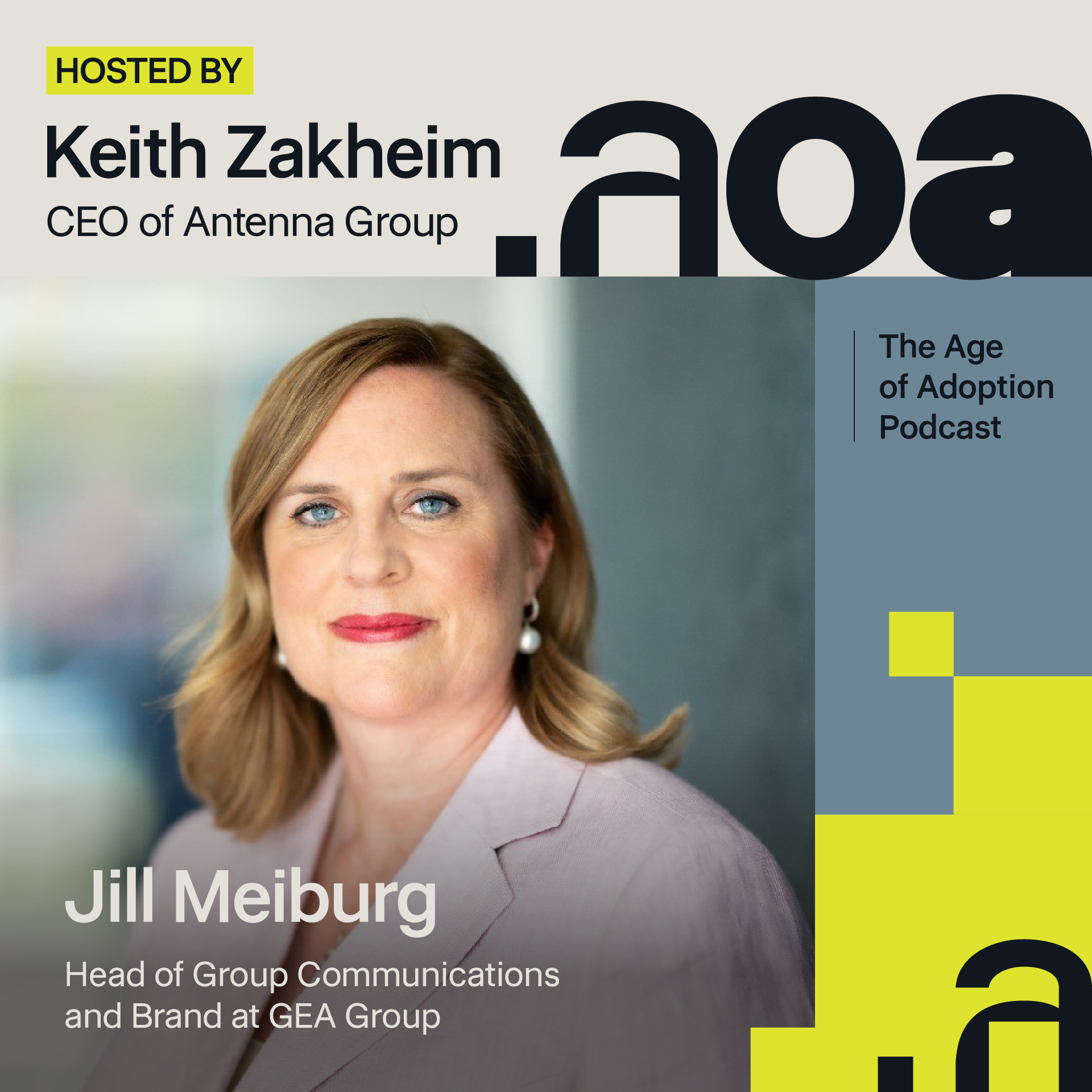
How does an engineering company balance profit with purpose while transforming the food system? Jill Meiburg, Head of Group Communications and Brand at GEA Group, shares how the 143-year-old German industrial equipment leader is tackling humanity's greatest challenge: feeding 10 billion people by 2050 while achieving net zero by 2040. With 25 years in corporate communications across Deutsche Telecom and logistics giants, Jill now leads the narrative for a company processing every fourth package of pasta and every third chicken nugget globally. "We're not out there just to save the planet. We're out there to make money on this," she explains, highlighting GEA's Mission 30 strategy targeting 60% sustainable solution revenue. The company made headlines by becoming one of the first to implement "Say on Climate" shareholder voting, passing with an impressive 98.5% approval.
Keith Zackheim
Welcome to the Age of Adoption podcast. I am your host, Keith Zackheim. Today as we do with every podcast, we're gonna ask our guest one question and one question only. What is your age of climate adoption story? A little bit about the age of adoption. We live in an era where enterprises of every shape and size, regardless of industry, must rapidly transform to become more sustainable, climate sensitive, and just. My day job as CEO of the marketing public relations firm antenna group. Our agency works exclusively with conscious brands. What is a conscious brand? It is a brand that is conscious of its responsibility to be on the right side of history. Like most businesses, our clients are experiencing a transition from an age of innovation. An era in which technologists, entrepreneurs and investors focused on innovating climate and sustainable solutions to this age of adoption, which characterizes the world today. So if you accept the age of adoption hypothesis, then there's really only one salient question to be asked. What is your age of adoption story? Jill Berg has spent 25 years mastering the art of corporate communications across telecom giants like Deutsche Telecom and logistics, powerhouses like Deutsche Post's, DHL group. But in 2020, she made a career pivot that would put her at the center of one of humanity's greatest challenges, feeding 10 billion people by 2050, while at the same time dramatically cutting. Carbon emissions as head of group communications and brand for GAA Group, a 140 3-year-old German headquartered industrial equipment leader with 5.4 billion euro in revenue. Jill now now leads the narrative for a company that processes every fourth package of pasta. Really, really interestingly, every third chicken nugget globally, what makes her role particularly fascinating is The Impossible Equation. Gay is trying to solve engineering solutions that increase food production by 60% while achieving net zero by 2040. Through Gaia's Mission 30 strategy, she's helping drive sustainable solutions from 41.5% to 60% of company revenue, while also growing digital solutions 20% annually. In recognition of this and other accomplishments, Gaia was just named number 12 on Time. Magazines World's most sustainable companies Today on the age of Adoption podcast. Jill shares gaia's ambitious climate and sustainability transformation goals and how it's successfully executing on them while still growing revenues and margins, as well as how GAA became one of the first companies in the world to implement the say on climate program in which investors vote up or down. Whether or not in this case, Gaya has the authority to continue down the road of its ambitious climate and sustainability goals. Spoiler alert, it passed with a whopping 98.5% of the vote. Back with Jill in a Dusseldorf minute. Hey Jill, welcome to the Age of Adoption podcast.
Jill Meiburg
Hi Keith. Thanks for having me.
Keith Zackheim
So, Jill, you and I actually first connected probably three, four months ago in Amsterdam at the Page Society Conference and you know, we, we didn't talk for long, but in those 10, 15 minutes I was, this is. The perfect age of adoption guests. So I'm happy we can connect. And you know, your professional background's an interesting one. You didn't start in a company or an industry, you know, food and pharmaceutical. You started a more telecom with Deutsche Telecom. Now you're leading communications for a company, which my favorite stat in in our research is processing one in three chicken nugget chicken nuggets globally and still even with processing those chicken nuggets driving net zero by 2040. So we could talk all day about chicken nuggets. I know my, my kids when they were younger for sure, would've loved to talk more about chicken nuggets, but we'll probably get into more substantive themes today. But anyway. Jill, if you don't mind sharing your, your professional background, your career journey with our listeners who we're, we're always hearing from them that they love this part of the podcast as much as the age of adoption part.
Jill Meiburg
Great. Well, thank you so much, Keith. It's really nice to, to be here. Maybe first question, how did an American end up in Germany working for a German company? In fact, my entire career has been with large German multinational companies. And yeah, I think that that really comes from my area of study, which was international relations. International affairs tied to that learning, mastering a, a foreign language, becoming fluent in German, having studied abroad. And so all of these things kind of coalesced and, and led me to a path that was actually going more towards journalism. So I was starting out. You know, as a reporter intern for Bloomberg, getting my feet wet, doing different things, and eventually after graduate school at Columbia, came back to Germany on a Robert Bosch Fellowship as a Bosch fellow with other young professionals. And we experienced Germany from a more. Professional setting, working in different companies, also looking into the public sector, understanding Germany's role in the world and all of this fascinated me. And yeah, I had crossed that language barrier was pretty fluent and it led me to my first job. I had been a Bosch fellow at Deutsche Telecom and they invited me then to, to stay on and work there permanently in Bon Germany, which is still my hometown today. That's where my husband and I live with our three children. And yeah, it's been, that's kind of been the common thread through the career, has been working in this international context in multinationals and working, pivoting. Then from a journalistic path to corporate communications and finding that I was very at home and really enjoyed the dynamic of being in business. That was a, a feeling for me where I was much more a part of a team and really enjoying also the business. Themes and topics that I was delving into. So yeah, I've built my career in, in communications and brand and have really just enjoyed it very, very much and yeah. In a nutshell. And what
Keith Zackheim
inspired that transition from telecom and and other industries to industrial equipments? And again, a lot of your remit, which we'll talk about is sustainability. So what inspired that?
Jill Meiburg
Yeah, I think that there were always opportunities there to just kind of expand my portfolio. I came from the editorial side as a lot of former journalists do running magazines and that type of thing. And then that really evolved into more strategic communications work where you're preparing and run. Writing things for CEOs and other top level executives and getting really more into the performance measurement side of communications. How do we actually demonstrate, measure our impact, and how do we orchestrate a fully integrated communications plan? You know, using all of the disciplines in the, in the tool set, internal, external, everything that you have, you know, at your disposal, thought leadership, CEO and so forth. So I think. Being a bit more of a generalist, having studied international relations, that that sort of strategic work really resonated with me. And so when I had opportunities to move more in that direction in my career, I definitely took them and that, and it was a good preparation, kind of gaining experience in all of the different disciplines of communications to then ultimately come here to GAA and to lead the entire function. So, you know, I have in my remit here, internal, external, brand, and various things. I do not have. Operational responsibility for sustainability, but our team is focused on the communications around sustainability in many, many ways. And it's such an important topic for GEA that it is absolutely top of the agenda for us all the time.
Keith Zackheim
Yeah, I mean, we talk about it all the time here that sometimes people, when they think about comms sustainability, I think they don't appreciate how critical. What we do as communicators and storytellers is to moving forward a movement that ultimately is so critical to transformation and global transformation and solving what we all think is an existential crisis around climate change. And, you know, all great movements ultimately are undergirded by great communications and storytelling. So, you know, I'm always in, in our agency for example, you know, most of our, most of our employees. Their day-to-day is doing communications and marketing around sustainability. And if you ask them, if they look in the mirror in the morning, they see themselves first as climate warriors. And then what they do ultimately is storytelling and comms and marketing. But that, that's a distinction, I think, with a difference, and I think it just inspires all of us every day. So kudos to you on that. So we're gonna get now into the age of adoption question, but I'm gonna frame it around this and, and one of the things I'm really excited about today. Is, we've been doing a lot of exploration around decarbonization of real estate, a lot of things around renewables, grid optimization, data centers. We haven't looked at food recently. We've done it but haven't looked at food recently, so. Your ambitions in terms of sustainability and goals, and then ultimately you can bring us through exactly how you're getting there. But the challenge is daunting, right? So the global population is estimated to reach about 10 billion by 2050. Food demand is increasing 60% by 2050. It's responsible and people don't always appreciate this. 33% of human caused. GHG emissions, right. So that's the food system. And then agriculture and industry are 90% of global fresh water withdrawals. And I know you're doing a lot of work on water tech, which I'm excited to hear about as well. So you've got a major, major industry, obviously feeds everyone. We have to keep doing that. Yet it's a huge contributor to the climate crisis. And then you've recently, as an, as an organization. Announced, I guess, mission 30 goals in general. You had a goal to be, I think it's what, net zero by 2040. But within that, what we, what I love about what I saw in Mission 30 is, and we've heard this from other companies as well, that there's growth goals. Goals, return on capital goals, but aligned with sustainable solutions. And it's not a, you know, ultimately I think some people look at, well, if you're gonna be sustainable, you're gonna have to take a hit to growth and margins. That's not what you're saying in this plan. So let's that, that's kinda how I'd frame this. But Jill, now I'm gonna give the floor to you and I am gonna ask the question that I know every single day when I do this, everyone around me gets super excited. So Jill. What is your age of adoption story?
Jill Meiburg
We are a global industrial technology leader. We build machinery and plants for the food, beverage and pharmaceutical indus industries primarily in among others. So in addition to your chicken nuggets statistic, also sort of one quarter of process milk in the world comes from GAA production systems. And fun fact, our pasta machines account for about every fourth. Package of spaghetti in the world. So every second liter beer goes through our production system. So
Keith Zackheim
I have, I have four children and three of them are significantly taller than I am. And I like to think that it's the milk that drove that growth, not the chicken nuggets.
Jill Meiburg
Yeah, I, I would hope so too. That's for
Keith Zackheim
another day.
Jill Meiburg
That's for another day. But, but indeed, food and beverage, very, very key for our, for our business. And I think, you know, to, to lead into our age of adoption story. It's important to know about Gaia, that we have a very strongly rooted purpose in our company, which is Engineering for a better World, right? We are an engineering company, a mechanical engineering company, and for a better world, really for us meets doing all of that in a sustainable way. We have a vision to, uh. Safeguard future generations by providing sustainable solutions for these industries. So those things are really well anchored in the company and they're, as you kind of said, we're a company of warriors. You know, people really believe that. It's very inspirational to our workforce. And yeah, I think. Basically when you're an engineering company coming from that industry, it's quite normal to have resource efficiency ingrained in the mindset that's part of the DNA. Every time you create a new machine, you're looking to make it more efficient, right? Every engineer is kind of hardwired in that way, but I think we're round about 2020, I would say was kind of a seminal year for us. We, our CEO, Stepan KBA had been in office for about a year, and he came really with bold. Ideas and a bold vision who you know, which, which really wanted to, to embrace not only what he viewed as our moral, ethical responsibility to save the planet, but also to recognize and embrace the business case for sustainability. We we're not out. There just to save the plant. We're out there to make money on this. Right? And I think that's absolutely legitimate and we have a fiduciary responsibility anyway to our sellers. We have to, we have to make money on this. And that is the intention. And he saw that opportunity because in food, beverage, and pharma, our customers are asking for these solutions. They want resource efficient machinery. They want. Carbon neutral plants. They want to electrify, they want to do all of these things. And we have the technology and, and the know-how to help them with that. So basically for gaa, what is considered scope three emissions, in other words, our machines in the use phase with our, with our customers. That's scope in one, one, and two for our customers. And they need, they have their own environmental goals that they need to meet. So it's a nice partnership there. We can definitely work together. And that's basically, you know. What got this whole thing off the ground, a commitment to that purpose and a vision to drive that business case, and we really ramped up then in 2021 with our very first climate strategy, and we built the sustainability function from the ground up, which I think was. Very, very helpful to look to a lot of other companies like Schneider Electric or you know, Unilever or other big brands that have done a great job and leverage all that best practice in getting the organizational anchoring correct. In, in, you know, it's, it's very difficult to sometimes do that in large organizations where you can't undo kind of legacy things that, that exist in terms of organizational structures. But we, we set it up, we got it on the road, we got our first strategy out, and I think that, you know. This was all important. Like all companies, we went through the steps of articulating the net zero target, getting the science-based SBTI validated targets, but we took it a step farther at gaa and I think that's, that's really quite groundbreaking. So in 2024, we took our climate transition plan, which clearly lays out. You looked at it in your research, I can see clearly lays out how we're gonna reach net zero by 2040. We took that plan and put it to a vote at our annual shareholders meeting. So we told all of our shareholders, it's called say on climates, right? You're actually giving your shareholders a say on climate. This is an initiative that came out of the UK and we decided to be really a path breaker here in Europe and be one of the very, very few companies to do a say on climate vote. And we wanted to do that because we. Felt it was important to take our investors, ourto, our shareholders. Yeah. Along this journey with us. And we wanted to have maximum transparency about what it's gonna take for us to achieve these very ambitious goals that we've set. It's not, uh, you know, it has implications also on. You know, investment and, and things that are really key for shareholder return and in the minds of shareholders. So we went forward with the sand climate vote and we received a 98.4% approval from our shareholder base. Wow. And that was really huge, great milestone and step forward for us, and gave us so much momentum to keep doing what we're doing with our climate transition plan. So that was really key. And I think that. You know, compared to 2019, which we consider to be our baseline year, when we report now on our progress, we really can, can, can demonstrate some, some very significant steps forward. So, you know, we've reduced our greenhouse gas emissions scope one and two already by 58% in scope three by 33%, and scope three is tough. I mean, that's a really, really tough nut to crack. So I think that for us and for Gaia, we're. Very focused on walking the talk. And I think that's really key. It's, it's out of this sort of lofty pledging and, you know, goal setting Yeah. Thing into real action. And that's because sustainability is embedded here as a business transformation and as a business case. Yeah. So I mean, well, you know, when
Keith Zackheim
you talk about Walk the Talk, one of the things I noticed and one of the features of of Gaia that I haven't seen elsewhere is that sustainability criteria is. Tied, I think, to executive compensation across the organization. Yes. So to me, like there's such incredible alignment. So now you have this say on climate vote amongst shareholders, executives in the organization are fully aligned there. 'cause that's where the incentives are as well. Yeah. And the results are there, right? So when you go to the shareholders and say, look, this is our climate transformation plan, our sustainability transformation plan, but. There's no sacrifice involved in that. It's actually enabling us to better our economics. Yeah. Uh, and show even better financial results. Yeah. That's a home run for everybody.
Jill Meiburg
It's a win-win. Indeed. I would definitely see it that way. And, uh, you know, you have nonetheless, you know, it's, it, you still have to find the, the, the energy and the commitment to stay the course. Right. And that, that's really what, what it's about. Now, in times of, I don't know, perceived green hushing or, you know, walking back, you know. That, that, to be honest, that's not what, what we experience. Our customers have confirmed around the world that they're still very much on board with their climate goals and so there's no need. I think
Keith Zackheim
that's way overblown. Yeah. I mean, this is what we do every day. We have not seen much of that.
Jill Meiburg
No, and it's good to hear from your end of the world too. I mean, it, it's, it's not, not what we experience and so we intend to just, you know, keep pushing forward. And you mentioned our mission 30, so that is our current. Strategy, and we are aiming within that context to achieve a 60% share of sales, of made up by sustainable solutions. So that is really, really significant there. Can
Keith Zackheim
you unpack that? What what do you mean by that?
Jill Meiburg
Yeah, so right now we, if you look across, you know, what we sell as a company, all of this machinery, plant solutions, processing lines, what have you, about 40% of those solutions are what we would call sustainable. Meaning either that they align to the EU taxon. These criteria for what can be claimed and called as a green sort of product, or they have other characteristics that we have self-defined as being sustainable. For example, resource efficiency and things of that nature. So we even created an eco label that's called our add Better label, and everything sold with that label is. Independently validated by a third party. And what we can say with that label is if you buy and add better machine, it is significantly more resource efficient than the predecessor, right? So there, you know that this is a, again, an independent third party validation process. So it's not just greenwashing it in any way at all. It's really showing and demonstrating to our customers that. You're gonna get what you're paying for here, and it's going to, it's gonna give you also the economic and the sustainability benefits, right? So again, a win-win. So we're doing things like that to boost even further that share of sales that can be tied back to sustainable products and solutions. So again, by 2030, we hope to boost that share up to 60%, which is. Really, you know, significant. And I think it shows, you know, our goal here is always to have bold and ambitious targets, but also backed by pragmatism. I think as a company we're, we're, we have a, a very pragmatic mindset and we just get to work and do it, and there's lots of customer examples that we can dive into that kind of demonstrate some of the ways we've helped our customers. So, yeah.
Keith Zackheim
Fantastic. Jill, I'm, I'm gonna ask one more question or, or actually just ask you to maybe double click on one piece of news that's hot off the press. And since we are based in the US antenna group, and, and most of our listeners, I think, for the age of adoption are in the us Yep. There's a great US story Yes. That just, that just was released, right. So yes, you're open the US-based food application and technology center in Wisconsin. So love to hear about that before we sign off.
Jill Meiburg
Yeah, absolutely. So I think we're all clear that the, the use of land and the, the, the stress that agriculture puts on the planet, that, that can't continue. That we need to find ways to create alternative proteins. Yeah. And this is what our application center is about in Janesville, Wisconsin. We have technology on that site that allows customers to come and test different ways of, of creating. Yeah. Different types of proteins using technologies such as cell cultivation. In other words, cultivated meat, cultivated eggs, right? Or using precision fermentation to create food ingredients. There's different things that, that you can do. We provide all of the technology for that experimentation phase, and the goal is really to help a customer go in, test that out, and figure out how they can go to industrial scale, right? In creating whatever. It may be alternative chicken, alternative steak, what have you. So that is, I think, something really essential as we approach that population statistic that you mentioned. We just need to be able to feed people in a low. Impact way. We can't be, you know, we need to have lower impact food alternatives. And I think that that's a way through Janesville and our technology center that we're really contributing to a more secure, more safe food system, but also a low impact, a low carbon food system.
Keith Zackheim
Fantastic. Well, Jill, this was fantastic. Really appreciate you joining us today. And I know you have, you post pretty frequently on LinkedIn. Is there any other way for people kind of to follow your content or, you know, keep on top of that?
Jill Meiburg
Well, I, you know, our home, our homepage, our, our GA group, LinkedIn account, all of these things are, are great sources. Our CEO is speaking regularly in Europe at conferences and so forth. I mean, we're out there and I, I think you might hear more from us in the future, we're approach. Potential entry into the German Dex Index, and that'll be decided in September. So things are, are marching along here in a great direction, but it's, it's been so fun to have this conversation, Keith, and I, I appreciate you having me. Yeah,
Keith Zackheim
thank you. Thank you for joining us, Jill, and I hope to be in touch soon.
Jill Meiburg
Alrighty, thank you so much. Bye-bye.
Keith Zackheim
The age of adoption podcast features CEOs, investors, entrepreneurs. And policymakers sharing their climate and sustainability business transformation stories. Episodes can be found on your favorite podcast apps, including iTunes and Spotify. The Age of Adoption podcast is brought to you by Antenna Group. Antenna is the home of conscious brands. We partner with companies that don't wait for change to happen. These brands shape the future, are awake and already moving. Unsure if you are a conscious brand or even if you are one. Whether you are positioned as one, please visit our website@wwwdottedgroup.com and take the Conscious Compass Assessment, a groundbreaking tool that enables enterprises to assess their brand against. The eight traits of Brand Consciousness. At Antenna, we partner with companies big and small from Growth stage to Fortune 100 to tell their climate and sustainability stories. So once again, if you're interested in joining the Conscious Brand Movement and learning more about Antenna Group, please check out our website at. www.andpenngroup.com. Ping us on LinkedIn and make sure to visit the conscious compass.