Jigar Shah on Clean Energy’s Next Chapter
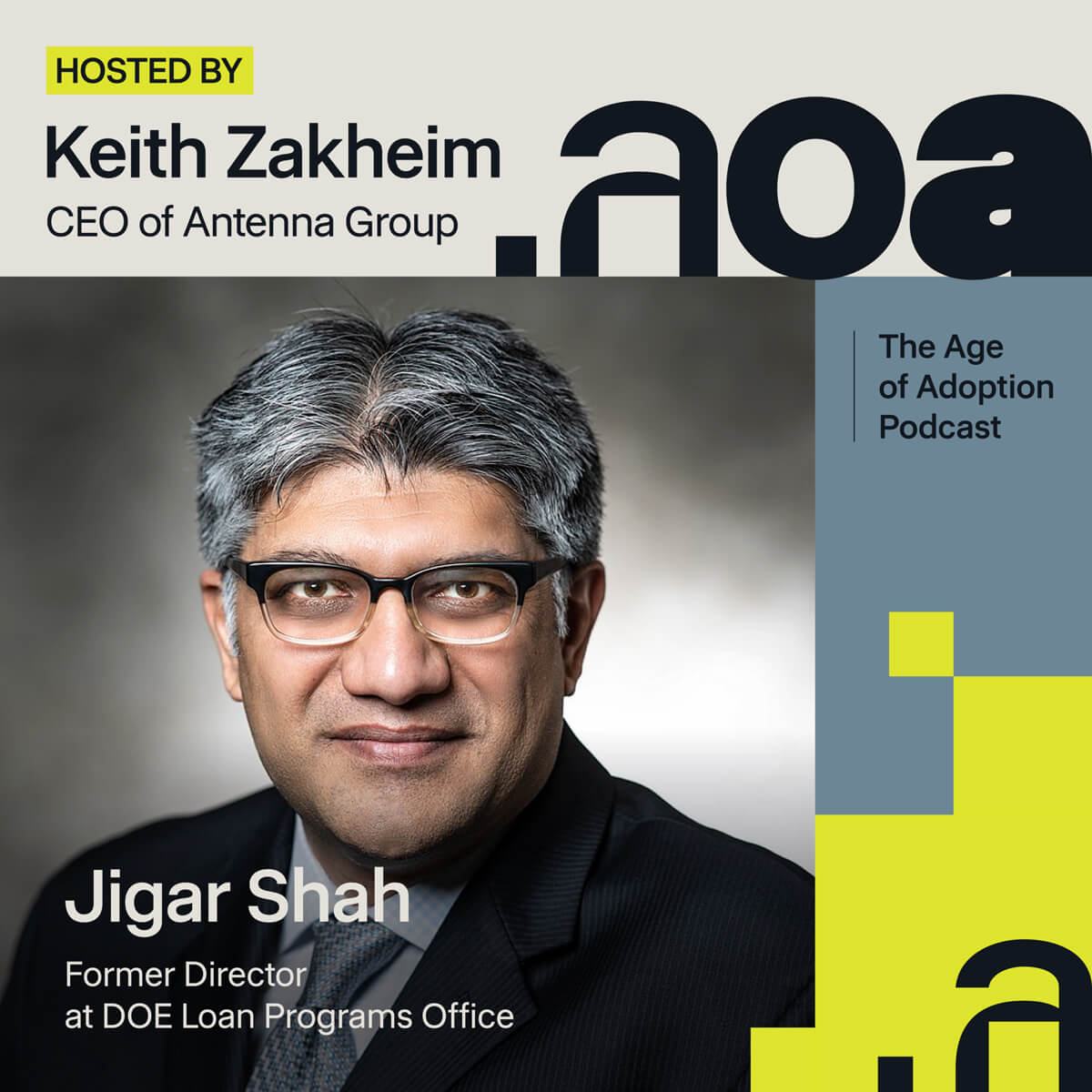
Jigar Shah on Clean Energy’s Next Chapter
Jigar Shah, widely considered a pioneer of the modern clean energy revolution, joins the Age of Adoption podcast to share his remarkable journey from mechanical engineer to industry transformer. As the former Director of the DOE's Loan Programs Office, Shah expanded loan authority from $40 billion to $400 billion, announcing 53 deals totaling $107 billion in committed project investment. His leadership helped boost US clean energy investment from $111 billion in 2020 to $236 billion in 2023. "I think it's deployment, right? And I think innovation actually follows deployment," Shah explains, outlining his deploy-first philosophy that has guided his career from revolutionizing solar financing at SunEdison to his current work at Multiplier.
In this compelling conversation, Shah addresses the intersection of populism and clean energy adoption, arguing that market forces will ultimately prevail over political headwinds. He reveals seeing unprecedented rooftop solar adoption and notes that "the folks who are closing financings are solar, not natural gas plants." Now focused on ensuring clean energy entrepreneurs "get paid" through his advisory firm Multiplier, Shah tackles the critical challenge of retention in the industry. Why does this matter? As Shah puts it: "I want them to stay in our industry because I think it's essential to tackling the climate problem." What obstacles are preventing companies from scaling successful pilots into fleet-wide deployments? How can the clean energy movement maintain momentum despite political uncertainty?
Keith Zakheim 0:00
Welcome to the Age of Adoption podcast. I am your host, Keith Zakheim. Today as we do with every podcast, we're gonna ask our guest one question and one question only. What is your age of climate adoption story? A little bit about the age of adoption. We live in an era where enterprises of every shape and size, regardless of industry, must rapidly transform to become more sustainable, climate sensitive, and just.
Keith Zakheim 0:30
My day job as CEO of the marketing public relations firm antenna group. Our agency works exclusively with conscious brands. What is a conscious brand? It is a brand that is conscious of its responsibility to be on the right side of history. Like most businesses, our clients are experiencing a transition from an age of innovation.
Keith Zakheim 0:51
An era in which technologists, entrepreneurs and investors focused on innovating climate and sustainable solutions to this age of adoption, which characterizes the world today. So if you accept the age of adoption hypothesis, then there's really only one salient question to be asked. What is your age of adoption story?
Keith Zakheim 1:17
Chris Pennington has spent more than 30 years at Iron Mountain climbing from frontline operations. Before landing in what might be the most critical role of his career, director of energy and sustainability for Iron Mountain data centers, the timing couldn't be more crucial. Goldman Sachs research estimates that global data center power demand will surge by 160% by 2030 as AI adoption accelerates making Chris's mission to achieve 24 7 carbon free energy by 2040.
Keith Zakheim 1:51
Both ambitious and essential. What sets Chris apart is his collaborative approach to decarbonization as Iron Mountain Acts as a digital utility for over 225,000 customers worldwide, including 90% of the Fortune 1000. Chris isn't just reducing one company's carbon footprint. He's enabling widespread decarbonization across entire industries.
Keith Zakheim 2:18
Today on the Age of Adoption podcast, Chris shares how his three decades of operational expertise is driving innovation in sustainable data center design, and why collaboration is the key to powering our digital future without destroying our planet Back with Chris in the blink of an eye. Chris, welcome to the Age of Adoption podcast.
Chris Pennington 2:43
Thanks, Keith. Great to be here.
Keith Zakheim 2:45
Chris, now is a, a great time for those of us who have been in climate and sustainability for a long time, to be fully immersed in it, there's so much going on and, and, and your position as Director of Energy and Sustainability at Iron Mountain Data Centers. Data centers are everywhere.
Keith Zakheim 3:02
We're living in a world of data center. You can't read a newspaper, you can't go to a news website. You can't turn on. The evening news, not that anybody does anymore, but if you did, one would hear about data centers and, and the impact that they have on energy consumption, energy capacity, et cetera. So I'm sure being that a big part of Iron Mountain's business both today and growing is data centers.
Keith Zakheim 3:26
There's gonna be a lot that, that you can share with us. Expertise and insights about what we should be expecting and, and what the current state of that industry is. But before we get there. You didn't get to your position of prominence by accident, or maybe you did, some of us do, but presumably there there was something there that was strategic, that was purposeful.
Keith Zakheim 3:48
So I'd love to hear, and if you don't mind sharing that career journey and how you got to where you, where you are today.
Chris Pennington 3:55
Yeah, thanks. It's, I wouldn't say it's by accident, but it, it, it probably wasn't very planned out. So I, I think the story actually begins with a newspaper ad because it was 1991 when I started working for Iron Mountain.
Chris Pennington 4:07
I needed a, a part-time job. Uh, well, I went to school at, at Portland State University and, and back in, back in the nineties, that's how you found jobs is you looked in the newspaper, which is quite the juxtaposition to the digital age that we find ourselves in today. But I, I worked in Iron Mountain's largest.
Chris Pennington 4:23
Business unit, which is the records storage business. So it's, you know, warehouse is full of business records that we, we are a client manage. There you go. Yep. Everybody knows the Iron Mountain boxes. And so it was, it was, it was amazing to me that where I went for my interview, they said they had 60,000 boxes of records in this building and it was just blown away.
Chris Pennington 4:43
You know, like didn't have the perspective. Like today we managed like 700 million boxes of. Records, but it was, it was really fascinating business and, and it was growing like Matt, so the, you know, I worked in the record center and, and our delivery vehicles would go out pretty much empty and just come back full, full, full.
Chris Pennington 5:01
Just like this business was growing super fast, which was really exciting. And so kind of part-time work and full-time school transitioned into full-time work and part-time school, which. Transitioned into full-time work. So I actually made the decision to, to just after about two and a half years stop going to college and just started working full-time at Iron Mountain, which was probably a bit of a reckless move, but when you're in your twenties, that's what you're supposed to be doing, I suppose, as reckless moves.
Chris Pennington 5:30
I held various kind of ascending roles up through the operations part of the physical business for the next decade or two, I guess, and I found myself in a role supporting. The operations for the western half of the US and this was really before the data center existed in inside our world. So, um, was it
Keith Zakheim 5:48
already transitioning to digital records and, and, and when did that kinda start?
Chris Pennington 5:52
Yeah, so it, it was exactly kinda that early 2000 time period where things like your medical record became more and more digitized, right? There was less paper in the, in the medical records office, financial records, but real estate. Records became more digitized. So as all of this happened, right about the 2012 timeframe, we were looking at our business and saying, we have to really kind of optimize our performance because this physical business, which is still growing today, like we're still adding more boxes of records into our buildings.
Chris Pennington 6:22
It was, it was slowing down compared to what it. Was so at the time I was, I was leading a small group of people that would, that were experts. Like we had a financial expert, a operations expert, security. They would kind of paratroop into our, our locations across the US and they would help make the business better.
Chris Pennington 6:40
And we did such a good job that like we actually kind of optimized where there was diminishing returns. And so my role kind of came to an end and right before that happened, so this is 2013 timeframe, one of the things that we were drilling into was how much we spent on energy. I. And so it became clear that like we didn't have a good plan for this.
Chris Pennington 7:00
Our, our energy strategy at the time could probably be described as just trying to predict how much more expensive it was going to be next year. Like that's, that's a terrible strategy. So this is a real opportunity. And, and the company was, was generous enough to like. Enabled me to create this, this role and step into it for as energy manager for Iron Mountain globally.
Chris Pennington 7:21
And I, look, I had no college degree, I had no formal training in this space. I, I was not an engineer, but I was an energy manager for Iron Mountain in, in 2013. And I knew the business very, very well. And I, I had this kind of, I, I found I was very good at helping to identify where things were kind of not optimized and put, put solutions together to help kind of fix problems problem.
Chris Pennington 7:44
So. Built an energy strategy for Iron Mountain, right as a data center business was kind of starting to take shape, so I wasn't working in that space yet. And it was, it was focused around using less energy, so energy efficiency projects, buying power more strategically and making it all clean internally, like leadership was, okay, use less.
Chris Pennington 8:05
That sounds good. You know, buy strategically. That sounds good. Make it all clean. I don't know about that. That sounds like it's gonna be expensive and that like that's gonna work. Cost power
Keith Zakheim 8:15
didn't
Chris Pennington 8:15
exist. Maybe at least the first. Well, and it was like, it was, it was perceived that like in order to be green, you've gotta pay more.
Chris Pennington 8:22
I. And you know, that still is true today to a large degree, and yet there's not, it's not necessarily that way. So, and we're, and this comes to like what is sustainability, which I think we'll get to hopefully in the discussion over the next couple of minutes, but, so we, we built this energy strategy, you know, started out doing energy efficiency projects with lighting upgrades, and really driving down consumption, transitioning from 0% clean energy up to 70% in just a few short years.
Chris Pennington 8:49
So now fast forward still to like 2021. The data center business had been launched. It was starting to grow. I was kind of working adjacent to them and, and the leadership there said, Hey look, you know, you're the only guy in the company with a title of energy in, in his title. Maybe you should come work for the biggest.
Chris Pennington 9:07
Consuming piece of our business. It's like that made a lot of sense. So I transitioned over to, to the data center business exclusively in, in 2021, focused on really, you know, maturing that thought around how we buy energy and what's our strategy for that, as well as all the complimentary sustainability piece like.
Chris Pennington 9:26
Green building certification, energy efficiency, and how much water we use and reporting on our performance and, and just, just the whole more broader suite of sustainability agenda items. And that's, that's, that's kinda what got me to the role I have today. I have responsibility for the, the energy that we procure for our data centers globally.
Chris Pennington 9:44
And, and I help champion projects that help us use less power, use less water, and, and build green buildings.
Keith Zakheim 9:52
Yeah. And, and, and for this episode, it's almost the age of adoption, but also the age of consumption. And according to a Goldman Sachs research report that, that came across my desk, I don't know, a few months ago, global data center power demands gonna go up by 160% by 2030.
Keith Zakheim 10:10
And that's not. That doesn't even take into account all the other, you know, demands on energy capacity and energy resources. I think the state of Virginia, which is, you know, a hub for a lot of these data centers, I think commercial power consumption rose by 37% in the last few years. So it, it, it's, it's astounding from your purview.
Keith Zakheim 10:32
You are seeing this front and center. Uh, so I'm excited to ask you the question that I ask all of our guests. You can take a deep breath. Don't be nervous. This is one you can answer easily. What is your age of adoption story?
Chris Pennington 10:49
Yeah. I, I, so first of all, I, I think that the story is still being written very much so, like, this isn't, this isn't at the end of the story.
Chris Pennington 10:57
This we are, you know, maybe in the first third I think of, of what we'll kind of recognize as, as, as what is like a transition, I think. I think there was a church or quote
Keith Zakheim 11:05
in World War ii. This is not the beginning of the end. This is the end of the beginning.
Chris Pennington 11:09
There you go. That's nice. Yeah, I like that. So yeah, it's a really exciting space to be in right now and it continues to evolve and change, and the story itself is super fascinating.
Chris Pennington 11:18
I, I, I think from my perspective and kind of coming into data centers where I did, what I see is, is a couple of, probably like four, yeah, four or five different like. Chapters of the story, let's say. So I think chapter one was everything kind of pre 2014, where effectively I think the title of the chapter would be like, there's no problem here.
Chris Pennington 11:40
Like, so data centers have been around for decades, right? And, and so for decades it was relatively straightforward. You go out and get your grid connection. You, you put your servers in there, you run all of your chilling equipment. Full speed, make it really cold and take zero risks. And that that zero risk piece is still a, you know, part of our DNA today.
Chris Pennington 11:59
And then I think there's a general climate awareness that started to happen around 2015 and 2016. You had the Paris Accord and a lot of, you know, countries recognizing like, oh. Wow, this climate change thing is a real thing. We have a lot of data supported and then we kind of, so we transitioned to chapter two, which was kind of no problem here to, okay, let's understand, this is a problem we have, we have a, we have a role in trying to solve it.
Chris Pennington 12:25
So what is that? And I, I think from, I think that that. Kind of awareness or age of enlightenment, if you will, from 2016 to 2020 was the precursor to what I would say chapter three was, which was kind of this era of promises and pledges, which, you know, were really oriented around trying to define targets and, and set goals and, and companies went out there.
Chris Pennington 12:50
It was amazing to see the, the really aggressive goal setting and target setting that that went out there. And we, we ourselves committed to RE 100 in 2018, even though we'd been buying a hundred percent clean power since 2017, and we still do today. We had a science-based target approved in the same year.
Chris Pennington 13:09
So there was this era of like, from what I identify as like 2018 to 2022 ish of like promises and pledges. And then I think, you know, the, the, the end goal date of 2050 or 2040 or whatever you choose. We, we, people were starting to look at the point of departure and the point of arrival and say, wait a second, this is, this is gonna get more and more challenging.
Chris Pennington 13:32
And so, so then we moved from like this era of promises and pledges, I think, to where we are today, which is largely about performance and progress. And so, you know, it's good to have pledges. It's, it's good to do that. It's also necessary that we demonstrate with accuracy what our true performance is, that it is holistic and that, and that we're, we're, we're demonstrating to make progress.
Chris Pennington 13:54
It's probably less important about what your goal ultimately is, I guess in my opinion, than, than it is to say I know where I'm at in the journey and I'm making progress, and I figured out some ways to continue to make progress for the foreseeable future.
Keith Zakheim 14:07
Yeah, I wanna double click on, on one part of your business, I think is fascinating.
Keith Zakheim 14:12
So, you know, as a co-location data center company, so you're renting out space effectively to customers who can then run their digital side of their operations, right? So almost their digital utility. And then because of that role, so ultimately you're purchasing energy on their behalf. So then you become in some ways responsible for their digital carbon footprints as well.
Keith Zakheim 14:35
So just if you could talk me through that. And part of what we find with the age of adoption is it's not just operations change and revenues change and business centers change, that type of stuff, but it's also the way one speaks to and sells to customers. And I'm curious kind of the, the, the piece of the digital carbon footprints being responsible for that.
Keith Zakheim 15:00
How does, or being their digital utility, how does that resonate? Is that part of the sales cycle? Sales process? No,
Chris Pennington 15:05
it's, it's a, it's a really, it's a really important point and it's a really great question because there, there are kind of two different types of data center models, one of which is this co-location, which we primarily operate in, as you said, it's, it's our building and, and we're leasing out space to maybe a hundred different companies inside that secure environment for them to operate their equipment.
Chris Pennington 15:23
So we're, we are, we are, we are providing them power. Just like a utility basically. And then there's the other type of data center, which is, you know, the data centers owned by the large tech companies with brands you'd recognize today. And those are their data centers with their servers operating their, their platforms.
Chris Pennington 15:39
And so very different business models. And in our role as as a co-location operator. Provider to our customers. That's, that is a key opportunity for us to help them achieve their decarbonization goals. Quite honestly, our companies, our customers rather, are recognizing the power they consume inside our building as their own.
Chris Pennington 16:01
Environmental footprint, their own scope two emissions actually, like, they count that as their scope two, so it's a little bit of a GHD geek speak there. But, but they recognizes that as, as their footprint as if it were in their own building. So now all of a sudden the data center becomes this amazing efficiency.
Chris Pennington 16:20
Tool to aggregate consumption that would otherwise be out there in a hundred different buildings on small scale, totally operating in inefficient ways. Bring all that into a centralized place, have a special purpose building with. Highly efficient cooling equipment, clean power, purchase from the grid, and, and effectively it, it enables our customers to take credit for that.
Chris Pennington 16:45
And we were, we were part of this initial work group called The Future of Internet Power Work Group in 2017, a 2018 timeframe, and which kind of defined the rules and said, okay, if we're buying the power, but they're using it, how do we actually keep track of stuff to make sure we're not. Double counting green power as an example.
Chris Pennington 17:01
So our product was the first to market called the Green Power Pass, where we actually have the protocol in place that credibly enables customers to take credit for the clean power that we buy for the site. And that credibility piece is key because effectively what we're doing. Is driving what the customer reports publicly as their performance downstream.
Chris Pennington 17:21
So this, this, this is where the data center is driving. I think just conceptually a lot of progress towards a more sustainable digital future by aggregating up all the stuff that would otherwise sit out there in very inefficient space. And, and we're, we're very proud to be part of that. We've been buying a hundred percent.
Chris Pennington 17:40
Of our power matched with clean power since 2017. We will continue to do that going forward. In 20 20, 20 20, Google came out with this bizarre concept of 24 7 carbon free energy, where they were going to match every single hour with locally produced carbon free energy by 2030. We were like, man, that's amazing, but that's also just Google.
Chris Pennington 18:01
Being Google with really smart people and tons of resources like who can do that? We thought, wait a second. We, we all better do that. So we were actually the first company to follow Google and set that exact same goal, except we gave ourselves until 2040. So right now we, we have four of our facilities in the US for example, that for the last two years we've matched over 97% of the hours.
Chris Pennington 18:24
Consumption with locally produced carbon free energy. So this is, this is what you can do when you consolidate all that load into smaller spaces. You can like really aggressively decarbonize the, the power that the facility is, is
Keith Zakheim 18:36
purchasing. Yeah. So that aggregation to ultimately, presumably, that then creates some economies of scale, both on consumption and demand.
Chris Pennington 18:47
Yeah. But I think what it does, so I think the consumption is good, is gonna run what consumption does. And you know, I think you mentioned it earlier, the expectation is that data centers are gonna just increase significantly from power consumption. And I think like the, the governing factor there, you know, one of the, the tough parts of that expansion is access to power on, on, on grids.
Chris Pennington 19:08
And so like, it's becoming a bigger and bigger challenge, but. Yeah. And, and as that footprint gets bigger, and, and by the way, data centers are using more power because they're doing more things. So let's not forget the fact that there's a ton of benefits that are gonna come out of this increased power demand We're gonna find, we're gonna use AI to have more efficient crop year yields and better traffic control and all this stuff.
Chris Pennington 19:31
So like a lot of positive is gonna come out of this growing load. At the end of the day, it is a load. And so one of the things that we see as an opportunity now, and maybe the next chapter of the story here of the age of adoption is, is how we can, how we can modify this paradigm where it's no longer just the data center being this kind of big load on the grid, but it's the data center using its size and scale to actually help support resiliency on the grid.
Chris Pennington 19:55
So, as an example, one of the things we're doing in New Jersey is, is putting a, a battery system in place that's equal in size to the load of the data centers. Like we could, we will have the ability to entirely, you know, like disconnect the load from the data of the data center, from the grid for hours without impacting any of the critical infrastructure that happens inside it.
Chris Pennington 20:15
So that level of like flexibility. Is, is I think the future of, from a power standpoint, that starts to say it's less about how you buy clean power and it's more about how you use clean power. 'cause there's gonna be points in time as more and more wind and solar comes onto grids where clean power is abundant and clean power is, is, is absent.
Chris Pennington 20:36
And, and so we need to find ways to use that load side of the equation to as, as a lever towards decarbonizing our
Keith Zakheim 20:43
grids. Chris, thank you so much for joining us on the Age of Adoption Podcast. This was a data center energy consumption 1 0 1 class, and, uh, really appreciate it. It was a ton of fun. Thanks, Keith.
Keith Zakheim 20:59
The age of adoption podcast features CEOs, investors, entrepreneurs, and policy makers sharing their climate and sustainability business transformation stories. Episodes can be found on your favorite podcast apps, including. iTunes and Spotify. The Age of Adoption podcast is brought to you by Antenna Group.
Keith Zakheim 21:19
Antenna is the home of conscious brands. We partner with companies that don't wait for change to happen. These brands shape the future, are awake and already moving. Unsure if you are a conscious brand. Or even if you are one, whether you are positioned as one, please visit our website@www.antennagroup.com and take the Conscious Compass Assessment, a groundbreaking tool that enables enterprises to assess their brand against the eight traits of brand consciousness.
Keith Zakheim 21:53
At Antenna, we partner with companies big and small from growth stage to Fortune 100 to tell their climate and sustainability stories. So once again. If you're interested in joining the Conscious Brand Movement and learning more about Antenna Group, please check out our website at www.antennagroup.com.
Keith Zakheim 22:12
Ping us on LinkedIn and make sure to visit the conscious Compass.