Revolutionizing the Concrete Industry
Revolutionizing the Concrete Industry
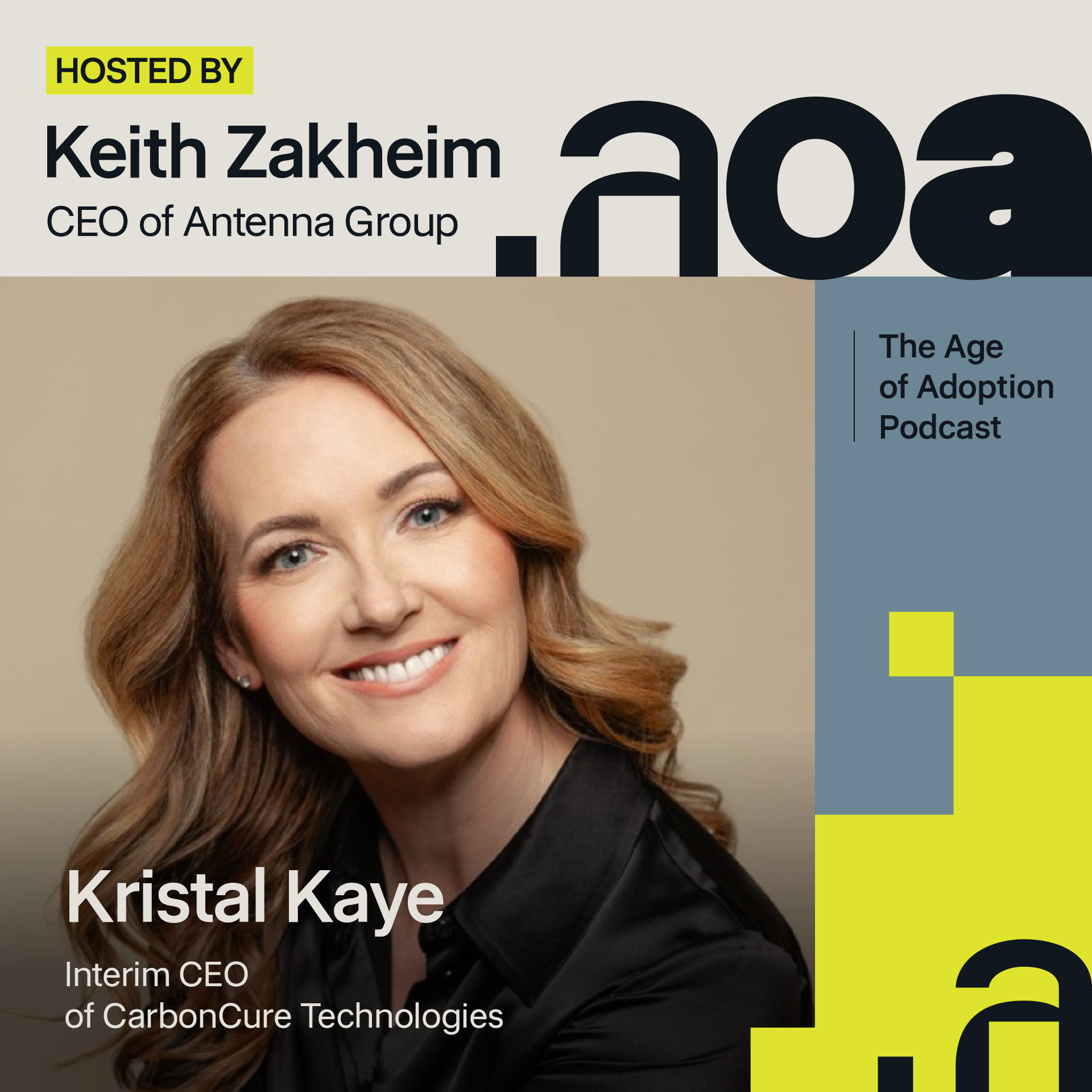
Kristal Kaye, interim CEO of CarbonCure Technologies, discusses her transition from traditional energy finance to leading a company revolutionizing concrete production. With over 30 years in finance across energy, mining, and retail, Kaye now heads a firm that injects captured CO2 directly into concrete, permanently storing it while improving economics for producers. "The concrete industry runs on very lean, tight margin profitability, and we can't ask them to adopt technology that would hinder their livelihood," she explains. CarbonCure has deployed 700+ systems across 35 countries, serving major clients like Amazon while targeting the massive opportunity ahead—over 100,000 concrete plants globally remain untapped. How does economics drive adoption in traditionally conservative industries?
Speaker
[00:00:00] Welcome to the Age of Adoption podcast. I am your host, Keith Zackheim. Today as we do with every podcast, we're gonna ask our guest one question and one question only. What is your age of climate adoption story? A little bit about the age of adoption. We live in an era where enterprises of every shape and size, regardless of industry, must rapidly transform to become more sustainable, climate sensitive, and just. My day job as CEO of the marketing public relations firm antenna group. Our agency works exclusively with conscious brands. What is a conscious brand? It is a brand that is conscious of its responsibility to be on the right side of history. Like most businesses, our clients are experiencing a transition from an age of innovation. An era in which technologists, entrepreneurs and investors focused on innovating climate and sustainable solutions to this age of adoption, which [00:01:00] characterizes the world today. So if you accept the age of adoption hypothesis, then there's really only one salient question to be asked. What is your age of adoption story? Crystal K has spent more than 30 years in finance across traditional energy. Diamond mining and retail Pharmacy industry is not exactly known for their environmental focus, but in 2024, she made a career pivot that would put her at the center of one of climates. Biggest opportunities transforming the concrete industry As a newly appointed interim, CEO of Carbon Cure Technologies, crystal now leads a company that's figured out how to inject captured CO2 directly into concrete, permanently mineralizing it while actually improving the economics. For producers. Economics, as we all know, is always key. The scale of this challenge is staggering. Concrete is the most [00:02:00] consumed material on Earth after water. That's a little nuts, and the cement industry alone produces 8% of global CO2 emissions. What makes Carbon Cures Approach revolutionary is really in its practicality. Their technology retrofits into existing concrete plants with 99% uptime. It requires no change to concrete performance and save producers money while permanently storing CO2. With 700 plus systems now licensed globally across 35 countries, carbon Cure has already saved 600,000 plus metric tons of CO2 and serves 86 Amazon building sites, including their HQ two in Arlington, Virginia. Yet there's so much more to do as this represents less than 1% of global concrete plants highlighting both the massive opportunity. That lies before Carbon Cure and the adoption challenges for the industry ahead Today. On the Age of Adoption podcast, crystal shares how her traditional energy [00:03:00] background prepared her to lead clean tech transformation. Why the conservative concrete industry is finally embracing innovation and how carbon cure could potentially reduce global emissions by three gigatons annually if deployed at scale. Back with Crystal in a bit. Crystal, welcome to the age of adoption.
Speaker 2
Great. Thank you for having me.
Speaker
It's my pleasure. And I think when we scheduled this, you were Chief financial Officer at Carbon Cure and, and today you are interim CEO. So first of all, congratulations on that elevation. And I think number two, it's a good, to me, it's a good omen and people should out there who, who we wanna be guests that if you do accept an invitation to the Age of Adoption podcast, a promotion or certainly an elevation is in the future for you.
Speaker 3
I am sure all of your future guests would like to have that experience. Yes. I wouldn't guarantee it. However,
Speaker
yeah. In fact, you know Kim who's on here, but you can't hear from her. And I love addressing because she can't respond. But Kim, [00:04:00] we gotta make sure that on LinkedIn we, we make a big deal about that, that we're the key to any promotion, unlocking, unlocking people's future success. Anyway, crystal, so. You've recently become the CEO of a carbon mineralization leader that we're, you're injecting CO2 into concrete and ultimately an adoption of a technology that could reduce global emissions by three gigatons annually. And I know three gigatons, some people will. Well, is that a lot or how much? We'll just say that's a lot. And you know, concretes. The world's most consumed material after water, 8% of global CO2 emissions. So there's a lot of work to do here and important work, and you're at the helm of a company that's incredibly innovative in its approach to doing it. And most importantly has got gotten a ton of market traction. So we're gonna get into the whole story, of course, the age of adoption story for carbon cure. But before we get there, crystal, [00:05:00] if you don't mind sharing your professional background, your career journey, which is interesting, pretty circuitous to get where you are. Fascinating. One from a little bit the different industries maybe you started in to where you are today.
Speaker 2
Yeah, thank you. I, I must. Charter professional accountant. That's the one benefit of being an accountant. You can go work in multitude of industries and always find applicability, and my background has mostly been around because I'm from Alberta, has mostly been around energy. And I also did a stint in my last career in diamond mining when I was looking to make a career move, in particular because I have children and because of just everything going on around the world in terms of. Global warming and you see what drastic weather changes. And I started to think about how could I take my expertise and do something that's better for the environment. And so [00:06:00] I ha I got an introduction to Carbon Care. I met the founder, Rob Niven. Spent quite a bit of time with him and really took a look at where Carbon Cure is today and where it potentially could go. The company's only just scratched the surface, which we can get into in more depth later, but I thought what a great opportunity to make a difference. It definitely was a positive around my house, my children, the, when I started at Carbon Care, were so excited that I was doing something great for the environment and for their future. And yeah, I just think it's a great Canadian company that.
Speaker
Fantastic. And before we go any further, being from Alberta, most important question is Oilers or flames?
Speaker 2
Well, I'll say I'm a Flames fan. However, that's not very popular in this province right now, given the local run. But I was cheering for the Oilers. A Canadian team definitely has to bring back the cup. So at
Speaker 3
this point, I [00:07:00] think all of Canada was behind the Oilers for a period of time.
Speaker
Yeah, but you know, you gotta be loyal to your team, so I appreciate the answer. I'm a big New Jersey Devils fan. Not had a lot to cheer about the last few years. Edmonton's great, great team. But let's get back to the topic of the day, I guess. So given your background and the inspiration of course, that you had to kind of make this career transition being your children. And now that they think that you are, I guess doing great things and you're cool. I have four children. They're always wanting to do anything we can for our kids to think we're cool, hard to do, but congratulations on doing that with your kids. So we're gonna get to the question of the day and the question of the podcast and the question that's eponymous for the podcast name, and that is, what is your age of adoption story?
Speaker 2
Concrete is everywhere. It's in your home, your streets, your schools, hospitals. It's in con, whether it was constructed years ago or it's going to [00:08:00] be revamped and re rebuilt. We have a carbon cure and opportunity because we're a carbon utilization company. On a mission to empower cement and concrete producers with technologies to help them meet their net zero objectives. We're developing and deploying a suite of innovative software solutions that permanently capture CO2 and Concrete through carbon mineralization. We have only scratched the surface. There's over a hundred thousand concrete plants around the globe, and today our equipment and technology is deployed in hundreds. So I think there's a tremendous runway and opportunity for us to grow and expand our impact globally.
Speaker
Great. So look, there's no question that advanced materials, advanced building materials, cement being the most prominent one. We need to make sure that we are reinventing. We need to make sure that it's [00:09:00] decarbonized, that, I mean, the amount of building the world's gonna need over the next decade is, is just astronomical. And we can't afford, of course, for more carbon to be, you know, released into the environment. I know that there's a ton of embodied carbon, and we could talk a little more about what embodied carbon is, but before we get there. Interested in, because it's a competitive market in terms of what you're doing. There's competition for customers. By the way, congratulations. I know that you're doing work on Amazon buildings, which is exciting. 86 buildings at the HQ two, but there's a lot of competition for business, a lot of competition for venture capital money or in general capital. What are your differentiators, you know, what do you think ultimately are the advantages that Carbon Cure brings to the market that its competitors don't?
Speaker 2
I think Carbon Cure has proven technology. Because we've been so successful in rolling out to a number of customers around the globe, [00:10:00] and it's a proven verified technology. We go through rigorous audit process in terms of calculating the carbon credits that we generate, which. Is based on stringent calculations for the cement saving cement reductions that our customers see, as well as calculating the carbon credit or carbon dioxide that's being mineralized as part of the process that we're able to prove the, uh, decarbonization impact that we're making, which adds to our credibility in the process.
Speaker
Let's talk about the demand side and the market for carbon cure. These are some of the stats that I've seen, and correct me if I'm wrong, embodied carbon is responsible for almost 50% of a building's lifetime emissions and concrete can represent upwards of 50% of that embodied carbon footprint at the same time. Global building stock is expected to double by 2060, which is another reason why this demand for what you do continues to grow. [00:11:00] So as you mentioned before, you have a proven technology. That technology has been deployed in 700 systems across 35 countries, and you're working with some of the biggest brands in the world. 9 million truckloads of carbon cured concrete have been delivered worldwide. So what do you need to do to get this scale? What does that look like?
Speaker 2
That's a good question. It really, it takes multiple levers for us, first and foremost, to have more engagement and more marketing advertising, getting our brand out there across different. Global countries where we haven't penetrated the market yet. The second component will be to have regulatory support. So in countries where today they don't have any specs or regulations around requiring green concrete use, having those regulations changed to adopt or. Force or incentivize industri industrial [00:12:00] manufacturers to use green concrete will help us. And then the third component is growth of our carbon credit market. So today we sh carbon revenue share. Our customers, the sale proceeds from the carbon credit rate, carbon credits generated from the cement reduction in the CO2 capture process. And so having a successful ability to increase the number of customers who buy the carbon credits, getting people more interested in meeting their net zero targets to the purchase of carving credits, will also help us grow and expand our market on a, a more rapid basis.
Speaker
Yeah, that makes sense. And last question, which I think really gets to the core of Age of Adoption and Carbon Cure's role in facilitating the adoption. Of climate tech and, and more sustainable solutions for the built environment is that, you know, we do a lot of work antenna group. You know, we're a public relations firm and marketing firm. We've done a lot of [00:13:00] work over the years with real estate companies, you know, all real estate classes, and we do a lot of work in property technology. And of course we're best known for our work in climate and sustainability. But what we've always seen is real estate is a laggard when it comes to adoption. The industry is super, super conservative. There's a lot of reasons for that. So any new technology, whether it's around, you know, brokerage, whether it's in how, in in building technologies, whether it's, you know, in terms of the different amenities that real estate companies on the technology side wanna be offering their their tenants. They're always late to the game. And you know, when you talk about the, I guess the suppliers to the real estate industry, we've seen the same as well. So that's a long way of asking you this. How do you convince concrete producers to change a process that is. I don't know, century old more than that. And in general, a risk [00:14:00] adverse industry to begin to adopt this at scale, and I'm sure that's in a lot of the conversations that you and your team must have when you're talking to these stakeholders.
Speaker 2
Yeah, that's a good question. I think that it's important for. Concrete producers, developers to understand that adoption of our technology does not impact the quality or performance specifications of their concrete. It does allow them the potential to have operating cost savings through reduced cement usage in their product, as well as generate revenue from a carbon credit perspective today. The concrete industry runs on a very lean, tight margin profitability scheme, and we can't ask them to adopt technology that would hinder their profitability or their [00:15:00] livelihood. So as much as we want. Decarbonization to happen. We have to be able to provide it in a way that's sustainable for them from a long-term operating perspective, which is what we offer. There's so much opportunity and growth coming. Like you mentioned, that building is expected to develop to double the building footprint in the globe by 2060. We are expecting significant growth in countries that haven't seen that type of growth before. So we could be early. If we can get in quickly, we could be first to market and have success right off of the gate. That would allow for probably a quicker acceleration of adoption in those areas than what we are seeing because they're gonna be new into the construction space. I think that would be a positive, but absolutely it takes. It's gonna take all people involved to want to have a decarbonization impact as part of their [00:16:00] production profile in the future, but also in a sustainable, not at least cost equal, if not profitably, benefiting them to adopt the process.
Speaker
Yep. And that that's the key to adoption and what we found in the age of adoption. It's economics, right? It's unit economics, it's margins. Can companies at this point afford to adopt various climate and sustainability solutions? The good news is. For almost all of them. The answer is yes, there is cost parity or at at time savings, so, mm-hmm. Crystal, thank you so much for joining the Age of Adoption podcast. I wish you much luck in your new role, and we'll be following Carbon Cure as it continues to decarbonize buildings. At scale.
Speaker 2
Thank you very much. I really appreciate it.
Speaker
The Age of Adoption podcast features CEOs, investors, entrepreneurs, and policy makers sharing their climate and sustainability business transformation stories. Episodes can be found on your favorite [00:17:00] podcast apps, including iTunes and Spotify. The Age of Adoption podcast is brought to you by Antenna Group. Antenna is the home of conscious brands. We partner with companies that don't wait. For change to happen, these brands shape the future, are awake and already moving. Unsure if you are a conscious brand or even if you are one. Whether you are positioned as one, please visit our website at www.andtedgroup.com and take the Conscious Compass assessment, a groundbreaking tool that enables enterprises to assess their brand against the eight traits. Of brand consciousness. At Antenna, we partner with companies big and small from Growth stage to Fortune 100 to tell their climate and sustainability stories. So once again, if you're interested in joining the Conscious Brand Movement and learning more about Antenna Group, please check out our website. [00:18:00] www.andpenngroup.com. Ping us on LinkedIn and make sure to visit the conscious compass.