Transforming Real Estate with Mass Timber
Transforming Real Estate with Mass Timber
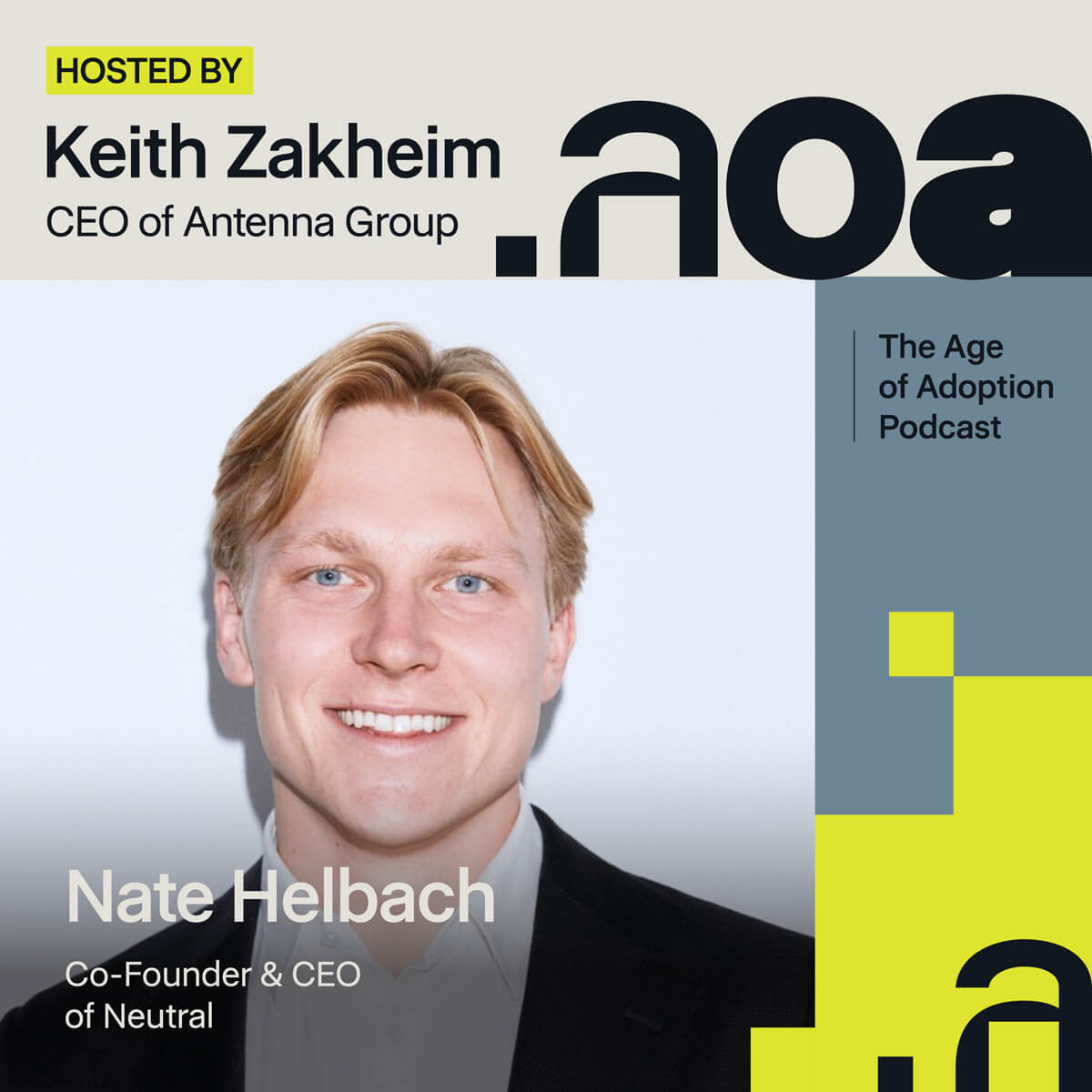
At 26, Nate Helbach has already founded Neutral, one of America's most innovative real estate development companies. Growing up between Wisconsin and California's redwood forests sparked his environmental passion, leading him to pioneer mass timber construction that reduces building emissions by up to 26.5%. Currently breaking ground on the tallest mass timber building in the Northern Hemisphere in downtown Milwaukee, Nate discusses the gap between sustainability solutions and implementation. "The difficulty isn't the solutions—it's getting investors comfortable with the unknown over the status quo." How is this young entrepreneur overcoming real estate's notorious risk aversion?
Keith Zakheim 0:00
Welcome to the Age of Adoption podcast. I am your host, Keith Zackheim. Today as we do with every podcast, we're gonna ask our guest one question and one question only. What is your age of climate adoption story? A little bit about the age of adoption. We live in an era where enterprises of every shape and size, regardless of industry, must rapidly transform to become more sustainable, climate sensitive, and just.
Keith Zakheim 0:30
My day job as CEO of the marketing public relations firm antenna group. Our agency works exclusively with conscious brands. What is a conscious brand? It is a brand that is conscious of its responsibility to be on the right side of history. Like most businesses, our clients are experiencing a transition from an age of innovation.
Keith Zakheim 0:51
An era in which technologists, entrepreneurs and investors focused on innovating climate and sustainable solutions to this age of adoption, which characterizes the world today. So if you accept the age of adoption hypothesis, then there's really only one salient question to be asked. What is your age of adoption story?
Keith Zakheim 1:17
At just 26 years old, Nate Beck has already founded and built one of the most innovative real estate development companies in the country. Growing up between Madison, Wisconsin and northern California's redwood forests, Nate developed what he calls an admiration for nature that would ultimately reshape his career trajectory after studying finance and sustainability.
Keith Zakheim 1:40
He created the framework for what would become neutral, a regenerative design company that's redefining how we build high-rise developments. What makes Nate's approach revolutionary is his commitment to mass timber construction, which can slash building material emissions by 13 to 26.5% compared to traditional concrete and steel.
Keith Zakheim 2:04
Now, Nate's age of adoption story isn't just about innovative materials. It's about overcoming an industry that's notorious for risk aversion and legacy business models. He's discovered that while the solutions to sustainable construction have existed for decades, the real barrier has been implementation, convincing investors and jurisdictions to embrace the unknown over the status quo.
Keith Zakheim 2:30
Today on the Age of Adoption podcast, Nate shares how he's turning trees into carbon sinks. Why passive house design is like wrapping buildings in a North Face jacket, and how a 20 year old's thesis is becoming the blueprint for carbon neutral development back with Nate in almost the amount of time that mass timber can sequester carbon in a high rise building.
Keith Zakheim 2:55
Nate, welcome to the Age of Adoption podcast. Thanks for having me, Keith. Nate, I know you joined us from Madison, Wisconsin. Kim, who was our producer as an Ohio State grad. I'm not sure that she appreciates you being in Badger Country, but, but either way, we're gonna do it. I see Kim rolling her eyes. I think she's muted so she can't respond and articulate her annoyance with my comment, but I just couldn't resist anyway.
Keith Zakheim 3:24
Let's get into things Nate, and, and you are, and I say this with admiration. You have already founded and and built a super interesting company at the rip old age of 26 company. Of course its name is neutral and we're gonna learn more about your company and unpack what really differentiates it, which I find to be fascinating.
Keith Zakheim 3:49
I'm not gonna do a spoiler here, so I'll let you explain to our audience exactly what the differentiator is in in your development strategy. But before we get there, you know Nate, obviously you're an entrepreneur, we're talking about high rise, sustainable development. One of the words I'm sure we're gonna talk about, we're gonna throw out is mass timber.
Keith Zakheim 4:09
So with all of that, as a background, I know our listeners would love to understand how you got here. Where you're going and then we can get into the age of adoption question.
Nate Helbach 4:21
Yeah. Thanks for having me on the show, Keith. So, just a background on myself and the company. I grew up most of my life in Madison on the west side, but then part of my life in California, my parents live in northern California in the Redwoods, Redwood Country.
Nate Helbach 4:37
Beautiful there and yeah, it's wonderful. And really from early on I, I kind of knew. I wanted to be an entrepreneur, but I didn't know exactly what type of kind of business I wanted to run. My dad's an entrepreneur. He has several businesses, and so I gotta work in those as a kid and throughout high school.
Nate Helbach 4:55
And I started to really take an interest in real estate because I interned for a real estate company. And then right after I was in high school, I got an offer at that real estate company. I worked there full time. And so while I was working there, I was also going to undergrad and I was kind of just thinking about like, what do I wanna do long term?
Nate Helbach 5:13
Do I wanna stay in real estate? Do I want to go maybe into investment banking or another different sector? And what I found was I got a really deep interest in sustainability and climate change mostly through my studies and really looking at this big problem. Is there an aha moment? I wouldn't say, I wouldn't say there's an aha moment, but I've definitely always been.
Nate Helbach 5:37
More environmentally focused, especially when you go up in Redwood Country and you see these massive redwood trees that are older than all of us that are still standing there, and it's like you definitely get this kind of admiration for nature. You want to take care of it. And so that was really, if I had an aha moment, that would be it.
Nate Helbach 5:57
And so I really looked at like there's a lot of different problems that people can solve, right? A lot of different problems around sustainability and climate change that people can solve. But when you look at what is the biggest contributor to climate change and sustainability and the destruction of our ecosystem, real estate is the biggest, and it's real estate.
Nate Helbach 6:19
And it's not just us operating buildings, but it's also us building new buildings. And that's what I was doing. Like I was working for a developer. We were building multi-family assets. During my tenure there, we had built about 2000 units and I was like, we are. Physically destroying our earth by building all these buildings because it's not that building buildings is bad, even though the current way that we're doing it is very bad.
Nate Helbach 6:45
It's that the way we have designed these buildings and the materials that we're using is not great, and there's ways that we can do it differently that allow us to have a lesser impact and hopefully. And that's the whole thesis behind neutral. I have a neutral impact. And so that led me into starting neutral and really just taking my thesis that I developed in school and trying to actually do it.
Nate Helbach 7:12
And I was like, I'm I, I was 20 at the time. I was like, I don't have kids. I'm not married. This is the time to take risks. Let's try to start a company and change the world. And about six months in the world just kind of slaps you in the face and it's like all these great ideas and wonderful thesises totally kind of fall flat on their face.
Nate Helbach 7:34
And it's been a journey. It's been like a wonderful journey to start to learn how to really go from where we're at, which is the status quo of building multifamily buildings to the thesis and vision of being completely carbon neutral.
Keith Zakheim 7:48
Yeah, and I can imagine growing up around the redwood trees, redwood forest, that would create a certain, I guess, almost worship of nature and certainly a feeling that we need to preserve it.
Keith Zakheim 8:03
So that is inspiring. Made. And, and you know, as we get to the age of adoption question, I do know that you've recently broke ground. If I'm not, if I'm, if I'm correct, on the tallest mass timber building in the us. Is that right? Or what will be, what will be, I guess.
Nate Helbach 8:20
Yeah. And in the northern hemisphere, outside of one project that's taking us up by a little bit in Perth, Australia, it's called, uh, that doesn't
Keith Zakheim 8:29
count.
Keith Zakheim 8:29
I've been to Perth. That's irrelevant. Uh, sorry to my friends in Australia. And we do actually have some people that listen to the podcast in Australia. And I have been to Perth. It's a beautiful city, but you know, Americans think that the world begins and ends in America, so that makes it the world's tallest timber building anyway.
Keith Zakheim 8:44
And, and, and is that, where is that building? Where, where's that being built? Right downtown Milwaukee. Okay, great, great. So yeah, so this is the vision and you are starting to implement that. So Nate, the question that has been known to strike fear in the hearts of even ambitious entrepreneurs like you, what is your age of adoption story?
Nate Helbach 9:07
Yeah. I think that there is, so just kind of continuing on the story of how we started neutral. There's been a lot of great thesises, a lot of great articles, peer reviews on sustainability in general. Right. And I think that the solution is somewhat prevalent of what we need to do. I think the difficulty when it comes to carbon neutrality, to sustainability, to taking care of our ecosystem is implementing all these great ideas.
Nate Helbach 9:37
I think the last. I don't know, 20, 30, even 40 years, there's been hundreds if not thousands of books written about how we can do this differently and that differently. But the implementation has not really been very much existing. And I think the big barrier has been entrepreneurs and companies that are not willing or not able to move forward with some of these ideas.
Nate Helbach 10:02
And
Keith Zakheim 10:02
so our Big eight, is that because of legacy business models? Is that because the economics didn't pencil out for a time? Like what do you attribute that to? Because the problem and challenge has been known for some time already.
Nate Helbach 10:15
I mean, I think like I can speak to what it is in real estate. I don't know what it might be.
Nate Helbach 10:19
Yeah, that's what I mean. Cation or energy. Yeah, in real estate. Yeah. But in real estate, I think that is really simple. It's developers and real estate entrepreneurs and investors that have a model that works, right? They build multifamily buildings in a certain way. And they know if they build it in that way, they'll make a certain return.
Nate Helbach 10:41
And the risk is not that, I mean there's risk, but it's relatively known and they're willing to take it. Once you start to layer on these additional aspects of things like mass timber or things like passive house design or are building, Milwaukee is gonna be the tallest living building challenge, certified building in the world.
Nate Helbach 11:01
Things like that, it starts to increase exponentially the risk, and investors start to get really, really nervous even though there might be complete rationale from a financial standpoint of why we think we should take this risk and why it might lead to higher rental rates, which might lead to higher returns.
Nate Helbach 11:21
They're still apprehensive to do so because they know what works. They know what they've done for the past 30, 40 years and they don't want to stray too far from it. And so there's kind of this implicit, almost bias towards the status quo because the status quo is less risky Than the unknown. And that's, that's what we've been running into as a company for the last six years of trying to really push the boundaries of trying to figure out how we implement some of our strategies that we wanna do and get investors on board with that.
Keith Zakheim 11:54
Yeah. You know, we, we, we do a ton of work in property technology and decarbonize the built environment and all those kinds of, you know, energy efficiency and demand response and all those different kinds of solutions to. Decarbonization of the built environment, and you're absolutely spot on. And it's not just you where there's risk aversion in real estate.
Keith Zakheim 12:12
When you look at industries and who early adopters are of any technology and who the latest adopters are, real estate is always coming in last. So they are, they are the tortoise in the race. And so again, I, I think that what you're experiencing certainly is typical. And then of course the friction in being able to sell that to investors, pitch investors, I guess, is.
Keith Zakheim 12:35
I'm sure it's frustrating at times, but also innovative.
Nate Helbach 12:38
Yeah, and I think it's like there's a lot of great aspects to what we're doing because we're delivering this really differentiated product. I mean, there's really three big things that we're doing that are differentiated. One is mass timber and passive house design.
Nate Helbach 12:53
Which really are the two that focus on reducing carbon emissions because mass timber has this brilliant way of sequestering carbon. 'cause when trees grow in the forest, they take in carbon through photosynthesis. And then when you take that tree down and you put it into a building like ours, you're now creating this beautiful carbon sink.
Nate Helbach 13:13
And so your embodied carbon is decreasing substantially. Passive house design, along with living, building challenge design. Reduces your operational energy exponentially because you're increasing the U value of your window, the R value of your wall. And what is
Keith Zakheim 13:29
passive house design? People may not be familiar with that concept.
Nate Helbach 13:32
Sure, yeah. I mean, it's really easy to explain. It's basically you take a traditional building and you buy a really big jacket, like a really nice North Face or Patagonia jacket. And you put it around the building and you hug the building with that jacket. And essentially what you're doing is you're creating a really tight airtight envelope and then you're also implementing some different strategies for your heating cooling.
Nate Helbach 13:56
So like in in, in Milwaukee, what we're doing for heating is we're actually using a byproduct of the local energy company, which is steam. And then we're also using the river 'cause we're right next to the Milwaukee River and we're using that through a geothermal system for cooling. And so really it's two things.
Nate Helbach 14:13
One is you're putting a really tight jacket, tight envelope on the building. The other is you're increasing the efficiencies of your HVAC systems.
Keith Zakheim 14:22
That's super interesting. Well let, let's double click a little bit on mass Timber. So I'm gonna throw out what I perceive to be the benefits or what I've, I've learned to be the benefits.
Keith Zakheim 14:32
And then I'd love to hear from you actually what the adoption challenges are around that. 'cause again, I think that's interesting. Topic within the age of adoption. So benefits, you mentioned fewer carbon emissions, you know, it absorbs CO2 during use, less weight in construction waste. And my understand is faster construction timelines because of prefabrication.
Keith Zakheim 14:55
So there, there's, there's a number of benefits, of course, you're selling in to investors and, and as a developer, what are some of the adoption challenges? And by the way, if there's other benefits that you wanna throw out there, feel free.
Nate Helbach 15:07
Yeah. Just to clarify, it doesn't actually taking carbon during use the trees, right?
Nate Helbach 15:12
They're taking carbon they already have, right? Yeah. During the lifecycle, and then when you cut 'em down, there's no more carbon, but the carbon is stored. Yeah, so it's storing carbon during use. The other benefits we see is there's definitely an increase in rental rate and rental retention with residents.
Nate Helbach 15:29
Because people love living in these buildings. They love looking up and seeing a beautiful mass timber ceiling. And then, which is kind of attributed to the biophilic design of mass timber. 'cause you're using natural materials. And then the other thing that we're, we're betting on, we haven't yet proven because we haven't sold one of our assets, is that there's actually an increase in sale price.
Nate Helbach 15:49
By having a compression on cap rates because there's more people that are interested in buying these buildings 'cause they are so differentiated from the, just the traditional market. So those are kind of the benefit side. The difficulties or the, you know, early adoption difficulties of mass timber definitely is from the jurisdiction.
Nate Helbach 16:08
So the local building inspector. The local fire marshals, fire chiefs, they all have a say on what type of material you use. And before 2021, you actually could not prescriptively use mass timber anywhere in the United States because in the United States, every single state follows a certain variation of international building code IBC.
Nate Helbach 16:31
And within the IBC, there was no provision for mass timber before 2021. So post 2021, there's now been an addition to the code where you can now build prescriptively with mass timber. But the hard part here, which is hard for adoption, is that not every single state, including Wisconsin, has actually adopted yet 2021 IBC.
Nate Helbach 16:54
So in Wisconsin, we're in 2015. We also have a project in Arkansas. Arkansas is in 2018, IBC. California thinks in 2012 IBC. In fact, they had their own certain provisions within IBC. And so the hard part has been having states start to adopt the new or newest code to actually be able to prescriptively build with this.
Nate Helbach 17:17
So every time we actually go through entitlements and go through our building permit and zoning requirements, you actually have to get a new variance or what we call an alternative means and methods request. Through the local billing, inspection, and fire marshal.
Keith Zakheim 17:34
Are there, and last question, I know we're, we're running up against time.
Keith Zakheim 17:37
What about procurement of mass timber? Are there challenges there? What, what does that whole kind of whole supply chain look like?
Nate Helbach 17:43
Yeah, the supply chain is robust, especially if you're okay with sourcing from Europe. Europe's been doing this since the eighties, and so they have a really robust built out supply chain in the us.
Nate Helbach 17:55
We're starting to have more and more Smart Lamb and Mercer are probably the biggest two. Then there's several others that are also kind of working on startups, but there's a great supply chain so that that side is actually not as bad. It's, I would say the hardest part for the adoption of mass timber is definitely the jurisdiction problems.
Nate Helbach 18:14
Yeah, which we're slowly overcoming and I think as we see more and more mass timber buildings get built, cities can point to other cities and say, Hey, these guys are doing it. How did you get comfortable? It'll get easier and easier for developers, but especially with the building I'm sitting in, we went through entitlements in 2021, and so that was a lot more challenging even to have a building go through entitlements today.
Keith Zakheim 18:37
Yeah. I mean, look, I think in general, right, real estate development, probably the biggest barrier to, you know, adoption to development is red tape, regulations, bureaucracy, those types of things. Anyway, Nate, thank you so much for joining us on the Age of Adoption podcast. We are, I am rooting for you. I love innovation in the built environment, in the real estate space.
Keith Zakheim 19:04
To really get to this problem and solve it at scale. The current toolkit is not sufficient, it's just not. So we're gonna need more innovation, more technology, but different approaches to actually how we go about build and and the building materials. That's such a huge part of the equation. And Nate, thanks again for doing what you do.
Keith Zakheim 19:23
Just real quick, if people, and no, of course you're on LinkedIn and you have a website, is that the best place to kind of follow you, follow neutral, all the different content that you guys are producing?
Nate Helbach 19:33
Yeah. Yeah. If you go to our website Neutral US and you just scroll down on the homepage, you can sign up for our newsletter.
Nate Helbach 19:41
We're pretty good about sending out monthly updates on all of our projects, and then we usually have a, a fun kind of investigative white paper there as well.
Keith Zakheim 19:50
Great. Nate, thank you again for joining us. Good luck in Godspeed. Thanks, Keith.
Nate Helbach 19:56
Thanks for having me.
Keith Zakheim 19:58
The Age of Adoption podcast features CEOs, investors, entrepreneurs, and policy makers sharing their climate and sustainability business transformation stories.
Keith Zakheim 20:07
Episodes can be found on your favorite podcast apps, including. iTunes and Spotify. The Age of Adoption podcast is brought to you by Antenna Group. Antenna is the home of conscious brands. We partner with companies that don't wait for change to happen. These brands shape the future, are awake and already moving.
Keith Zakheim 20:30
Unsure if you are a conscious brand or even if you are one. Whether you are positioned as one, please visit our website at www.andtetagroup.com and take the Conscious Compass Assessment, a groundbreaking tool that enables enterprises to assess their brand against the eight traits of brand consciousness.
Keith Zakheim 20:51
At Antenna, we partner with companies big and small. From Growth Stage to Fortune 100 to tell their climate and sustainability stories. So once again, if you're interested in joining the Conscious Brand Movement and learning more about Antenna Group, please check out our website at www.andpenngroup.com.
Keith Zakheim 21:11
Ping us on LinkedIn and make sure to visit the conscious Compass.