Net Positive
Net Positive
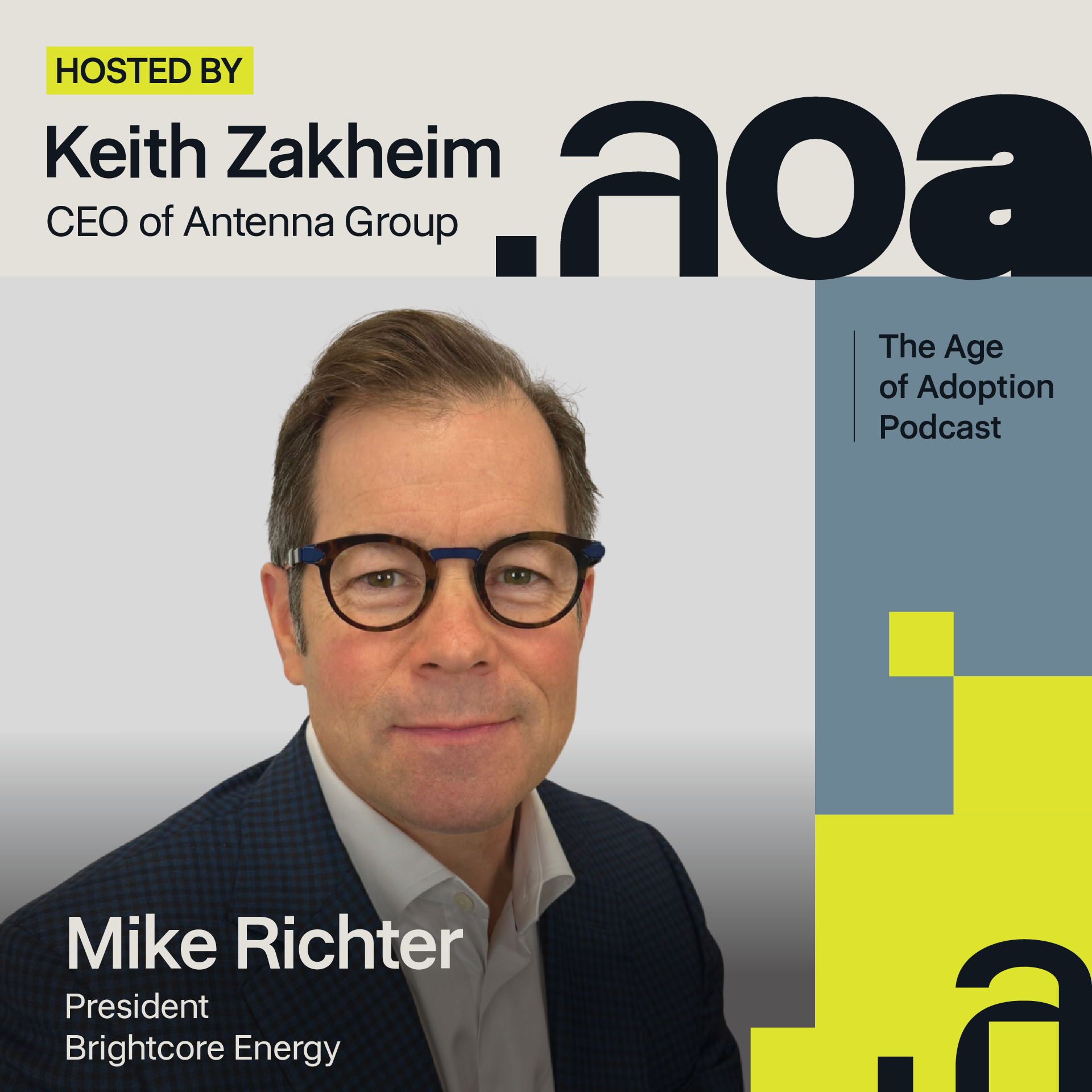
Mike Richter, President of Brightcore Energy and former Stanley Cup–winning NHL goalie, discusses the realities of scaling clean energy solutions in the built environment. Drawing on experience across sports, environmental policy, and clean energy finance, Richter explores why geothermal is gaining momentum, how building decarbonization is evolving, and why the biggest challenge in climate today is no longer innovation, but deployment.
[00:00:02] Keith Zakheim:
Welcome to the Age of Adoption podcast. I am your host, Keith Zakheim. Today, as we do with every podcast, we're going to ask our guest one question and one question only. What is your Age of Climate adoption story? A little bit about the Age of Adoption: We live in an era where enterprises of every shape and size, regardless of industry, must rapidly transform to become more sustainable and climate sensitive. My day job is CEO of the marketing public relations firm Antenna Group. Our agency works exclusively with conscious brands. What is a conscious brand? It is a brand that is conscious of its responsibility to be on the right side of history. Like most businesses, our clients are experiencing a transition from an age of innovation, an era in which technologists, entrepreneurs and investors focused on innovating climate and sustainable solutions, to this age of adoption which characterizes the world today. So, if you accept the Age of Adoption hypothesis, then there's really only one salient question to be asked: What is your Age of Adoption story? I've been fortunate enough to host almost 100 episodes of the Age of Adoption podcast. Each and every one of my guests is renowned for their success in their respective field. The same is true for my guest today, Mike Richter of Brightcore Energy. Mike has achieved success in both his first and second career. What makes Mike unique is that he is the first guest on the Age of Adoption podcast who was the winning goaltender in a Game Seven of a Stanley Cup Final. As a climate and sustainability enthusiast and an ardent hockey fan, I enjoyed this episode as much as any I have hosted. About Mike Richter: Mike spent two decades as one of the NHL’s best goalies. As Mike pointed out, as a goaltender, you learn quickly that your performance depends entirely on your health, and your health depends entirely on your environment. Break your toe a week before the Olympics and your lifelong dream vanishes. Get a cold before the Stanley Cup Finals and you're done. Athletes are obsessive about sleep, hydration and recovery because the connection between environment and performance is immediate and undeniable. This epiphany inspired Mike’s second career. After retiring from the New York Rangers and continuing his studies at Yale, Mike joined the Riverkeeper board to help fight pollution in the Hudson River, the waterway that serves as his backyard on Manhattan’s Upper West Side. Dipping his toe in the environmental industry waters—no pun intended—led Mike to the next stop on his career journey: Brightcore Energy. When Mike joined Brightcore Energy in 2016, geothermal heating and cooling was conceptually interesting, but prohibitively expensive and nearly impossible to retrofit into existing buildings. Brightcore set out to solve that problem, and solve it they have. Today on the Age of Adoption podcast, Mike explains how geothermal borefield systems can fit inside a Manhattan freight elevator, why a 125-year-old Upper West Side co-op replaced its oil furnace with geothermal technology that is floodproof and fireproof, and why competitors who ignore efficiency will get their lunch eaten. Back with Mike faster than he would stop an Al Iafrate slap shot.
[00:03:44] Keith Zakheim:
Mike Richter, welcome to the Age of Adoption podcast.
[00:03:47] Mike Richter:
Keith, thanks for having me. Thrilled to be here.
[00:03:50] Keith Zakheim:
Yeah. And, Mike, you're a special guest for a number of reasons. First and foremost is that we have the pleasure of working with you as a client, longtime client now at Antenna Group. So we are obviously, as an agency and myself, big fans of Brightcore Energy, obviously appreciative of everything that you're doing, and really look forward to digging in today into geothermal specifically. I know Brightcore brings a number of different decarbonization solutions to the market, but I think for the purposes of today, let's dive a little bit into geothermal. And, you know, geothermal, for whatever reason, has a political tailwind and seems like a strong political tailwind. We've had over the last year a number of guests that were analyzing political headwinds around certain renewables. So this is also a nice escape from that. So, you know, we'll talk about that. But for the most part, really want to understand Brightcore, the promise of geothermal, what the market looks like, and of course, that'll all be incorporated into the question of the Age of Adoption question. But before we get to all that, Mike, if you don't mind sharing your career journey, which we've had other former athletes before who have gone into renewables. You're not the first, but you're probably the first Stanley Cup-winning goalie we've had who has gone into renewables. So we'd love to get, you know, your full career journey and we can go from there.
[00:05:09] Mike Richter:
Great. Well, I love the work you're doing. So much of what my job is, and basically business development for Brightcore, is education. And I think you guys have been nobody better. You've really been helpful in that regard. And ultimately, that's our biggest headwind. And before I could start talking to somebody else about it, I had to learn a bunch myself. So if you want to start with how I started, I think the interest has always been there somehow in my life. I loved playing ice hockey. I did as a kid. I participated in all kinds of sports. I was a serious student and athlete. And I think as I aged, you really start to recognize there's an equation that is, it just seems to get more powerful, this idea that we have limited resources and unlimited demand on those resources. And so that brings up moral, ethical questions. Who gets to have the clean water, the fresh air? That brings up economic questions. How do you disperse this across eight billion people now? Maybe if there's half that number, it wouldn't be such an important question to consider, but we are using these resources at an increasingly rapid rate. And so when I played, I took a lot of time on my own. I was a goaltender. You go on the road trips, you're in a hotel room by yourself, by design. You know, if I'm playing and you're the other goalie, you're not playing. So they usually give you a little bit of time off, and myself a chance to focus and vice versa. So I ended up reading a lot about this and, say, the coming resource wars and things about everything from water to energy. And energy fascinated me. And that nexus, that intersection between energy in particular but limited resources and that demand really starts to intersect on the financing. And so that, to me, became something I wanted to study when I went back to school post-career, which I did undergrad, and I was able to take a couple really interesting classes at the School of Forestry at Yale. That started me on that journey. And so I think from that point on, I've been absolutely fascinated and committed by changing that equation to the better.
[00:07:39] Keith Zakheim:
Yeah. And you know, Mike, you mentioned kind of the supply-demand dynamic, of course, of energy, the increasing, you know, there is supply, but certainly the demand curve right now is exponentially growing. And what I've also always found fascinating about energy policy in general is impact on national security. Right. So supply, demand, and then impact on national security is profound. And I mean, today you read the newspaper. I mean, it's never been more profound. Right. I mean, the Strait of Hormuz and what prices happening to prices and bottlenecks and supply chains and everything else. So I couldn't agree more that I've always loved energy because there's economics, there's environment, there's national security. I mean, it's at the convergence of so many interesting areas of policy. So, yeah, I mean, that's fascinating. So you went to Yale and, you know, went through kind of, that's kind of how you got your academic grounding in all this, and then to Brightcore, kind of. How did that, how did that all happen?
[00:08:39] Mike Richter:
Well, I think what I did recognize is, and it's sobering because I was going to summer class for a good portion of my professional career, which is funny. I left as a sophomore to play in the Olympics in 1988 out of the University of Wisconsin. And so, okay, well, you're a sophomore, and I can take a couple classes this summer, maybe two, maybe three if you're lucky. But then next year you're a sophomore, and the following year you are, in fact, a sophomore. And so about five years of being a sophomore, I'm going, boy, I'm not really sneaking up on this degree very quickly. But you have a responsibility to the career at hand. And I love playing, and I was dedicated to improving in the summer. And if you have an injury or anything else, that's your job. You're paid to heal, get better and prepare. And so I really, at some point later in my career, when I had started a family, realized there's a pecking order. Your family and your career come first, and I'll do my second career secondarily. So I knew then, look, I'm close enough. I'll finish those last two years when I completely eliminate my playing time. But I also recognize you're in this very, very specific and artificial bubble as a professional athlete. Purposely, you put yourself in it, you stay in it. You don't let the outside world penetrate. You're heading into the Olympics or the Stanley Cup Finals. You're not thinking about the Strait of Hormuz. You're not thinking about anything. You're not thinking about energy. You're thinking about your own sleep, hydration, preparation and execution. That is it. And I love that challenge to do that. It's on a personal level, very compelling. And if I could have played my whole life, I would have. But you can't. And at some point when that changes, you better make up the ground that you've been missing for the last two decades. And so now I'm saying it's time to get experience in the real world. And you're one of 700 players in the world that can play at that level at the National Hockey League. Well, you're just a guy who's 36, 37 or 38 coming out of undergrad. You have some ground to make up. And so I joined a lot of NGOs. I lived on the Upper West Side of Manhattan, and I'd always watched the, you know, coming home from a road trip, it could be two in the morning, you arrive in there and you have these ice flows going down and actually an estuary, so there's a couple different currents. Fascinated by it. And then reading about the pollution, I joined Riverkeeper because I thought, you know, there's something in my backyard. I felt kind of the, it's not someone's dumping ground. It's also fishing grounds and recreation and water source, drinking water source, commerce. So, you know, when you start to think about the taking of the commons and these philosophical ideas, it's just interesting to get into the debate. And I remember joining that board and the president of it said, well, you're an unlikely environmentalist. Why? I don't know many athletes that have that connection. I'm thinking to myself, what does an environmentalist look like? I guess we all have a stereotypical idea of it. But I'm thinking, you know, if I live in that area and that's part of my environment, my resource, I don't want it to be polluted. That's not a political statement. That's not an odd thing for an athlete to say. Think about it. You know, athletes have a great standing. Our health is absolutely connected to the environment in which we live. If you're in an asthma alley, you're going to have trouble breathing. And all of our performance as an athlete is totally based upon your health. So your health is predicated upon that environment and your performance is predicated upon that health. I played for a long, long time, and I don't know too many athletes that would go into the Olympics not sleeping, not eating properly, not getting their rest and their rehab. You're really anal about those things. So that connection to your health is front and center every day of your life as an athlete. You break your toe a week before the Olympics, your lifelong dream may be gone. Or you get a cold. So I think you have great standing to talk about that. You know, I always use the phrase Phil Knight once said when he was selling sneakers, you know, if you breathe, you're an athlete. Because he's saying, look, we're all athletes. We can sell sneakers. Not just to Michael Jordan. But I was saying, if you breathe, you're an environmentalist. Like who doesn't have a stake in clean air, clean water? That's not a political statement. It's asinine to start to marginalize this. We rely on this for our health, for our economy, for national security. As you pointed out, everything. So I think we're all ultimately, we may debate on how we go about it, but we all care about this and we need to.
[00:13:18] Keith Zakheim:
Yeah, yeah. As a proud parent, actually, you did mention a broken toe. I can't wait to tell my middle son who plays college basketball and in the first round NCAA Tournament, he broke his toe in the first half and still played through it and hit the winning foul shot. So an apt, apt metaphor that I will be sharing with him about the good old broken toe.
[00:13:38] Mike Richter:
I do have to ask, which toe was it?
[00:13:41] Keith Zakheim:
His big toe.
[00:13:43] Mike Richter:
Okay. He's got my respect because the big toe does the work of the next four.
[00:13:47] Keith Zakheim:
And man, he's got an incredibly high threshold for pain, kind of like my wife. I get a cold, I'm in bed for a week. You know, my wife and my son are very different. But anyway, that's not why we're on. So we're going to get to the question that I ask all my guests. It typically strikes fear in their heart. I don't know what you're more stressed. You know, you obviously were the goaltender in games, Game Seven of the Stanley Cup Finals. I'm sure there was some anxiety and stress in that. I hope this question I asked you doesn't give you more. But Mike, what is your Age of Adoption story?
[00:14:24] Mike Richter:
I love that question. The reality sounds like a made-up answer to that question. What is Brightcore? We try to make commercial industrial buildings operate more efficiently and that does two things. It eliminates waste one way or another, which means there's physical waste. Could be CO2, it could be particulate matter. If you're more efficient with your boiler or anything else, whether doesn't matter whether it's fossil fuel based or not, you're using less of it and creating less waste. That's something that we can all get behind. But of course, there's the financial waste that you're hoping to eliminate too. And that's ultimately what we're selling: financial savings. If I'm using less of a resource, I'm purchasing less of a resource, I have more money in my bank account and that's what we sell. So ultimately, if I can knock on your door and say you're getting 20 miles to the gallon, I've got this carburetor that can give you 80 miles to the gallon and it's at a price point that's reasonable and it's proven, man, there's a conversation to have. And that's ultimately what we're doing to buildings. So how do we start with this concept? We started with lighting. Lighting's fundamental to every building, basically, I guess, except the dark factories that we're now creating. But there's been such a step change in terms of their performance. LEDs used to be a little bit ugly, but now you can tune them in, they're quite great. And their longevity can be 10 times that of a conventional. And they use 40 to 60% less energy. Great, great equation. We structured it so that we could do energy as a service. We'll purchase those lights ourselves, we'll put them in, you'll pay them off with the savings realized. There's lots of creative ways of doing it, but this is a commodity and there's a lot of good people doing it. Solar. I had a background in working with solar before I came to Brightcore. And my two partners who founded this company were structured finance guys. They did a lot of financing for PPAs, so we had that in common. Of course, then we were going to gravitate towards solar, putting in where appropriate. And the right state incentives makes it really sing. But that's commodity too. There's lots of good people doing it. And if I change every light bulb in this country, I'm going to save 10 to 20%. Really probably 10 to 15% of a building's load. The elephant in the room had always been heating and cooling. How do you heat and cool a building no matter where you are, right? So if you're in Maine and it's 12 below zero Fahrenheit, you have a pretty good load that you had better understand how to handle effectively. If you're in South Carolina in the middle of the summer and it's humid and hot, yeah, those air conditioners are screaming. Can we find a way to be more efficient here? And we did our own research, we talked to a lot of people, and geothermal kept coming up. And it was clearly, in terms of engineering, the most efficient way of heating and cooling a building. There were two major hurdles. One, outrageously expensive relative to what it would be replacing. Two, the applicability was really a challenge. I mean, I don't think the retrofit market was even a thought. How many people do you know took an oil furnace out of their building and put in geothermal in an existing building? It just was too difficult to do. And so we were moving forward with this. We hired a really bright engineer that troubleshooted a lot of these from PW Grosser and his days of seeing what didn't work informed what we need to do both in terms of our business model and also our technology. And so he had a relationship with a lot of PhD-level designers in Scandinavia. And so we opened up an office, hired two. They're not consultants, they are employees of ours in a small office in Stockholm, Sweden. And that started changing things dramatically because they are probably two decades ahead of us. I really think, Keith, we have the best of both worlds in that we have commercially proven technology. I'm not coming to you as a client saying, hey, I'd like you to be the guinea pig. Nobody wants that. And understandably so. This has been in the marketplace, this being technology that can be applied to the retrofit market in urban settings. Directional drilling, borefield thermal storage, very cutting-edge things for North America, but being deployed for 20 years in Scandinavia. So we know it's commercially proven.
[00:18:49] Keith Zakheim:
We bring it really de-risk. I think it's Iceland and Finland, I think, where it's a huge, huge percentage.
[00:18:55] Mike Richter:
Yeah, we feel comfortable enough to design our own, to build these things and actually give a 10-year performance guarantee. And I'm getting ahead of myself. But the adoption started becoming. We were capable of changing people's mind when we said, look, we will own and operate these things if you wish. We're agnostic to that. We'll bring our own financing, we'll bring third-party financing, we'll take your financing, but we will give you a performance guarantee if you allow us to design and execute these things. And that changed the equation dramatically because people are saying, all right, look, these guys are putting their money where their mouth is. What's the worst thing that can happen? They owe me BTUs and they're going to figure that out or else I'm suing them. So we took a lot of risk out of the conversation by that 10-year performance guarantee. And we're able to do that because we now control every aspect of it. In the past, it was a very disaggregated sale. I would knock on Keith's door and say, gee, we want to do geothermal. And they say, okay, how do you do that? I would get into a mechanical engineering firm and they would hire out, somebody would design it and then they'd hand it off to somebody who was going to drill it and then somebody else again might finance it. And most importantly, the owner's left holding this bag going, how do I even operate this thing? And anywhere along that value chain, things were falling through the cracks. And so we said, look, this is insane. We'll design it. And we found that some of the sophistication of our design was overshooting the capabilities of the drillers here in North America. So we bought our own drilling company, a woman with 30 years experience. She's fabulous. We're able to integrate that with a lot of the learnings that took place in the last two decades in Europe. And now we take care of the entire thing turnkey. And we'll work anywhere within there. We do drill other people's design, but we won't stand behind it unless we design it. Anyway, the idea was to de-risk it and that will get adoption. And the single best thing that I can do to convince you that this works is to go out and get deals done in a similar building as yours. So if you're a college and I can say, look, Yale, Harvard has this done. Take a look. Kick the tires, understand what they're going through. Don't talk to us. Go look at this and talk to the facilities guy. And now the adoption is getting there. I really believe that we're at a sea change right now because people aren't saying conceptually that sounds nice, but come back to me when it's real. This is commercially viable and it's going in the ground all over the place right now. So it's necessary.
[00:21:30] Keith Zakheim:
I think adoption also, we look at adoption and kind of the sea change in it. It's also the conversations you have, right? And the audience and where they are. So 10 years ago, it was a conversation that to many seemed like sci-fi. Today it's real. That in itself is ultimately a progression in the Age of Adoption. Then of course, the actual units and projects and all of that going in, of course, is the ultimate measure. One quick question, and you kept alluding to this. In any sale, economics ultimately is the driver, right? Everything's a pocketbook issue. All technologies ultimately need to achieve those economies of scale, right? So as you get more scale, cost goes down. Where are we in that with geothermal?
[00:22:22] Mike Richter:
I mean, great question. I guess it's a bit of a scary answer, but a hopeful one. The market penetration in the United States or North America is somewhere a little less than 1%. Maybe by the time this thing airs, it'll be 1%. There's a lot of deals that are coming to fruition right now, but if you contrast that to, say, Scandinavia, which is why we're there, it's closer to 25%. And so I was just at an event last evening and someone said, well, you can't do it in these urban settings. And we've done a really beautiful project that was supported by NYSERDA right in the heart of Manhattan, the Upper West Side. And, you know, we were able to take a small, very specific customized drilling unit and stick it inside the freight elevator, go downstairs into what once was the coal room, historically 125-year-old co-op on the Upper West Side. It eventually evolved into an oil furnace room, and now it is the geothermal room. We went through the subfloor into the Manhattan schist and the thing's saving somewhere around 40% on their common area energy costs. It's beautiful, it's quiet, it's clean. And these things are robust. They're really resilient, fireproof. We're talking about, you know, the radiator that we put beneath your feet in the subsurface. They're floodproof, and they have a guaranteed life expectancy of 75 to 100 years. If I can hit a price point and stand behind this work again, there's a conversation to have. You're using 40 to 60% less energy than you once used to heat and cool that same building. It's actually quieter, it's more robust, it's dollars in your pocket. And so even if you didn't care about hugging a tree, you should be listening to this conversation because if I'm a competitor of yours, for example, and my energy costs are 40 to 50% lower than yours, I'm eating your lunch. So just in a competitive world, it begs you to be more efficient.
[00:24:28] Keith Zakheim:
Yeah, yeah. And that's, I think, a great bow on the episode. And what we're seeing every day and what polling shows is part of this Age of Adoption is this is not just about virtue anymore. This is about economics, this is about efficiency, this is about resiliency, this is about national security. And Brightcore is certainly doing its part in driving all of those objectives and wins in the industry. And Mike, really appreciate the time, really appreciate the insights and look forward to seeing you again soon.
[00:25:01] Mike Richter:
Keith, I really appreciate what you guys do and getting the word out is the single most important thing we can do. We have the technology, we gotta change people's understanding of what's possible.
[00:25:11] Keith Zakheim:
Great. Thanks, Mike.
[00:25:13] Mike Richter:
Great stuff. Thanks.
[00:25:15] Keith Zakheim:
The Age of Adoption podcast features CEOs, investors, entrepreneurs and policymakers sharing their climate and sustainability business transformation stories. Episodes can be found on your favorite podcast apps including iTunes and Spotify. The Age of Adoption podcast is brought to you by Antenna Group. Antenna is the home of conscious brands. We partner with companies that don't wait for change to happen. These brands shape the future, are awake and already moving. Unsure if you are a conscious brand or even if you are one, whether you are positioned as one, please visit our website at www.antennagroup.com and take the Conscious Compass Assessment, a groundbreaking tool that enables enterprises to assess their brand against the eight traits of brand consciousness. At Antenna, we partner with companies big and small, from growth stage to Fortune 100, to tell their climate and sustainability stories. So once again, if you're interested in joining the conscious brand movement and learning more about Antenna Group, please check out our website at www.antennagroup.com, ping us on LinkedIn and make sure to visit the Conscious Compass.