The Backbone of Electrification
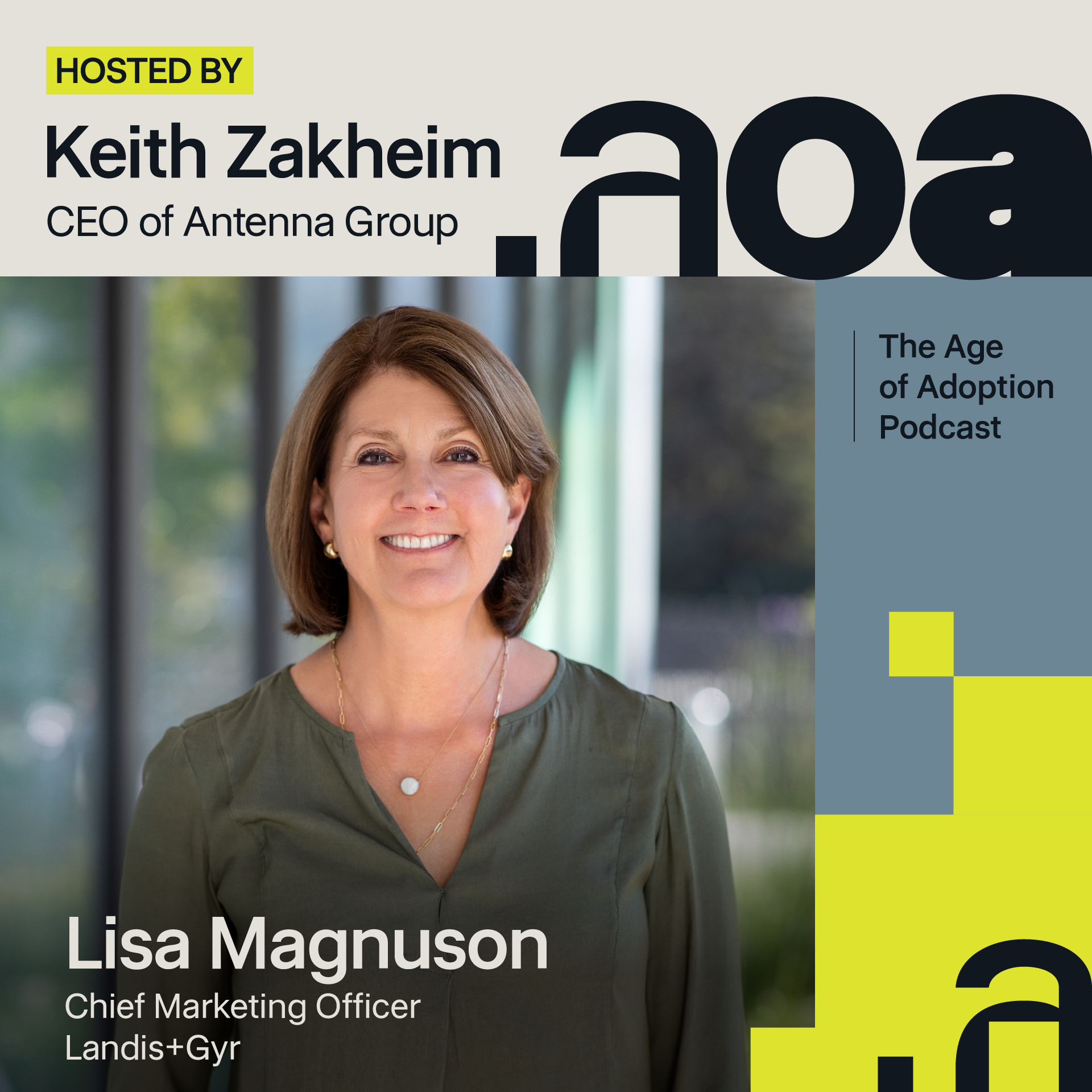
The Backbone of Electrification
Lisa Magnuson has spent her career at the intersection of technology, utilities, and clean energy, helping organizations translate complex infrastructure into real-world adoption. In this conversation, she explores how grid intelligence, real-time data, and customer engagement are becoming essential to managing rising electricity demand, extreme weather, and electrification. Lisa shares why the future of the energy transition depends not only on generating clean power, but on building a smarter, more responsive grid.
[0:02] Keith Zakheim
Welcome to the Age of Adoption podcast. I am your host, Keith Zakheim. Today, as we do with every podcast, we're going to ask our guest one question and one question only. What is your Age of Adoption story?
A little bit about the Age of Adoption: We live in an era where enterprises of every shape and size, regardless of industry, must rapidly transform to become more sustainable and climate sensitive. My day job is CEO of the marketing public relations firm Antenna Group. Our agency works exclusively with conscious brands.
What is a conscious brand? It is a brand that is conscious of its responsibility to be on the right side of history. Like most businesses, our clients are experiencing a transition from an age of innovation, an era in which technologists, entrepreneurs and investors focused on innovating climate and sustainable solutions, to this age of adoption which characterizes the world today.
So, if you accept the Age of Adoption hypothesis, then there's really only one salient question to be asked: What is your Age of Adoption story?
Lisa Magnuson started her career at Apple and next in the early days of high tech. Then around 2004, over a cup of coffee with a friend, she was told about a really cool company doing utility networking. Lisa, like probably any of us at that time at least, was skeptical. What could possibly be so interesting about utility networking? Her friend explained something that changed her perspective. Back in the day, utilities didn't know your power was out unless three or more neighbors called to report it. There was no real-time communication between the meter on your house and the utility’s operating center. When one of Lisa's kids asked what she was working on, she realized, ‘I think we're building the energy Internet.’ So Lisa spent her first 15 years of her career at Silver Spring Networks. She was her first marketing hire and then rose to become VP of Marketing and stayed through a successful IPO, all the while helping utilities adopt smart grid networking. She then moved to PG&E, one of Silver Spring's largest customers, where she experienced firsthand the challenges that utilities face: affordability, reliability, and the fundamental shift from treating people as ratepayers to actually calling and treating them as customers who need to understand and engage with their energy choices. I think those challenges still sound familiar today. The energy conversation today focuses almost entirely on generation and demand. But without grid intelligence, metering data infrastructure, real time communication from edge to enterprise, matching supply and demand becomes nearly impossible. Global electricity demand is growing twice as fast as total energy demand driven by the electrification everywhere. Trillions of dollars are forecasted for grid upgrades through 2035, with digital grid technology alone representing up to $1 trillion in investment. Today on the Age of Adoption podcast, Lisa explains how Landis+Gyr’s Revelo meter functions as a grid sensor with compute power at the edge, why the value of intelligent platform increases exponentially once intelligence is embedded – think Uber evolving beyond just connecting people in cars – and why extreme weather has created higher public awareness of utility challenges, making this the right moment for real solutions. Back with Lisa in a bit.
Hey Lisa, welcome to the Age of Adoption podcast.
[4:04] Lisa Magnuson
Thank you Keith. It's my pleasure to be here today.
[4:07] Keith Zakheim
Yeah, and it's always great for me and I enjoy having guests on the podcast who I've known for some time. And as you'll hear about Lisa relatively soon, she's been in the industry in various positions for a long time, as have I, so our paths have crossed many times and she's incredibly well respected by everyone in the industry. So really appreciate you coming on and it's a great way to reconnect and learn more about the latest step in your career journey. And if you don't mind sharing that career journey that's brought you to Landis+Gyr. And in general, I think if I can just frame it as I think your career kind of traces this commercialization layer of the energy transition, which again for the Age of Adoption podcast is so beautifully aligned and moving from big tech into smart grid utilities, clean energy. And I guess again the common theme is you've always helped to translate complex infrastructure into market adoption and that's all of us as communicators try to do that. You've done a great job of it and made that your career. So anyway, if you don't mind reflecting on that career journey and then we'll get into again the question that I know you've been preparing for months how you're going to answer the Age of Adoption question. But don't worry, we still give you a few more minutes to get ready. Anyway, Lisa, thanks.
[5:28] Lisa Magnuson
Fantastic. Thank you so much Keith. It's really a pleasure to be here today. So as you mentioned, I began my career in high tech, had the valuable experience of working both at Apple and Next very early on. And then I remember one day a friend from my kids school said hey, I'm with this really cool company. What did they do? I asked and he said utility networking. And I was like, really? What's so interesting about that? And so this must have been around 2000. No, 2000. Yeah, 2000. 2004. And it was explained to me that the utility didn't know if my power was out unless three or More people in my neighborhood called the utility and said, hey, our power's out. So what the promise of AMI was that there was going to be real time communication between a meter on your house and the utilities operating center. I was lucky enough to work at Silver Spring Networks for about 14, 15 years, from the first marketing professional to VP of marketing and a successful IPO. So during that time, we saw large IOUs and municipalities adopt smart grid networking because it gave them the opportunity and ability to actually have real time communications with a meter, near real time communications with a meter. I then went to one of our largest customers at Silver Spring and that was PG&E. And it was an incredible opportunity to actually see from a utility side the challenges that they have with affordability, with communicating with their customers. No longer ratepayers, but customers in ways that they could understand and engage with from there.
[7:33] Keith Zakheim
And PG&E, I would have imagined that that would have been incredibly formative experience, mainly because PG&E, at least from where I sit, historically, has been early adopters and willing to pilot a lot of solutions that other utilities wouldn't. So that's incredible opportunity as a comms and marketing person, right, to be able to talk about those things.
[7:54] Lisa Magnuson
And it was a little bit after their adoption of Smart Grid, but there were still a lot of communications challenges. And I think the biggest was really just changing the mindset from ratepayer to customer and really communicating in a consistent, easy to understand way. And then I took a tour through other companies that were providing really innovative solutions to utilities and large industrial customers. And that was Wartsilla and Bloom Energy. So I had the opportunity to start working with Landis+Gyr about six months, eight months ago on a rebrand project. And they are in a transformation process as well, going from obviously a global company based in Switzerland, but to more of a focus company with their divestiture of EMEA. So it's been fun to watch, watch the industry grow, change and move. And we're currently, from a utility perspective, really trying to figure out the big challenges that are facing them. Reliability, this extreme load growth, demand, resiliency due to extreme weather, and most importantly, affordability and sustainability.
[9:29] Keith Zakheim
Absolutely. And why I think the conversation that we're having today is so relevant and there's not a lot of it and that I think when people think of energy transition, they overlook the backbone of it. Right. So the discussions and debates typically focus on generation. It focuses on demand. This conversation I know, and how you'll address a lot of this Highlights the critical role of grid intelligence, metering data infrastructure of if you don't have that as the backbone, if you don't have that as the infrastructure, the foundations, then matching demand and generation, no matter how much the need is going to ultimately not work. And demand, as we all know for global electricity, is growing and it's growing twice as fast as just total energy demand. Right. So major structural shifts towards electrification, which we see that in many, many different applications. And I guess what's great for Landis+Gyr is that there's trillions of dollars forecasted for grid upgrades between through 2035. Digital grid tech, I've seen estimates up to $700 billion to $1 trillion. So there's incredible opportunity. It's got to be done well, it's got to be done smart, but real urgency to it. So that to me. So before actually we get to the age of doctrine, age of adoption question, because Landis+Gyr, to some on this, you know, some who listen to the podcast, they may not totally be aware of all that Landis+Gyr does. Maybe if you just give, you know, a minute or two about Landis+Gyr and then we'll get into the age of adoption question.
[11:04] Lisa Magnuson
Absolutely. So Landis+Gyr is a global energy company and we connect devices, data and decisions from the edge to the enterprise. So that's our elevator speech. And what I think is really important about it is that our Revelo meter, I would say, is really a grid sensor, has amazing compute power at the edge. So that utilities now have real time access to what's going on across their grid. And we connect all of those again, devices and data immediately in real time so that utilities have more visibility across their grid and have the opportunity to react and respond in real time.
[11:56] Keith Zakheim
Yeah. Which again, as this grid becomes, become a lot more complex because of all that demand. It's. Yeah, it's, it's a great time to be in the business of doing that. So, Lisa, now is the time for the question, the only question that matters. Lisa, what is your Age of Adoption story?
[12:17] Lisa Magnuson
I think it's both personal and professional. So I've always sat at the intersection of utilities and technology and that it's always been very purpose driven work because the grid and the utilities provide an essential and critical infrastructure that impact every single one of us every single day of our life. So I think from my early beginnings in this early time in this industry, one of my kids asked me, mom, are you building the energy Internet? I was like, yeah, we are.
And so that was all about connectivity. And as I know is a trite analogy, but if you look at where the Internet's gone, platforms have gone like Uber. It won. It first started as let's connect, you know, people and cars. Now the value of that platform has increased exponentially when there's intelligence in it. And that's what Landis+Gyr is providing is this intelligent energy so utilities can see across their grid, make real time decisions, take real time action to really help the grid be more responsive, efficient and sustainable.
[13:47] Keith Zakheim
Yeah, no, I mean, that makes a lot of sense. And as you are giving your perspective on the age of adoption, something popped to mind, which I'd love your perspective on. Again, as somebody who's a marketer communicator and you know, how do you translate something as complex as grid infrastructure into a story that drives adoption? And I ask that also maybe has that changed over the years in terms of how we as communicators translate complex things like the grid? And I mean that also in terms of are people, you know, a little more aware of some of the challenges that we're addressing? So that makes comms easier or potentially does political headwinds and cultural changes make it more difficult and complex? Maybe if you can reflect on that for a bit.
[14:40] Lisa Magnuson
Sure. I think it's all of the above. I think that the most important thing as a communicator in the energy world is to make it relatable to whomever you're speaking with. So if you're speaking to a consumer, what do they care about? They care about, well, do my lights go on? Are my rates going up? Can I plug in my new EV? From a utility perspective, you have to address their challenges of affordability, scalability, interoperability, reliability, resiliency, sustainability. And so I think it's having a consistent message that you tailor to your audience.
[15:24] Keith Zakheim
Yeah, yeah, for sure. And you know, utilities are quite the audience. You know, in terms of, I think how utilities, first of all, the complexity of their operations and the business of utilities. Right. So having to kind of in some ways be private sector, in some ways be public sector, having to answer to multiple stakeholders makes it difficult. I think right now, utilities, of course, being under fire for some things that are really out of their control. But ultimately, you know, the, regardless of data center demand and what that does to, you know, to, you know, regardless of data set of demand and the lack of control utilities have over that demand. At the end of the day, when a consumer, not a ratepayer, But a consumer receives their utility bill, they are making the angry call when, you know, when it's up 30% to the utility. So it's complex for utilities and I totally get it. And that makes sense in terms of what you're saying as a communicator, understanding that nuance and being able to speak to them, speak to their challenges and hopefully address them. Give you the last word before we, before we close the episode. And again, as somebody who's been part of the energy transition, you know, and being part of it from a marketing comms perspective, like I am, or what have you, but you've seen a lot and you've had an interesting purview. What excites you most about where the energy transition is headed and what still worries you a bit?
[16:50] Lisa Magnuson
What excites me most about this age of adoption is that people are, I think there is a higher awareness of the utility challenges based on the extreme weather that we've been having, and it affects everyone everywhere. So I think there's a recognition that energy technology companies like Landis+Gyr can provide real solutions today that help not only help customers, but help utilities have visibility as to what's going on. That can really provide the intelligence to make customers more aware of their energy use, make cleaner, more sustainable choices. And I think that's the same on the other side. When you put intelligence into the grid, it now can respond and help utilities think through the impacts that are happening all over the grid.
[17:54] Keith Zakheim
Okay, well, Lisa, appreciate it. That's, I think, a good way to close the episode. And again, it's great to connect. Congratulations on what's been a great career and your latest position right now and all that you do for the industry. So we appreciate it and look forward to seeing you in person in the near future.
[18:11] Lisa Magnuson
Yes, thank you. And you too.
[18:14] Keith Zakheim
The Age of Adoption podcast features CEOs, investors, entrepreneurs and policymakers sharing their climate and sustainability business transformation stories. Episodes can be found on your favorite podcast apps including iTunes and Spotify. The Age of Adoption podcast is brought to you by Antenna Group. Antenna is the home of conscious brands.
We partner with companies that don't wait for change to happen. These brands shape the future, are awake and already moving. Unsure if you are a conscious brand or even if you are one, whether you are positioned as one, please visit our website at www.antennagroup.com and take the Conscious Compass Assessment, a groundbreaking tool that enables enterprises to assess their brand against the eight traits of brand consciousness.
At Antenna, we partner with companies big and small, from growth stage to Fortune 100, to tell their climate and sustainability stories. So once again, if you're interested in joining the conscious brand movement and learning more about Antenna Group, please check out our website at www.antennagroup.com, ping us on LinkedIn and make sure to visit the Conscious Compass.