The New Case for Nuclear
The New Case for Nuclear
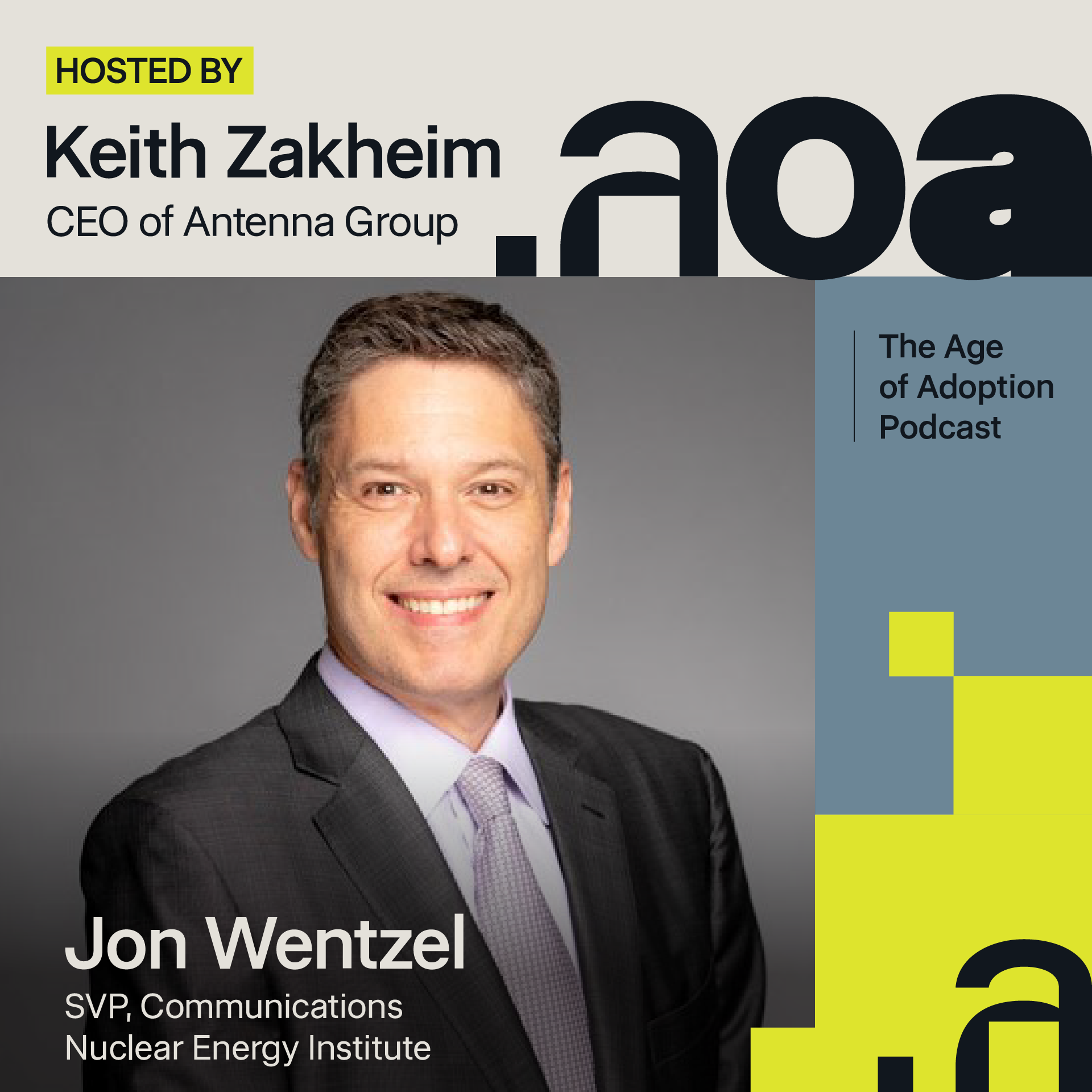
Nuclear energy is becoming central to the future of economic growth, AI, manufacturing, and energy security. In this conversation, Jon Wentzel, Senior Vice President of Communications at the Nuclear Energy Institute, explains how the industry's messaging has evolved from defending nuclear power to demonstrating its value as critical infrastructure. He explores the forces driving today's nuclear resurgence, why communities are increasingly embracing new projects, and how reliability, affordability, workforce transition, and geopolitical resilience have reshaped the case for nuclear. The discussion also examines what communicators can learn from the industry's transformation and why storytelling has become as important as technology in accelerating adoption.
[00:00:02] Keith Zakheim:
Welcome to the Age of Adoption podcast. I am your host, Keith Zakheim. Today, as we do with every podcast, we're going to ask our guest one question and one question only. What is your Age of Climate adoption story?
A little bit about the Age of Adoption: We live in an era where enterprises of every shape and size, regardless of industry, must rapidly transform to become more sustainable and climate sensitive. My day job is CEO of the marketing public relations firm Antenna Group. Our agency works exclusively with conscious brands.
What is a conscious brand? It is a brand that is conscious of its responsibility to be on the right side of history. Like most businesses, our clients are experiencing a transition from an age of innovation, an era in which technologists, entrepreneurs and investors focused on innovating climate and sustainable solutions, to this age of adoption which characterizes the world today.
So, if you accept the Age of Adoption hypothesis, then there's really only one salient question to be asked: What is your Age of Adoption story?
Jon Wentzel spent 25 years at large advertising and PR firms before anyone handed him a reason to care deeply about any single industry. And Ogilvy, he helped brands differentiate themselves on sustainability before the term was even commonplace. He was good at it, but he was also ready for something more.
My guest on today's episode of the Age of Adoption, brought to you by Antenna Group, walked into a job interview at the Nuclear Energy Institute with CEO Maria Korsnick, a woman who had operated a nuclear power plant, became the first female chief nuclear officer in the United States, and understood fission and chemical engineering as fluently as she understood storytelling. Jon walked in knowing nothing about nuclear energy and made sure that Maria knew that. Her response stopped him cold: ‘I have a building full of people and engineers who can build a nuclear reactor. We need someone to help tell our story.’ Whatever she was selling, Jon decided that he wanted in. That was 2017, and at the time, nuclear industry communications were focused on debunking myths, myths about the safety of nuclear energy, as well as addressing fears about waste and environmental footprint. It wasn't working, and public opinion polls reflected that lack of traction. So how do we get to today's nuclear renaissance driven by storytelling? In the interest of not being a spoiler on my own podcast, I will let you hear from Jon himself. Today on the Age of Adoption podcast, Jon explains why four Wyoming communities actually competed to host a next generation nuclear plant, why 70% of coal jobs translate directly into nuclear jobs, and why a ceramic pellet the size of your thumbnail loaded into a reactor every 18 to 24 months makes nuclear, the most geopolitically resilient energy source on the planet. Back with Jon in a bit.
[03:24] Keith Zakheim:
Jon, welcome to the Age of Adoption podcast.
[03:29] Jon Wentzel:
Very nice to be here, Keith. Thanks for the invitation, of course.
[03:33] Keith Zakheim:
Of course. And you know, I'm sitting up in northern New Jersey in sweltering heat. I know that you are the same down in South Carolina using a lot of air conditioning. So maybe, what we need is those coolers that they use in nuclear reactors. We probably need that level of cooling right now to survive this heat wave. But we'll get into all of that. Well, Jon, you know, as the head of communications for the Nuclear Energy Institute, there's probably nobody who's got a better purview of the industry right now and the communication challenges and opportunities than you do. Of course, as someone who is professionally involved in communications for energy in general and some nuclear in specific, I'm really interested in your insights, but just to kind of set up the conversation and really set up also, not just the topic, but I'd also love to hear your career journey as the first part of the podcast. I grew up in Washington, D.C. so we one of those families where both of my parents worked in government. So, our dinner table conversations was the Washington Redskins back when they were the Redskins and then policy. And my mom actually worked at DOE in the late 70s and 80s and she was al always a big proponent. And my mom is not shy, so she was a vocal proponent of nuclear energy. And of course, you know, when you're growing up in the 80s and the Cold War, that was scary because, you know, as a kid, nuclear energy, nuclear bombs, what was the difference? But it always stuck in my mind, her being a proponent. And as I professionally got into the energy space in the industry, that was always a question and critique I had of the climate and sustainability community that they were vocal opponents of the development of nuclear capabilities in this country. So, you know, what's been gratifying to all of us is obviously a public opinion has changed so much over the years, which is great. And then also just by way of background and for our listeners who maybe are intimidated by the topic, last year I read a fantastic book by Tim Gregory. I think it's something called Going Nuclear or something like that. And he has a gift for, first of all, demystifying the topic and really explaining a lot of the science in layman's terms. Which someone like myself really needs. And also, again, demystifying the industry, debunking some of the myths. So, anyway, great book. And some of my perspective, maybe some of the questions I asked later kind of derived from some of the stuff I read there. But anyway, this is not about me. I am speaking way too long. Jon, let me give you the floor. You have an amazing position right now. You come from the comms industry. Would love to know what inspired you to come here, what got you here. That career journey would be really interesting.
[6:12] Jon Wentzel:
I'm honored to follow your mother as an advocate for nuclear energy. I spent most of my career, about 25 years, working in large advertising and public relations companies. And my sustainability journey actually began early, but on the public affairs side. So, I was working with large brands that were trying to answer questions about their environmental impact, right? In the 90s, sustainability was less of the term, and it was a real focus on the environment. And so I found myself doing a lot of work kind of reactively and helping counter misinformation, misperceptions about industries and brands and their impact on the environment. And then about 10 years into my career at Ogilvy, I was chosen to be the PR public relations representative to a new practice called Ogilvy Earth, which was a multidisciplinary advertising PR research group that came together to help brands tell their sustainable story. And it was actually at that point where it was kind of the other side of the coin where I started working with brands, big brands that were trying to differentiate themselves, trying to proactively tell their sustainability story and differentiate themselves in categories where everyone was fighting for that space. So, I went from kind of a reactive, countering misinformation into how do I really craft a story about how a brand is contributing to a sustainable society? Fast forward. I was looking for change. I was looking to get out of the agency space. And this opportunity was given to me at NEI, and I knew nothing about nuclear energy. And throughout the interview process, I kept on making that point. And it was my final interview with our CEO, Maria Korsnick, who said, ‘I literally have a building filled with people who can build a nuclear reactor, but we don't have anyone here who helping tell our story.’ And so in that meeting, this is a woman who operated a nuclear power plant. I think she was the first female plant operator, certainly in the United States, became the first female chief nuclear officer. So, she understood the technology and how it worked, and she understood vision and chemical engineering and. But she's also a wonderful storyteller and advocate. And so pretty much in that interview, I decided whatever she was selling, I wanted to be a part of that. But when I came to NEI back in 2017, we were closing plants, right? A lot of the conversation was around how do we try and keep plants that were operating, generating clean power. How do we keep those open? Over the course of the past, what, nine years now, now we're building nuclear power plants and it's been a really exciting journey to not only see the change in the industry and what the industry is bringing to the market, but also how the storytelling has evolved during that period of time.
[9:26] Keith Zakheim:
Yeah. And building, and also innovating. Next generation plans and SMRs and all that stuff that I'm sure you'll get to when we ask the question of the day. And we're going to get there now, Jon, so be prepared. We're going to ask that big question, the only, the only question that matters. And I just frame it kind of what, what you just, what you just articulated, which is that nuclear organizations, and this is a big thing Judy and I talked about – Judy Rader from Constellation Energy – is that nuclear organizations no longer have to defend the technology, or if they do, that's a super minor part of their remit. It's really now trying to explain how quickly it can scale to meet demand and what it means to right now become part of the strategic energy infrastructure of this country. And that's a huge, huge transition paradigm shift. And with that, I'll ask you, Jon, what is your Age of Adoption story?
[10:28] Jon Wentzel:
Well, you've set it up perfectly. When I joined the industry in 2017, we were an industry that answered questions that we thought if we answered the questions – and people have a lot of legitimate questions about nuclear energy – we thought if we answered those questions, particularly around safety, around nuclear waste, that would then lead to support for nuclear. If people just understood how the technology worked, that would be great and they would, they would then move into, into a belief in the technology. But what we started, what we set out to do in 2017, is really change the way that we talk about nuclear, nuclear power, the promise of nuclear power, to give people reasons to support. It's not just about answering the questions and making people feel more comfortable. It's really changing the way we communicate about the solutions that we can provide. And there were, over the course of the past near decade, there have been three major inflection points. And one, Keith, you alluded to, which is historically we built large gigawatt size reactors that we and the customers for the industry were the utilities. But what started to happen about 10, 15 years ago is a shift in that mindset to look at how we can design reactors that solve a lot of problems and have multiple customers. And that's where you start seeing these smaller designs, small modular reactors, even micro reactors, where the conversation became about in a world that's moving toward electrification, in a world that is, is looking for sustainability not just in electricity, but in agriculture, in manufacturing, what are some of the ways in which nuclear can provide solutions that, that deliver clean, reliable power beyond electricity? And so you started to see some of these smaller designs that are built for different types of customers. So that was the first inflection point was really on the industry side. The technology and the way we were thinking about the technology was changing. The second was in 2018, and that was when the United Nations Intergovernmental Panel on Climate Change issued their special report about the impacts of global warming. And basically, and I'm summarizing, giving us about 12 years to make significant changes in order to help mitigate against some of the worst changes that we would experience due to a changing climate. And that report really shifted the conversation from being a policy wonky conversation into the mainstream. We saw Bill Maher talking about it, the report. We saw this big shift start to take place in the way we were talking about climate change. And then the third, you also alluded to, Keith, which is demand growth. For, for decades, demand for electricity in the United States was basically flat. We were adding new generation, we were retiring some generation. But the demand for load wasn't really changing year over year. And that has been a huge change over the last couple years. And now we're talking an unprecedented growth of, of 5% annually. And that has changed the conversation to where does that power come from and what are the attributes we want that power to have? We want it to be clean, we want it to be reliable, we want it to be affordable, and we need a lot more of it. And that has really changed the conversation around nuclear.
[14:39] Keith Zakheim:
Yeah. And the progress is self-evident. So from what I understand, and I got this information from your website so I'm going to assume it's accurate, but eight reactors under construction right now across North America and 90 additional projects in development or various stages of development. And so that's an accomplishment. Presumably, it also begs the question certainly though 90 in development and these are, even if you're at the small modular, modular reactor type of reactor or utility scale, the larger ones, there's still huge CAPEX investments, huge NIMBY issues, land usage, I mean all these things that tend to slow it down. So, 90 are in development. I think people are aligned right now that this is the direction we need to go. I mean the amount of compute power that's going to be needed to power AI and then therefore the amount of energy to ultimately unlock that compute power is growing exponentially. So, everybody agrees we need this energy abundance. Everybody agrees that nuclear is a huge, huge part of that solution. The question is, I guess is as communicators, we go into a community and propose the development. What does that conversation look like? How do we facilitate good outcomes there? I talked to the Chief Sustainability Officer at Iron Mountain, Chris Pennington, and we were talking about this and ultimately, they are not meeting that challenge. They are much more of a top-down approach where it's a fait accompli. You know this is going to be sited here because we need it and there's no interaction with the community, there's no dialogue, there's no bottom up or meeting kind of in the middle. So I think the nuclear industry has been much better if not really good at it because it's kind of had to from necessity. But you mind reflecting on that a little bit?
[16:43] Jon Wentzel:
Yeah, it's a great question. And unfortunately, there's no simple answer because in every community that conversation is going to look a little different. There's a project right now in Wyoming, in Kemmerer, Wyoming. It's a TerraPower, new design, next-generation nuclear design.
[17:02] Keith Zakheim:
No pride of ownership, but TerraPower is an Antenna client.
[17:05] Jon Wentzel:
It's a fantastic company doing great work. And great communications. You know this was an interesting story because four communities in Wyoming actually competed to host and that is something I didn't know I was ever going to see. And Kemmerer was actually chosen and one of the ways in which that conversation unfolded. And the key is to start having those conversations in the community before the bulldozers show up. And TerraPower has done a great job with that. And one the key elements of that story is there's a retiring coal plant in that community. And so it's a small community. A lot of the jobs are associated with that coal plant, a lot of the indirect jobs, the cafes that are related to that coal plant. And so that community was facing a struggle. You know, running a turbine for a coal plant and running a turbine for a nuclear plant is basically the same skill set. And so one of the key elements in communities that are energy communities that are transitioning to cleaner sources of energy, the economics is a great part of that story. There have been reports that say 70% of the coal jobs can translate into nuclear jobs. And so that becomes a very compelling story for that community. I do think, you know, what's the three things that drive public opinion about energy broadly: Clean, reliable, affordable. Now the order of those three things change based on demographics. Currently, affordability, given our current situation, has emerged as the number one concern. But understanding how we can go in and talk about the value that comes to that community, whether it's economic, whether it's clean energy, whether it's reliable energy, in the face of the great data center debate that's taking place across the country, people are afraid. People are afraid that their reliability is going to go away. People are afraid that the cost is going to go up. And so being able to go in and talk about those value aspects from nuclear, is a great way of creating the conversation. It can be a different conversation on Capitol Hill, it can be a different conversation in the state capitol where you might emphasize different attributes. But, but ultimately everyone is wrestling with the same problem, which is demand for electricity is increasing and it's going to continue to increase. And yes, it's data centers, but it's also advanced manufacturing, electrification, those types of things, sweltering temperatures in New Jersey. That demand is increasing and we've got to solve the problem in the best way we can.
[20:03] Keith Zakheim:
Yeah, I know we're pretty much at time, but I did want to kind of bring up one more value proposition that probably is not as appreciated by consumers, but certainly from a policy, national security, government perspective is resiliency. And where that was profoundly felt in Europe was post Fukushima when Germany decided they were going to roll back pretty much all, actually going to bring it to a full halt, all of their nuclear energy. And then all of a sudden the Russia/Ukraine war breaks out and supply becomes a huge stress to the economy in Europe, specifically in Germany. And then you have obviously rates rise and the impact to consumers was profound. So maybe just for two minutes if you can kind of talk about resiliency, where that's coming up when you're speaking to stakeholders.
[20:52] Jon Wentzel:
Yeah, certainly after Russia's invasion of Ukraine, energy security has become a driving topic, particularly in the policy space. And nuclear power plants refuel every 18 to 24 months, so any geopolitical actions that are taking place won't necessarily, won't impact the fuel supply to run a nuclear reactor.
[21:15] Keith Zakheim:
Please explain real quickly for our listeners when you say refuels every 18 to 24 months, what that means.
[21:21] Jon Wentzel:
So, within the core of the reactor are rods, ceramic pellets of uranium. One pellet is about the size of your thumbnail. And it generates an enormous amount of power and every depending on the reactor model, every 18 to 24 months, about a third of those rods, those uranium pellet rods come out and new rods go in. But because our fuel is on site, the geopolitical winds don't affect supply chain like hurricanes, don't disrupt the fuel supply to run the reactor. So, once the fuel is in the reactor, you've got 18 to 24 months without any need to worry about what's happening. And so that when Russia turned off the gas supply to Europe was a huge call for who your energy partner is really does matter.
[22:16] Keith Zakheim:
Yeah. Well, Jon, thank you so much for spending the time with us. I could go on for an hour, if not more. But we do have a brand promise to our listeners that we are going to try to meet their expectations for people's attention span nowadays, which really would be 15 seconds. We decided to make it 15 minutes, but if we go way too over, we'll start to lose our listeners. Anyway, Jon, thank you so much. Happy 4th of July to you and your family. Enjoy the long weekend and look forward to meeting in person one of these days.
[22:45] Jon Wentzel:
Thanks for the opportunity and Happy 4th.
[22:47] Keith Zakheim:
The Age of Adoption podcast features CEOs, investors, entrepreneurs and policymakers sharing their climate and sustainability business transformation stories. Episodes can be found on your favorite podcast apps including iTunes and Spotify. The Age of Adoption podcast is brought to you by Antenna Group. Antenna is the home of conscious brands.
We partner with companies that don't wait for change to happen. These brands shape the future, are awake and already moving. Unsure if you are a conscious brand or even if you are one, whether you are positioned as one, please visit our website at www.antennagroup.com and take the Conscious Compass Assessment, a groundbreaking tool that enables enterprises to assess their brand against the eight traits of brand consciousness.
At Antenna, we partner with companies big and small, from growth stage to Fortune 100, to tell their climate and sustainability stories. So once again, if you're interested in joining the conscious brand movement and learning more about Antenna Group, please check out our website at www.antennagroup.com, ping us on LinkedIn and make sure to visit the Conscious Compass.