The Long Road to Nuclear
The Long Road to Nuclear
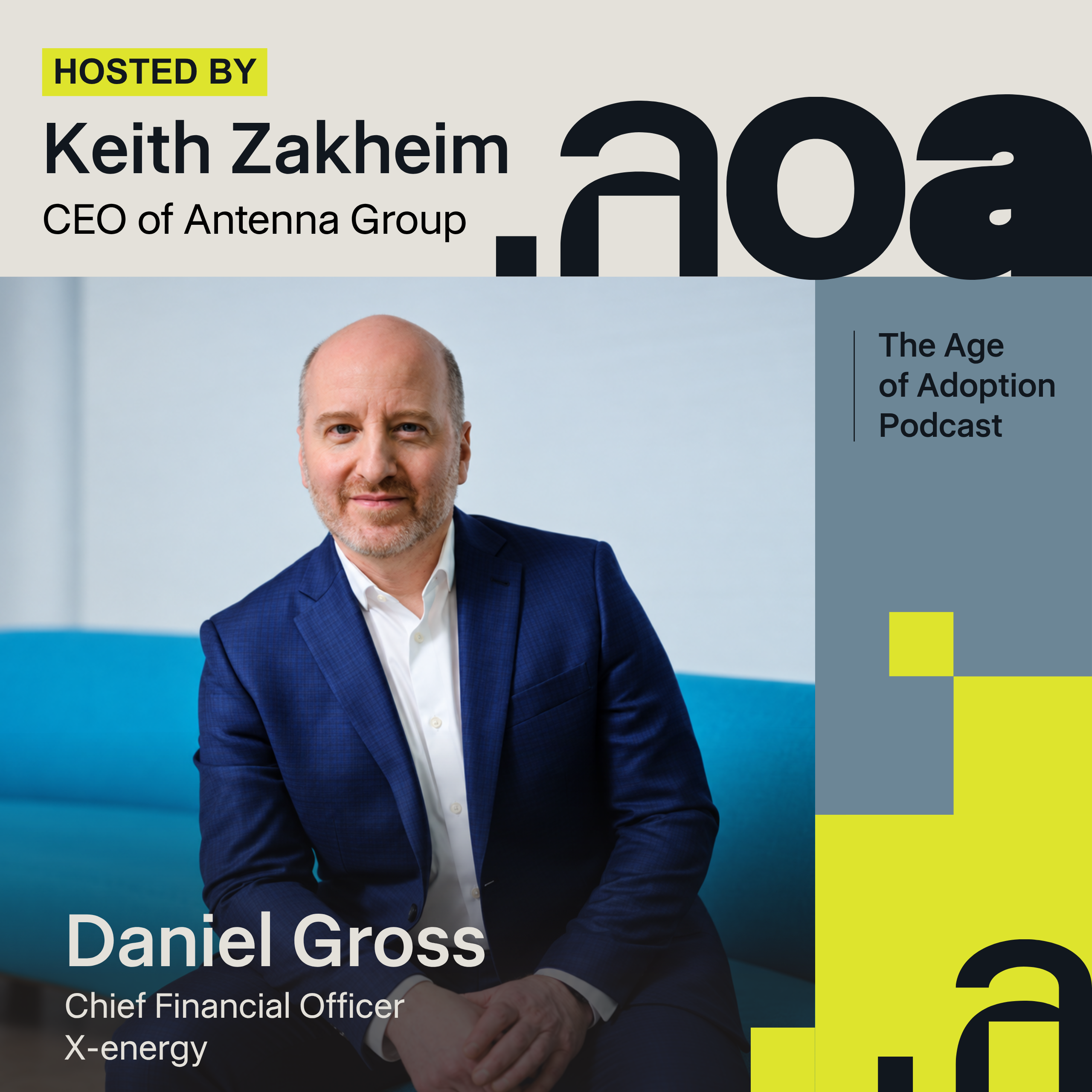
For the 100th episode of Age of Adoption, Keith sits down with longtime clean energy investor and X-energy CFO Daniel Gross to talk about what more than three decades in energy finance have taught him about moving new technologies into the mainstream. Daniel traces his career from the early days of renewable energy investing at GE Capital through Goldman Sachs, private equity and Amazon’s Climate Pledge Fund, where he helped lead Amazon’s investment in advanced nuclear company X-energy. He also shares his own unlikely adoption story: how a longtime nuclear skeptic did the research, changed his mind and ultimately became CFO of a nuclear company. The conversation explores what the rise of wind and solar can teach the next generation of energy technologies, why first-of-a-kind projects are so difficult to finance, and what it will take to make nuclear as routine and financeable as other forms of energy infrastructure.
[00:00:02] Keith Zakheim:
Welcome to the Age of Adoption podcast. I am your host, Keith Zakheim. Today, as we do with every podcast, we're going to ask our guest one question and one question only. What is your Age of Climate adoption story?
A little bit about the Age of Adoption: We live in an era where enterprises of every shape and size, regardless of industry, must rapidly transform to become more sustainable and climate sensitive. My day job is CEO of the marketing public relations firm Antenna Group. Our agency works exclusively with conscious brands.
What is a conscious brand? It is a brand that is conscious of its responsibility to be on the right side of history. Like most businesses, our clients are experiencing a transition from an age of innovation, an era in which technologists, entrepreneurs and investors focused on innovating climate and sustainable solutions, to this age of adoption which characterizes the world today.
So, if you accept the Age of Adoption hypothesis, then there's really only one salient question to be asked: What is your Age of Adoption story?
[00:01:17] Keith Zakheim
100 episodes, six years one question asked a hundred different ways to 100 different guests. Scientists, investors, public officials, sustainability executives, founders, operators, communicators all united by a single conviction that the energy transition is real. It's accelerating, and the most important work isn't debating whether it happens, but figuring out how fast. When I started this podcast, my goals were simple but ambitious, have genuine dialogue with fascinating people, tell compelling stories in an efficient 15 to 20 minutes, and do my small part in advancing the energy transition movement. 100 episodes later, I believe that together we've done that, and I couldn't be more excited about the next hundred episodes. It's no coincidence that Daniel Gross is sitting across from me for this milestone. My guest on today's episode of the Age of Adoption podcast, brought to you by Antenna Group, was one of Antenna Group's very first clients when we began our own climate and sustainability storytelling journey more than 20 years ago. In many ways, Daniel's career and Antenna's business journey evolved similarly, both of us betting early and often against the conventional wisdom that the energy transition was not a niche cause, but the defining economic and infrastructure story of our era. There are few people I'd Rather Share Episode 100 with. Daniel has had a storied career in the energy transition industry, and I will let him share it directly. But what makes this episode so striking is Daniel's admission that he grew up as a nuclear energy skeptic, shaped like so many of our generation by Three Mile Island, Chernobyl and Cold War era nuclear drills that have all of us diving under our school desks what changed his mind wasn't politics or pressure, it was the research and a billiard ball. Today on the Age of Adoption podcast, Daniel explains why all the spent nuclear fuel in American commercial history could fit inside a single Walmart, how a ceramic pebble the size of a billiard ball containing 19,000 poppy seed sized uranium kernels eliminates the very concept of a nuclear meltdown and why his journey from anti-nuclear activist to nuclear CFO may be the most personal Age of Adoption story we've ever told.
Back with Daniel in a bit.
[00:03:47] Keith Zakheim
Daniel, welcome to the Age of Adoption podcast.
[00:03:50] Daniel Gross
Thanks Keith.
[00:03:52] Keith Zakheim
Daniel, it's great to have you on and we are celebrating with this episode, our hundredth episode. We've been doing this now for probably six, seven years. Try to do an episode a month. Hard to believe that we've gotten to this milestone and it's no coincidence that I asked Daniel to join me on today's episode. Daniel and I have known each other now probably close to two decades, which is hard to believe. I guess that puts a number not just on my age, but how long I've been doing this. But we have been doing this a long time. And during those 20 years, as people who have been immersed in the energy transition, we've experienced not just the solar coaster, but in general the ups and the downs of the climate sustainability energy transition industry. And I think what I always find gratifying is if you take out kind of the year-to-year ups and downs, but look at the trajectory over those 20 years. It's been growth and it's been positive transition, positive evolution and incremental gains more than incremental losses. And that's again gratifying. And Daniel, I know that you'll share your perspective on the age of adoption. And again, as somebody who's been in this for that many years, you'll have an interesting perspective. But it's not just the duration of time that you've been involved in the industry. And I'm going to ask you to take us through your career journey. And you know, for many of my guests, they've of course meandered through an industry. They've had different stops along the way. But you've had so many positions that have been instrumental and foundational to the growth of the energy transition. And I'm not doing what my kids will say glazing somebody, which is just trying to flatter them in my kids parlance. It's not about glazing, it's really more about asking you to take us through your career journey. But again, that almost refracting it through the lens or it parallels with, I think, the last 20 years of the energy transition. So I've said a lot and I don't want to take away your thunder. So, Daniel, if you could take us through your career journey and then we'll get to the question that I know has kept you up the last two or three nights thinking about how you're going to respond to the age of adoption question. But we have a few minutes until we get there.
[00:06:04] Daniel Gross
All right, cool. So, Keith, you've been at this for, call it 20 years or so. I was already like 20 years deep when we first met.
[00:06:14] Keith Zakheim
So you started at the age of eight then?
[00:06:16] Daniel Gross
Yeah, pretty much, yeah. So I majored in economics and environmental studies as an undergrad and I graduated in the early 1990s. So, like before it was a thing, before cleantech had a name, this was something that I was passionate about. And I went to grad school. I went to undergrad at Yale, I went to grad school at the Yale School of Management where I got an mba, and the Yale School of the Environment, where I got a master's in environmental management. So, like, same theme. I didn't meander. I like, knew this was an area where I wanted to focus. And I remember when I was in grad school, I was gravitating towards renewable energy. I was just like, there has to be a way that wind and solar can drive sustainability. Like, the notion of investing more in coal fired power plants or natural gas seemed insane to me. Like, I just thought that there had to be a way. I wanted to be a part of it. And at the time, if I wanted to get together with everyone at Yale who was interested in renewable energy, basically I would have lunch with Elliot Mainzer, who today is CEO of the California ISO. But there were two of us. This was really, really early days. So my first job out of grad school is at GE Capital in the energy financial services business, which at the time was one of the largest investors in power plants and other energy infrastructure. Because I had a good mentor. I had a summer job at the World bank and my mentor said, don't come to the World Bank. Go learn to be an energy investor if you want to do wind and solar. So I show up at GE my first day and I'm like, I want to work on wind and solar. And people literally responded like, oh, that is so cute. But we do real energy. And so I spent my first years suffering and toiling in oil and gas and Coal fired power plants in Eastern Europe. And I worried if anyone at Yale knew what I was doing that would revoke my environmental degree. But I learned to speak utility. I learned how fossil fuels work and then evenings and weekends and I spent my own money learning about renewables, going to conferences, whatever. So GE wakes up in early 2000s and realize renewables are going to be a thing. I'm the only person in GE Capital who knows about it and cares. And so I'm given this incredible privilege to go lead the renewable energy business for GE Capital and kind of build it up from scratch, which, you know, like I loved my job, it was amazing. It was everything I ever wanted to do. And then I eventually realized that it was somewhat limiting in that GE's approach was to do project finance. Let's invest in a wind farm, let's invest in a solar installation. Was not set up to invest in manufacturers and technology providers and developers. It didn't take that kind of risk. And so eventually I left GE and went to Goldman Sachs into the Special Situations Group. So I was not an investment banker. I was investing Goldman's money for its own account because Goldman saw an opportunity in investing in these technology platforms and developers. And so I learned to be a private equity investor and a venture capital investor focused on clean tech. And together with a small team of people we built a very successful portfolio. Things like pre IPO investments in First Solar, like Sun Edison, long before it blew up. But when it actually was on the rise and, and after a number of years I left Goldman with a few of my colleagues and raised a clean tech fund over a billion dollars which at the time was huge for a first time fund. And that's, you know, Keith, that's where you and I connected.
I mean you helped with the communications for a lot of the portfolio companies there. And so I continued my career in private equity and ultimately landed at Amazon in 2021 in corporate development, co heading a strategy called the Climate Pledge Fund. And Jeff Bezos had approved initial funding of $2 billion for Amazon to invest in businesses and technologies that could help Amazon to decarbonize. For example, Amazon delivers a lot of packages, drives delivery vehicles and decided that they were going to go all electric, went big with Rivian. And so we made an equity investment in Rivian because in part by being a customer, the portfolio investment becomes more valuable. Really nice kind of self-fulfilling way to improve a portfolio. Investments in electrofuels for alternatives for diesel, in aviation and nuclear power. And so one of the investments that I led was into a company called X-energy, which is an advanced nuclear reactor company based in Maryland. We led a very large investment round several hundred million dollars of Amazon's capital. I served on the board of directors of that company for about a year and a half while still working at Amazon and ultimately left Amazon to become the chief financial officer of X-energy in late 2025 and have been there since.
[00:11:06] Keith Zakheim
And that's where we are today. So X-energy and you, as you said, you serve as their chief financial officer and I'm sure more than that as well. Daniel, we're going to get to that Age of Adoption question, but I want to frame it as follows. When it comes to nuclear energy, it seems like there's been a convergence of two phenomena or in a moment of history where two things are happening which weren't the case, let's say five years ago, one is of course, soaring electricity demand. All right, so it had been flat growth for many years and the growth is super fast, exponential, and at least the expectations that'll continue to grow significantly over the next five to 10 years, driven by data centers, driven by AI, electrification, et cetera. So that's one. And then number two specifically when it comes to nuclear energy is that it's experienced a renaissance. There's a renewed momentum around it. I think number one is more of a mind shift. Right. So public opinion around nuclear, concerns around safety have been somewhat mitigated. And also I think that the science behind it to a certain degree, the nuclear industry did a very good job of demystifying some of that, which again relates to safety. And then of course, the need for all of this new energy sources to do it at scale, to do it in a way that's clean. All of that, of course, is something that points to nuclear as being a solution to bring us to this moment in time, solution for this moment in history. So with all of that said, Daniel, here it goes. Daniel, what is your age of adoption story?
[00:12:48] Daniel Gross
Yeah, so I'm going to give you not the X-energy age of adoption story, but like my personal adoption story and how that has changed to bring me round on nuclear, which is also now a story that's true for the majority of Democrats and Republicans based on polling data in America. And, and you know, one of the things I didn't mention in my career story is Also for about, I don't know, 15 years, I've been a professor. I teach a class on clean energy finance.
[00:13:14] Keith Zakheim
I consider myself a student of yours, with no degree, of course, but a student of yours.
[00:13:18] Daniel Gross
Yes, I appreciate that. And I. One of the things that's fascinating for me in interacting with younger people is how, like, there's no issue, there's no concern about nuclear. It's, of course, it's safe and reliable. And this is something we should be doing which is very, very different from where I began. So I'll give you the arc on the age of adoption.
[00:13:37] Keith Zakheim
So, I mean, to be fair to younger people, right? And you remember this. I mean, in the 1980s, I remember that we'd have fire drills and also we'd have nuclear drills or you'd go under a desk, right. So there's no. I mean, of course our generation was predisposed to having certain conceptions about nuclear that today they do not.
[00:13:55] Daniel Gross
I mean, I was a kid, but I remember Three Mile Island. I certainly remember Chernobyl. Right. It all felt reckless. And so when I was in college and even grad student, I thought, like, it's the ultimate inhuman hubris to create a waste product that's deadly for thousands of years in order to fuel, like, the convenience and affordability of modern society. Like, we should not be doing that. And hence I'm going to spend my time not on. On fossil fuels, but on wind and solar, because that was at least benign and like, it was a joy and a privilege in terms of my age of adoption to be a part of driving those from the periphery into the mainstream. Right? And, like, help move them from being prohibitively expensive to being the low in cost of lowest cost of energy. Right? Amazing ark. But one of the, I don't know, moments of, like, growing up already as a fully formed adult at Amazon is that I really came to realize that as much as I love wind and solar, people are counting on the ability to stream, Netflix or conduct their daily lives when the sun isn't shining and the wind isn't blowing. The cost of balancing intermittent renewables is really high. I'm sure that you've had conversations about the ducktail in California or amounts of curtailment in really sunny areas of America or like in Germany. The impact of the renewable energy policy on ratepayers and industrial competitiveness, like, all of it, has been hugely painful. And as much as I love wind and solar, they're not the answer to everything, right? Like the. We've reached the point where the benefit of renewals of additional renewables isn't that like they have a low marginal cost of adding more wind and solar because we have too much energy in places we don't need it and we're generating energy at times when we don't need it. So we need like transmission and four hours of battery storage won't cut it, but seven hours of that, it's like seven days of battery storage is impossible. It's like we need some kind of reliable, safe carbon free energy that can be baseload and can be load policy.
[00:16:00] Keith Zakheim
And especially by the way, the choice is not a zero sum choice when it's not, it's not wind, renewables or fossil. And that's the beauty of nuclear, right? That, that it can be all of the above and still be clean.
[00:16:11] Daniel Gross
Yeah, that it can have like all of the convenience that you get from fossil in terms of being baseload, not intermittent, even load following to some extent, but it's also carbon free. And so you know, but I was coming in terms of my adoption story from this point of being very anti nuclear and I just did the research and reconsidered my own position. And you know, it turns out that like in terms of deaths per terawatt hour, nuclear is the safest energy form out there. Safer than coal, gas, even wind. Nuclear has been generating about 20% of U.S. load for 40 years. The first, first nuclear power plants were commissioned in the 1950s. And if you were to take that whole radioactive waste problem and look at all of the spent fuel in the history of the US commercial utility nuclear history, you could fit that waste into a volume the size of a Super Walmart. That's the extent of our waste problem. And this is not to diminish the importance of creating a permanent repository and isolating that material from the environment for thousands of years, which is no small task. But surely this is a thing that we can engineer and maintain and limit the potential damage that that could come from it. And it's not like a reason not to pursue. So I did the research at Amazon and I came to the like the conclusion that the historic fleet, like despite Three Mile island in Fukushima, the historic fleet of light water reactors was actually safe. But that if I was going to advocate, you know, from my little perch at the Climate Pledge Fund that Amazon support the deployment of a new technology, I wanted it to be the safest, right. Hands down, what is the safest? And so did research with the most incredible experts in nuclear engineering, the people who I had access to was phenomenal and came to the conclusion that, well, all nuclear technology is safe. The absolute safest in my opinion was a high temperature gas reactor using Triso fuel, which I'll explain in a second. And, and so with that conclusion, that's when I advocated that Amazon should pursue this investment strategy. Also more significantly, become a customer of X-energy, which we did. So let me give you the safety story. So we're on a podcast, so you can't see this, but I'm holding up a pebble that's like solid black and it's about the size of a billiard ball. And this we call a pebble. This is our fuel form for the X-energy reactor. In a conventional light water reactor, think of having like 4 to 5 foot thick walls of reinforced concrete with steel. That's a containment vessel, a containment structure in order to prevent leakage, like radioactive contamination from hitting the environment. Right? The X-energy reactor, although it is contained, its containment is actually this pebble that's the size of a billiard ball. The way it works is that the pebble I'm holding up. So think billiard ball contains about 19,000 tiny little poppy seed sized kernels of uranium. And each one of those kernels is individually coated in pyrolytic carbon, silicon carbide and graphite. It's basically ceramic. And the idea is this, neutrons can pass through ceramic and cause a chain reaction, but the fission products, the radioactive byproducts that you worry about are trapped inside the pebble. Not just trapped inside the billiard ball, but each individually trapped inside that little poppy seed. Alright, so like what's the big concern of conventional nuclear? It's a meltdown, you know, and in a meltdown what happens? It's the fuel rods are melting down, right? They're clad in metal, they're clad in zirconium, it melts, releasing radioactivity. And then you have steam that's used as the coolant. And if there is some kind of rupture within that containment structure, you leak radioactive steam or water, as was the case in Fukushima. What's the difference? Ceramic doesn't melt like it's. You're meant to throw it in a kiln, right? The ceramics that were made by like the Aztec still exists. There's no temperature that's achievable in a reactor at which this can melt down. And so instead of having, you know, relying on this containment building, we're relying on material science, basically. In addition, the X-energy reactor doesn't use steam as a coolant it uses helium. And the way that helium works is helium doesn't pick up radioactivity in this reactor. So in the event that, that there were to be some kind of rupture in containment, you know, a missile is fired directly into the reactor, an airplane crashes into it, something beyond its, its design capacity, we would vent non radioactive helium and all of the bad stuff is contained within this ceramic. So the safety case is totally different. Right. We basically use material science to not just like have more and more safety modes and safety systems, but eliminate the failure mode altogether. On top of that, speaking to like, how could I adopt this technology and suddenly go from being anti nuclear to being an advocate for this is that our reactor is designed to have what's called a negative temperature coefficient. And what that means is if there's a loss of cooling event, as the reaction gets hotter, the chain reaction actually slows down. So you'd sort of think it gets hotter, it feeds upon itself, it goes faster, and then you approach disaster. But in the way our reactor is designed, as it gets hotter, the reaction slows down and eventually it gets so hot that the reaction comes to a stop. And it comes to a stop long before there would be any, any like structural damage, long before ceramic melts or there would be structural damage that could create any kind of environmental contamination. So like, even if all of the operators of one of these facilities were incapacitated, Right. An act of terrorism, something like that, the reaction just stops without any human intervention. It's called walk away safe, like walk away from the plant and it's done.
[00:22:23] Keith Zakheim
It's interesting because again, it's been a long time since I was doing high school physics and I didn't do it particularly well when I did do it. But heat typically is what fights through entropy. Right. And that's ultimately what unleashes all the chemical reactions. So more heat actually slowing them down is so counterintuitive. But I believe you just, I hope my high school physics teacher's listening because I use the word entropy and she'll be really, really happy about that. So that's really why I just jumped in now.
[00:22:51] Daniel Gross
Yeah, no good use of vocabulary. And you know, and I imagine there are some engineers at X-energy that are horrified that, you know, the CFO has so oversimplified the safety case.
[00:23:00] Keith Zakheim
No, but all joking aside, it is counterintuitive. That's fascinating.
[00:23:03] Daniel Gross
Yeah, yeah. And you know, and so that's why I say, like, look, I genuinely believe that all nuclear that has been built in America is safe. I don't mean to be, you know, casting any shade, but if we're going to be building new nuclear or if American technology is going to be deployed anywhere outside of the U.S. you know, just look at how Europe has become so exposed to Russian gas or those who are importing LNG are exposed to the Strait of Hormuz. And so nuclear is an answer to that. But with American technology, it's like it would be concerning to be deploying a technology that could lead to weapons proliferation by putting plutonium, a nuclear waste product, in the hands of, let's say, governments that may not have the stability to contain it. Right. What do we do in Africa where there definitely is a need also for baseload power? And the amazing thing about this pebble is with 19,000 little poppy seeds inside of my billiard ball, like, good luck trying to get plutonium out of that. You're unpeeling these tiny little layers of, you know, of ceramic. It's the very last thing you would ever want to make a weapon out of. And so, like, in terms of proliferation, it is a better technology. And so that kind of arc of adoption for me has been fascinating and came kind of fast over the past five years. But, like, how big of an arc is. I went from being an anti nuclear guy to being the CFO of a nuclear company and taking its IPO. I was just convinced this stuff is real and it's safe.
[00:24:51] Keith Zakheim
All right, well, thank you, Daniel. That's super interesting. First of all, the journey, and then for breaking down into layman's terms, the technology, there's a great book I read probably about a year ago, maybe a little more, called Going Nuclear by Tim Gregory, this professor in Cambridge. And his book does a lot of what you were just doing over the last few minutes, which is demystifying the technology, but then debunking a lot of the myths around safety. And he went through each of the disasters and quotations and what the real fallout was, no pun intended. It was. It's a great book. You know, I'd be remiss if I didn't ask you one more question before we hop off. And we are. This is a longer episode than usual, but it is our hundredth. So I'm going to. I'm going to. We're going to do it and I'm not going to apologize for it. I've got Daniel Gross on. For God's sake. We're going to go past 15 minutes. But I do have one more Question that I think also speaks to the years that you've been in the industry, specifically the transition from wind and solar renewables to nuclear. And that's this, you know, wind and solar, when you started, they faced a lot of this similar, a lot of the similar headwinds to nuclear right around high costs, policy dependence, skeptical capital markets before they became mainstream infrastructure investments. And putting the policy and political headwinds aside, I think most would agree that wind and solar are now considered to be mainstream infrastructure investments. Can you tell me what you learned from that experience that informs how you approach your work At X-energy SMRs, the nuclear industry in particular?
[00:26:22] Daniel Gross
Yeah, I mean, I'd say the big one takes me back to my first job out of grad school at GE where like I learned project finance. That is the thing that I teach, you know, in my capacity as a professor. But like even though I don't do it, it informs how I think about everything. In part because I started that way, in part because it's such a useful tool. And what did I learn in the early days of wind and solar is that stuff that hadn't been project financed before could be that the toolkit is super flexible and you just need to be able to decompose the risks and show what's different from what's been done historically and isolate them and come up with ways of dealing with it. So before SunEdison or before solar integrated technologies before them, no one thought you could ever project finance. Rooftop solar. That's not done. Then we could shrink it down and we could do rooftop solar on a house. We could do SolarCity, Sunrun.
[00:27:15] Keith Zakheim
Sunrun is an Antenna client, so we’ve got to talk about Sunrun.
[00:27:18] Daniel Gross
All right, Shout out for Sunrun. But there are all of these kind of technologies that were introduced that at one time were un financed or there was a first of a kind financing that needed to happen and we could come over it. And the big barrier that we face in cleantech and that nuclear is worried about is how are we going to fund the first ones. Right. Because the model in the US for nuclear was we'll put it into the rate base and utilities, the regulator will allow them to recover that from the ratepayer and whatever it costs it'll be. And that doesn't work today. So we've got to come up with.
[00:27:49] Keith Zakheim
Especially today.
[00:27:50] Daniel Gross
Especially today, yeah. And so we've got to come up with a way to solve how to project finance stuff that's first of a kind. And I feel like over my career that's A thing that I learned and it's a practice that I've been through and I'm committed to doing the work. I mean, it's not an accident that I'm CFO of this company doing the work to help investors understand how to break down that risk and take prudent risk to get the first ones done and then ultimately make nuclear as boring as wind and solar, which is, you know, that's the goal. Right. The first ones will be expensive for sure.
[00:28:26] Keith Zakheim
And I guess being on the hyperscaler side prior to this, in which you were the customer making the case to be an off taker for this, I assume that also informs your approach when you're doing the project finance.
[00:28:38] Daniel Gross
Absolutely. And now like at risk of going way over time. Yeah, no, I want to characterize Amazon's role with X-energy a little bit differently. Amazon isn't an off taker. Amazon didn't just say we'll sign a power purchase agreement. X-energy, you figure out how to get this financed and built it. That is most of what you've seen out of hyperscalers who've made nuclear announcements. Amazon actually did something different, which I'm super proud to have been a part of. Just Amazon said if we do that, we may be waiting a long time because getting people to finance first of a kind is really hard, or second of a kind or third of a kind. So Amazon has stepped up and said we will fund to the tune of hundreds of millions of dollars development, licensing and pre construction for nuclear projects that ultimately Amazon doesn't want to own, but that will be dedicated to Amazon. So part of how do you get to first of a kind is someone who really wants it out there, who, who has strong enough shoulders to carry the weight, has to be prepared to take risk. And Amazon deserves enormous credit for its willingness to do it. But why are they doing it? Like, they know the first ones are going to be expensive, but someone has to go first. And as the costs come down, like one of the great things about small modular nuclear reactors is that you don't have to build a gigawatt to, you know, to get to your first one. You don't to do it 10 times, you have to build 10 gigawatts. X-energy is 80 megawatts at a time. To get to 10, build 800 megawatts, you get to many of a kind much faster. And Amazon saw that logic and stepped up putting real capital at risk to help drive it.
[00:30:19] Keith Zakheim
That's great. Daniel, what a treat. Thank you so much for joining us on the Age of Adoption podcast episode 100 and I hope we're going to see you in New York around Climate Week. But if not, you're now we got a lot of geographic shout outs today, so Rockville, Maryland, next to my hometown of Silver Spring. So if we don't see you near Climate Week, which I hope we will, I'll see you in Rockville.
[00:30:44] Daniel Gross
I'll see you Climate Week. Thank you so much for having me. Honored to do your 100th episode, Keith. Take care.
[00:30:49] Keith Zakheim
The Age of Adoption podcast features CEOs, investors, entrepreneurs and policymakers sharing their climate and sustainability business transformation stories. Episodes can be found on your favorite podcast apps including iTunes and Spotify. The Age of Adoption podcast is brought to you by Antenna Group. Antenna is the home of conscious brands.
We partner with companies that don't wait for change to happen. These brands shape the future, are awake and already moving. Unsure if you are a conscious brand or even if you are one, whether you are positioned as one, please visit our website at www.antennagroup.com and take the Conscious Compass Assessment, a groundbreaking tool that enables enterprises to assess their brand against the eight traits of brand consciousness.
At Antenna, we partner with companies big and small, from growth stage to Fortune 100, to tell their climate and sustainability stories. So once again, if you're interested in joining the conscious brand movement and learning more about Antenna Group, please check out our website at www.antennagroup.com, ping us on LinkedIn and make sure to visit the Conscious Compass.